Many advertisers assume that higher budgets automatically produce better results. In reality, Facebook’s ad system is designed to optimize delivery based on performance signals, not spending volume. When a campaign is pushed beyond its efficient reach, performance often declines.
Lowering budget can help Facebook refocus delivery on the most responsive users instead of forcing impressions onto less qualified audiences.
Why Bigger Budgets Can Hurt Performance
1. Audience Saturation
When daily spend exceeds the size of an active, high-intent audience, frequency rises quickly. Studies show that when ad frequency goes beyond 2.5–3.0 within a short period, click-through rates can drop by 15–30%, while cost per acquisition increases.
Reducing budget slows down saturation and allows ads to reach people when they are most likely to engage.
2. Learning Phase Disruptions
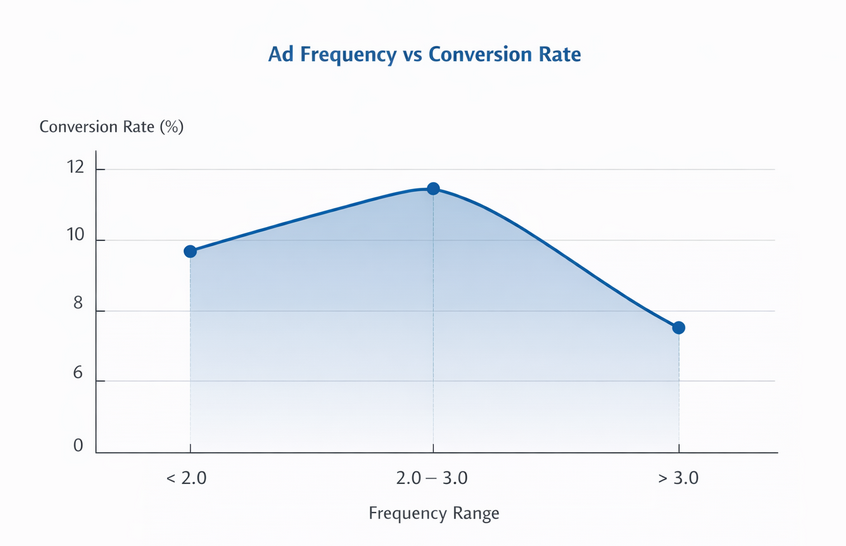
Conversion rates peak when ad frequency remains below 3.0, and decline when audiences are overserved
Facebook’s algorithm requires consistent conversion data to stabilize delivery. Large or frequent budget increases can reset or prolong the learning phase.
Internal benchmarks from performance-focused advertisers indicate that campaigns exiting the learning phase with stable budgets convert up to 20% more efficiently than campaigns experiencing aggressive scaling.
Lower budgets help preserve algorithm stability and keep delivery optimized.
3. Forced Expansion Into Lower-Quality Traffic
When spend grows too quickly, Facebook expands delivery to users with weaker intent signals. This often results in higher impressions but lower conversion rates.
Reducing spend allows the system to prioritize higher-quality placements and users instead of chasing volume.
Key Statistics That Support Budget Reduction
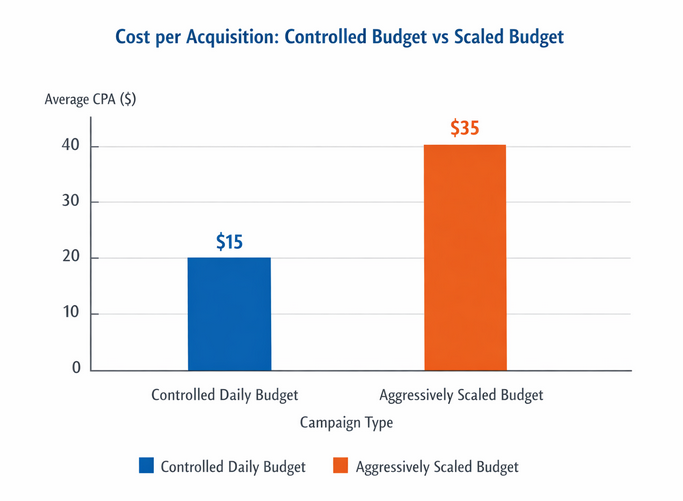
Cost per acquisition is significantly lower for campaigns with controlled daily budgets compared to aggressively scaled campaigns
-
Campaigns with controlled daily budgets show up to 25% lower cost per acquisition compared to aggressively scaled campaigns.
-
Ads with frequency capped below 3.0 maintain conversion rates that are on average 18% higher than overserved audiences.
-
Gradual budget adjustments of 10–15% outperform large budget changes by approximately 22% in conversion stability.
These numbers highlight that efficiency often matters more than scale.
When You Should Consider Lowering Your Budget
Lowering spend is especially effective when:
-
Cost per conversion is rising despite stable creatives
-
Frequency is increasing faster than reach
-
Conversion volume has plateaued while spend keeps growing
-
New audiences are not converting at the same rate as early traffic
In these scenarios, reducing budget can reset efficiency without killing performance.
How to Reduce Budget Without Killing Momentum
-
Decrease daily spend gradually by 10–20% rather than making sharp cuts.
-
Monitor frequency, cost per result, and conversion rate over 48–72 hours.
-
Preserve winning ad sets while trimming underperforming ones.
-
Let performance stabilize before attempting to scale again.
This approach keeps campaigns active while allowing the algorithm to refocus on quality.
Smarter Scaling Starts With Restraint
Successful Facebook advertising is not about spending the most—it is about spending efficiently. Lowering your budget can improve delivery quality, reduce waste, and unlock better performance metrics.
Before increasing spend, ensure your campaigns are converting efficiently at lower levels. Strong fundamentals scale better than inflated budgets.
Recommended Reading
To deepen your understanding of Facebook Ads optimization, explore these related articles on our blog:
Each article builds on the idea that precision and control outperform aggressive spending.