
As digital advertising becomes more competitive, fake leads are increasing across almost every acquisition channel. Bots, incentivized traffic, and low-quality lead farms now imitate real user behavior with surprising accuracy.
According to industry benchmarks:
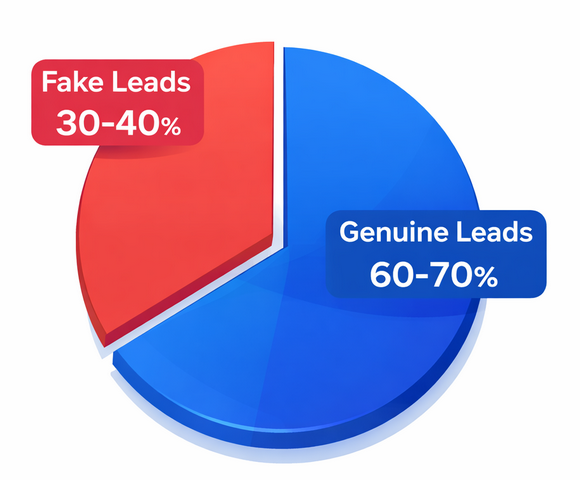
Pie chart illustrating that 30–40% of paid leads in competitive markets are fake, with the remaining 60–70% genuine
-
Up to 30–40% of paid leads in highly competitive niches show signs of low intent or fraudulent behavior.
-
Companies that fail to filter leads early report 20–25% higher cost per acquisition due to wasted follow-ups and skewed optimization data.
-
Sales teams spend an average of one full working day per week chasing unqualified or fake prospects.
Early detection isn’t just a defensive tactic — it directly improves campaign performance and decision-making.
What Counts as a Fake Lead?
Fake leads are not always obvious bots. In practice, they fall into several categories:
-
Automated submissions created by scripts or bots
-
Incentivized leads generated only to earn rewards
-
Low-intent users who never planned to buy
-
Mismatched audiences attracted by poor targeting
All of them inflate numbers while producing no revenue.
Early Warning Signs You Shouldn’t Ignore

Comparison of lead engagement and conversion outcomes showing how fake leads disengage rapidly and convert significantly worse than quality leads
1. Unusual Submission Patterns
If multiple leads arrive within seconds, share similar names, or follow identical formatting, automation is often involved. Real users rarely behave in perfectly uniform ways.
2. Disposable or Suspicious Emails
Addresses with random characters, repeated domains, or temporary email providers are strong indicators of fake or low-quality leads. A spike in such emails usually correlates with low conversion rates.
3. Zero Engagement After Submission
Leads that never open emails, never answer calls, and never return to the site within the first 48–72 hours should be flagged. Studies show that over 60% of fake leads disengage immediately after form submission.
4. Geographic Mismatch
If your campaign targets a specific region but leads consistently come from unrelated locations, something is wrong. Geographic inconsistency is one of the fastest ways to identify invalid traffic.
Data Checks That Catch Fake Leads Early
Compare Conversion Lag
Legitimate leads usually move from submission to first interaction within a predictable timeframe. When that delay suddenly increases, lead quality has likely dropped.
Monitor Cost vs. Quality
A sudden drop in cost per lead can look like success — until revenue stalls. In many cases, abnormally cheap leads convert 50–70% worse than average-quality leads.
Segment by Source Behavior
Analyze how different audience segments behave after submitting a form. If one segment has significantly higher bounce rates, zero session duration, or no repeat visits, it deserves closer inspection.
Preventive Measures That Work
Tighten Audience Signals
Broad or loosely defined audiences attract volume, not intent. Campaigns that rely on engagement-based or behavior-based signals tend to produce up to 2× higher lead validity rates compared to interest-only targeting.
Add Friction Where It Matters
Small changes like additional form validation, confirmation steps, or simple logic questions can eliminate a large percentage of automated submissions without hurting genuine users.
Sync Lead Quality With Optimization
When fake leads are allowed to influence optimization, ad platforms learn the wrong signals. Filtering early ensures algorithms optimize for revenue potential, not empty form fills.
How Early Detection Impacts Growth
Businesses that actively monitor lead quality in the first 24–48 hours report:
-
15–30% improvement in close rates
-
Lower sales team burnout
-
Cleaner data for scaling decisions
Fake leads are not just a marketing issue — they affect forecasting, staffing, and long-term strategy.
Related Articles You May Find Useful
Final Thoughts
Fake leads are inevitable in modern digital marketing, but wasted budgets are not. By spotting warning signs early, validating data consistently, and aligning optimization with real user behavior, marketers can protect performance and scale with confidence.