Many advertisers assume the best Facebook ads should look highly produced: cinematic footage, perfect lighting, and studio-level editing.
In practice, those ads often perform worse than simpler creatives.
Campaign data frequently shows that polished ads generate lower click-through rates and higher acquisition costs, while casual product demos or smartphone videos drive stronger engagement.
The reason has less to do with creative quality and more to do with how people behave in the feed and how Meta’s algorithm interprets engagement signals.
Facebook Ads Compete With Organic Content
A Facebook ad doesn’t compete with other ads.
It competes with posts from friends, creators, and communities.
When an ad looks like a traditional advertisement — perfectly lit product shots, corporate motion graphics, or heavily edited promotional footage — users recognize it immediately as marketing content.
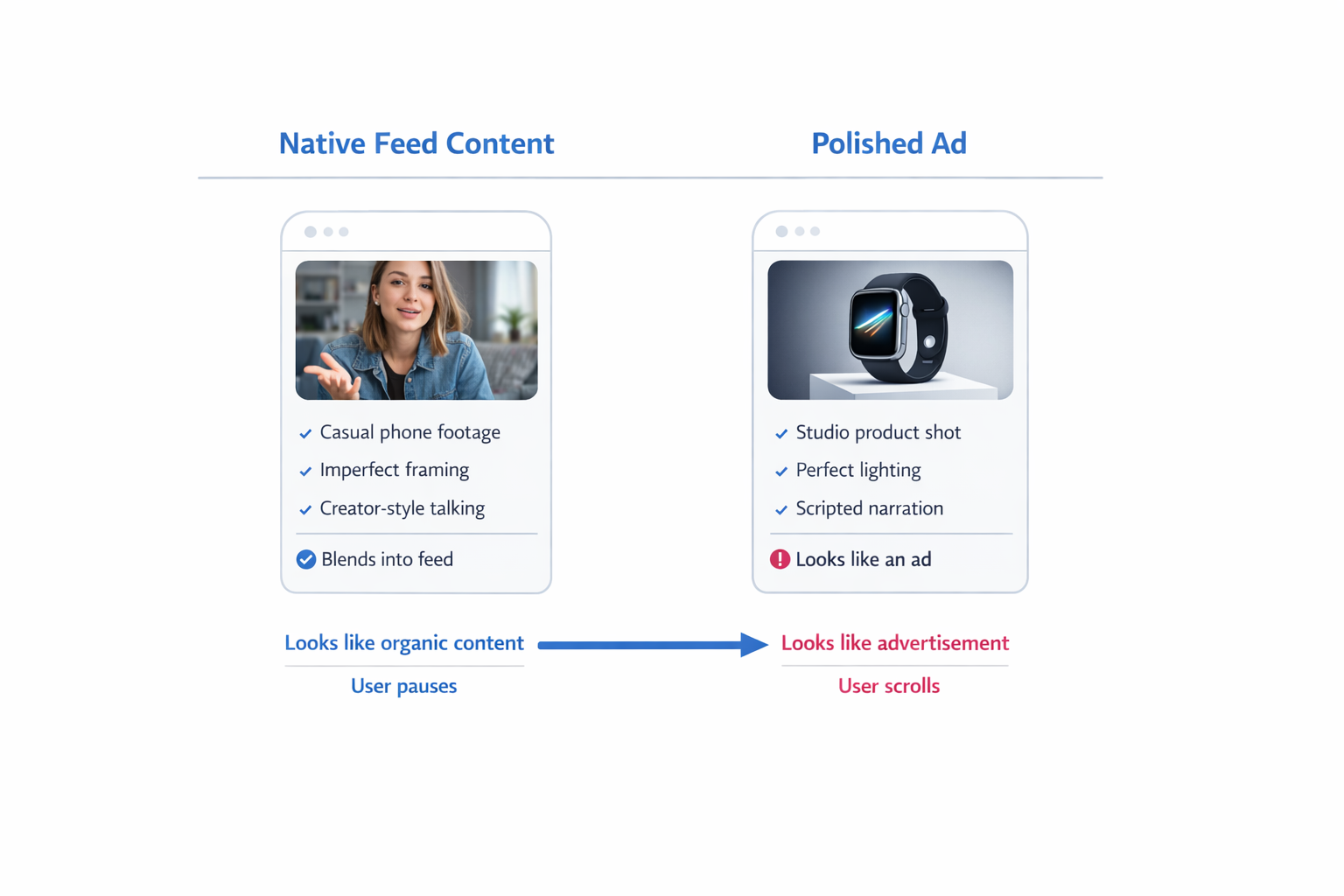
The typical reaction is simple: scroll past.
Creatives that resemble organic posts interrupt scrolling less aggressively. This is why formats such as:
-
screen recordings,
-
simple product demonstrations,
-
casual talking-head explanations,
-
smartphone footage,
often outperform studio-produced ads.
They look like normal content inside the feed.
Early Engagement Determines Delivery
The first few thousand impressions of an ad strongly influence how Meta distributes it afterward.
When a new creative launches, the algorithm observes early signals such as:
-
link clicks,
-
watch time,
-
reactions and comments,
-
scroll-stop behavior.
If engagement appears quickly, the system expands delivery to similar users.
If users scroll past the ad, the algorithm reduces distribution.
Polished ads often struggle during this stage because they trigger immediate advertisement recognition. When users skip them quickly, engagement signals weaken and delivery slows.
If you want to understand how these signals affect campaign optimization, see Why Facebook Ads Stop Working.
High Production Can Reduce Authenticity
Highly polished creatives sometimes create the opposite of the intended effect.
Instead of increasing trust, they signal “marketing message.”
In many industries — particularly SaaS tools and digital products — audiences respond better to demonstrations than brand storytelling.
Compare two formats:
Studio Ad —
-
cinematic lighting
-
scripted narration
-
staged scenes
Product Demo —
-
screen recording
-
quick feature explanation
-
real workflow example
The demonstration often produces stronger clicks because it looks authentic and useful rather than promotional.
Production Budgets Often Reduce Creative Testing
When teams invest heavily in production, they usually launch fewer variations.
A campaign might run one expensive video with only minor edits.
From an optimization perspective, this limits Meta’s ability to discover strong creative angles.
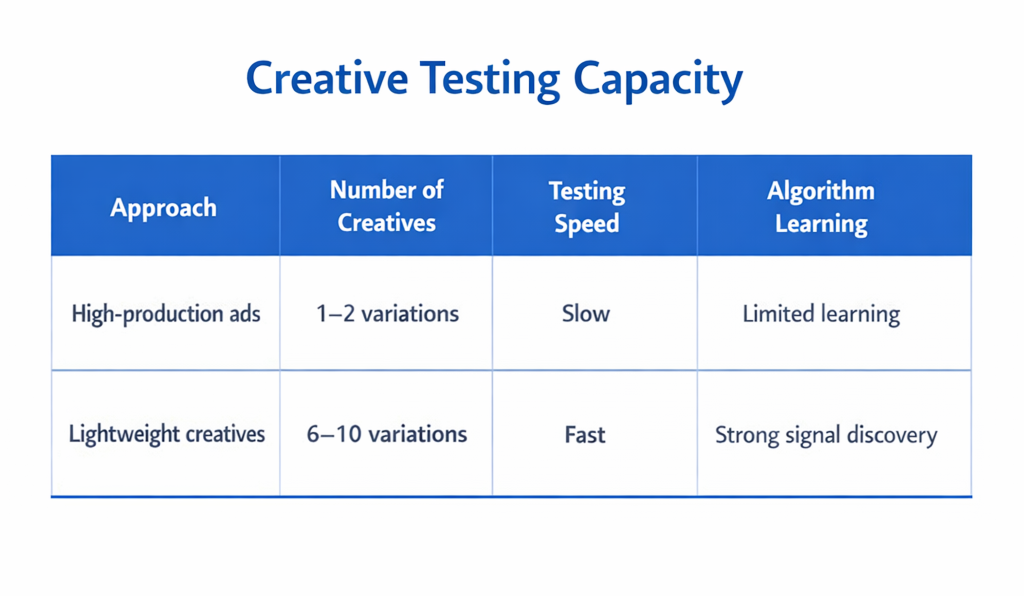
Lower-cost creatives allow teams to test:
-
different hooks,
-
alternative product demonstrations,
-
multiple opening frames.
Creative experimentation works best when audience quality is strong. If your seed data is weak, scaling can fail even with strong creatives. A useful diagnostic guide is How to Diagnose Weak Seed Audiences Before Building Lookalikes.
Signs Your Ad Is Too Polished
Several Ads Manager patterns often appear when creative polish hurts performance.
High CPM with weak CTR
Users scroll past the ad quickly, forcing the system to enter more auctions to generate engagement.
Good video retention but low clicks
Viewers watch because the video looks visually appealing but never interact with the message.
Simple creatives outperform immediately
When a raw demo quickly beats a studio ad, the issue is usually creative authenticity rather than targeting.
Audience repetition can also amplify this problem. If your ads repeatedly reach the same users, performance drops quickly. This issue is explained in Facebook Ads Showing Only to the Same People? Here’s Why.
How to Balance Quality and Feed Authenticity
The goal is not to eliminate production quality.
The goal is to align creative style with the environment where the ad appears.
Several adjustments help maintain performance:
-
Show the product immediately. The first frame should communicate the problem or solution.
-
Use demonstrations. Showing how the product works often beats cinematic storytelling.
-
Test multiple hooks. Different opening frames attract different user segments.
-
Include native-style footage. Screen recordings and smartphone clips integrate better into the feed.
These formats generate clearer engagement signals for Meta’s delivery system.
Key Takeaway
Production quality does not determine Facebook ad performance.
Engagement signals do.
An ad that looks simple but communicates a clear problem and solution often generates stronger early interaction. Those signals guide Meta’s optimization system and help the algorithm identify responsive users faster.
In many campaigns, the winning creative isn’t the most polished one.
It’s the one that makes someone stop scrolling.