Many advertising campaigns start strong, delivering high click-through rates (CTR), healthy conversion rates, and efficient cost per acquisition (CPA). However, after weeks or even days, results often begin to deteriorate. This decline is not random. It is driven by predictable platform mechanics, audience behavior, and data saturation effects.
Understanding these causes is critical for maintaining long-term performance and avoiding budget waste.
1. Audience Saturation and Ad Fatigue
One of the most common reasons performance drops is repeated exposure to the same audience.
As frequency increases, users become less responsive to ads they have already seen multiple times. Industry benchmarks show that when ad frequency exceeds 3–4 impressions per user, CTR can decline by 15–30%, while conversion rates often fall by more than 20%.
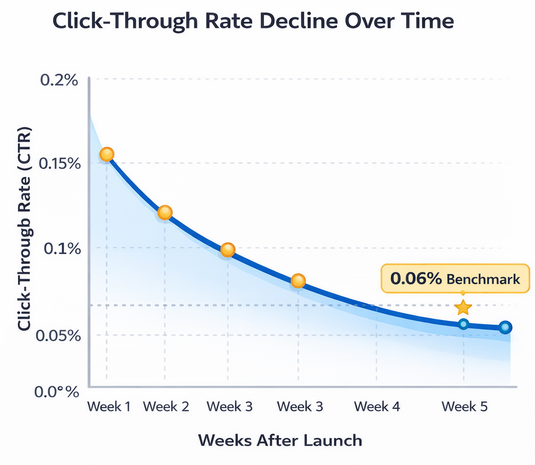
Average click-through rates for display ads decline toward industry benchmarks as audience engagement weakens
This happens because:
-
Users mentally ignore familiar creatives
-
Messaging loses urgency
-
High-intent users have already converted
Without creative refreshes or audience expansion, campaigns naturally exhaust their most responsive segments.
2. Learning Phase Instability
Platforms rely on machine learning models to optimize delivery. Early success often occurs when the system is exploring high-intent pockets of traffic. Over time, however, performance can fluctuate if the campaign fails to exit or repeatedly re-enters the learning phase.
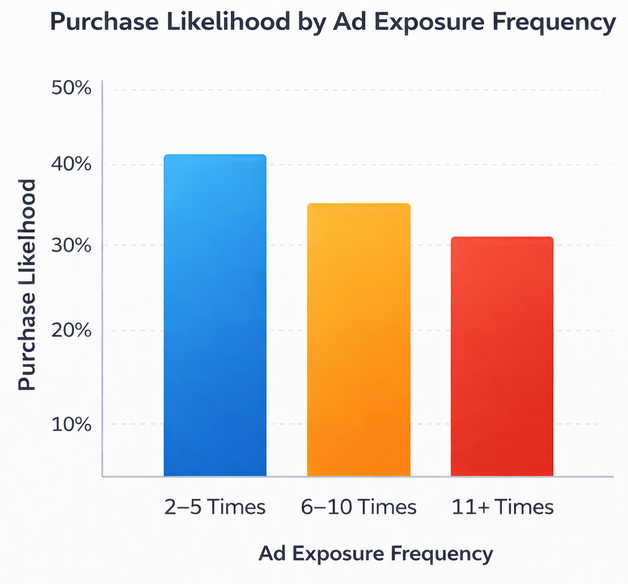
Higher ad exposure frequency correlates with lower purchase likelihood due to ad fatigue
Research across major ad platforms shows that campaigns generating fewer than 50 conversions per week experience up to 30% higher CPA volatility compared to stable campaigns. Budget changes, audience edits, or creative swaps can all reset optimization, reducing efficiency.
3. Creative Wear-Out
Even well-performing creatives have a limited lifespan.
Studies indicate that static ad creatives typically peak within the first 7–14 days, after which engagement rates begin to decline. Video ads last slightly longer but still experience noticeable fatigue within 3–4 weeks.
Common signals of creative fatigue include:
-
Falling CTR despite stable impressions
-
Rising CPM with flat conversion volume
-
Increased negative feedback or hidden ads
Without a creative rotation strategy, performance decay is unavoidable.
4. Budget Scaling Effects
Initial success often encourages aggressive budget increases. While scaling is necessary, rapid budget jumps can disrupt delivery efficiency.
Data from performance marketing audits shows that increasing budgets by more than 20–30% within a short timeframe can lead to a 10–25% increase in CPA. This occurs because algorithms are forced to expand beyond high-performing audience segments into less efficient traffic pools.
Gradual scaling preserves stability and minimizes waste.
5. Auction Competition Shifts
Ad performance does not exist in isolation. Auction dynamics change constantly.
As competitors launch promotions, increase bids, or enter peak seasons, cost per click (CPC) and CPM can rise. In highly competitive verticals, CPM inflation of 20–40% during peak periods is common, even when campaign settings remain unchanged.
If conversion rates stay flat while costs rise, overall performance naturally declines.
6. Data Saturation and Signal Loss
Over time, campaigns collect large volumes of similar conversion data. When signals stop changing, optimization models gain fewer new insights.
This data saturation effect can reduce marginal efficiency, especially in narrow audiences. Advertisers often see stable impression delivery but declining incremental conversions as campaigns mature.
Expanding audiences, testing new objectives, or introducing fresh conversion signals helps restore learning momentum.
How to Prevent Performance Decline
While performance drops are common, they are not inevitable.
Best practices include:
-
Refreshing creatives every 2–4 weeks
-
Monitoring frequency and capping exposure
-
Scaling budgets gradually
-
Consolidating fragmented ad sets to strengthen learning
-
Introducing new audiences before saturation occurs
Proactive optimization consistently outperforms reactive fixes.
Conclusion
Ad performance drops after initial success because platforms, audiences, and auctions continuously evolve. Fatigue, learning instability, competition, and scaling pressure all contribute to gradual decline.
Advertisers who anticipate these patterns can extend campaign profitability, reduce volatility, and maintain consistent results over time.