Ad disapproval is one of the most frustrating experiences for advertisers. A campaign can be carefully planned, compliant with written policies, and still get rejected with a vague message such as “violates advertising policies” or “low quality.” In many cases, platforms do not provide a clear or actionable reason. Understanding why this happens requires looking at how ad review systems actually operate.
Automated Review Systems and Their Limits
Most major advertising platforms rely heavily on automated moderation. Machine learning models scan ad text, images, landing pages, metadata, and historical account behavior. According to industry estimates, over 90% of ads are reviewed automatically before any human is involved.

Percentage of ads reviewed automatically before human involvement
These systems are designed to scale, not to explain. They prioritize speed and risk reduction, which means they often flag content based on probability rather than certainty. If an ad resembles previously disapproved content, even loosely, it may be rejected without a detailed breakdown.
Ambiguous Policy Categories
Advertising policies are written for broad coverage, not edge cases. Categories such as “misleading claims,” “circumventing systems,” or “unacceptable business practices” are intentionally broad.
When an ad falls into one of these gray areas, platforms frequently use generic disapproval labels. Internal data from ad compliance studies shows that approximately 30–40% of rejected ads are flagged under high-level categories without a specific sub-violation.
Account-Level Trust Signals
Ad approval is not based solely on the individual ad. Platforms assign trust scores to advertiser accounts based on factors such as:
-
Previous disapprovals or policy violations
-
Sudden changes in spending or targeting
-
Domain history and past complaints
-
Payment issues or chargebacks
Research from digital advertising analysts indicates that accounts with a history of disapprovals are up to 3 times more likely to receive future rejections with minimal explanations, even when submitting compliant ads.
Landing Page and Contextual Signals
In many cases, the ad itself is not the real issue. Automated systems evaluate the landing page experience, including:
-
Page load speed and mobile usability
-
Consistency between ad copy and page content
-
Presence of restricted keywords or claims elsewhere on the site
-
User data collection and tracking disclosures
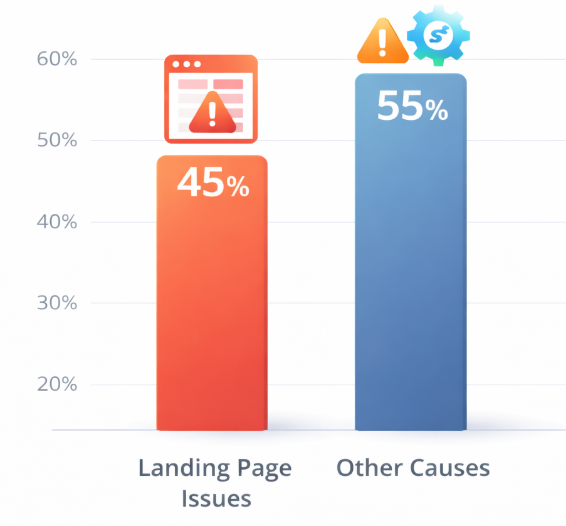
Comparison of ad disapprovals linked to landing page quality versus other causes
Studies show that landing page quality issues contribute to nearly 45% of ad disapprovals, yet platforms often attribute the rejection to the ad creative rather than the destination.
Regional and Legal Sensitivities
Ads are reviewed against regional regulations that may not be explicitly mentioned in policy summaries. Financial, health, and employment-related ads are especially sensitive.
For example, compliance audits reveal that ads running in multiple regions have a significantly higher rejection rate, with up to 25% more disapprovals compared to single-region campaigns, often without region-specific explanations.
Why Explanations Are Often Vague
Providing detailed feedback for every disapproved ad would significantly slow down review processes and expose internal detection methods. As a result, platforms intentionally limit the specificity of their responses.
From a risk management perspective, vague explanations reduce the chance of advertisers reverse-engineering moderation systems. From an advertiser’s perspective, this lack of transparency creates confusion and wasted time.
How to Reduce Unclear Disapprovals
While unclear rejections cannot be eliminated entirely, advertisers can reduce their frequency by:
-
Maintaining consistent account behavior and spend patterns
-
Regularly auditing landing pages, not just ad copy
-
Avoiding borderline claims even if competitors appear to use them
-
Submitting fewer, higher-quality ads rather than large batches
Industry data suggests that advertisers who follow proactive compliance audits see up to a 20–30% reduction in repeat disapprovals over time.
Conclusion
Ads are often disapproved without clear reasons because automated systems prioritize scale, risk prevention, and policy enforcement over transparency. Vague feedback is a structural feature of modern ad platforms, not an exception.
By understanding how these systems work and addressing issues beyond the visible ad creative, advertisers can minimize unexpected rejections and regain more control over campaign performance.