
Meta’s shift toward broad targeting isn’t accidental. It reflects a larger move away from manual segmentation and toward algorithmic optimization.
On Facebook and Instagram, you’re now encouraged to give the platform a wide audience. From there, Meta’s system is supposed to identify the users most likely to convert.
But here’s the core issue: broad targeting only works when you supply meaningful, structured data that tells the algorithm what success looks like.
Without that, broad targeting becomes inefficient at best and wasteful at worst. For a deeper look at how this strategy fails without the right inputs, read Why Broad Targeting Fails for Some Brands But Works for Others.
What Happens When You “Let the Algorithm Decide”
Many advertisers assume Meta’s AI can handle targeting on its own. But if the algorithm lacks high-quality feedback signals, performance suffers.
Here’s what typically happens when you launch broad targeting without proper data foundations:
-
Wasted impressions — Ads are served to users with no intent, simply because they fit basic engagement profiles.
-
Poor optimization cycles — The system starts optimizing toward cheap actions (e.g., link clicks), not meaningful conversions.
-
Budget inefficiencies — Spend accumulates on low-value audiences who never progress past the ad click.
Meta’s tools are only as good as the data you give them. When that data is vague, outdated, or misaligned with your business goals, your campaigns will reflect that.
Broad Targeting Depends on Strong Input Data
Meta's system uses conversion signals to guide delivery. The more accurate and structured those signals are, the better the algorithm can perform — especially in a broad environment with minimal manual input.
These are the three areas where better data drives stronger outcomes:
1. Define High-Quality Conversion Events
Relying solely on default events like Purchase or Lead limits optimization. Meta doesn’t know if a lead is qualified, or if a purchase is from a one-time buyer or a long-term customer.
Instead, define custom events that represent real business value. For example:
-
High-Value Purchase — Only fires for orders over $150, or for products with strong margins.
-
Qualified Lead — Triggers only when a user completes a form and books a consultation or demo.
-
Engaged Signup — Tracks users who not only register, but return to the site or visit multiple product pages.
These signals filter out noise and focus optimization on high-intent users.
2. Clean and Prioritize Your Event Structure
A large percentage of accounts use pixels or CAPI (Conversions API) incorrectly. Either events are firing too often, firing too early, or failing to fire at all.
A proper event setup should meet the following criteria:
-
Signal clarity — Events should only fire on valuable user actions (e.g., purchases, bookings), not on low-intent behaviors (e.g., time on page).
-
No duplication — If you’re using both pixel and CAPI, implement deduplication to avoid double-counting events.
-
Proper prioritization — Use Meta’s Aggregated Event Measurement to rank your most important conversion actions for optimization under iOS tracking limitations.
Need a step-by-step walkthrough? See How to Create Facebook Pixel and Track Conversions.
3. Use High-Value Seed Audiences
Even in broad targeting campaigns, you’re still feeding Meta clues. Custom audiences and lookalike seeds help the algorithm learn which users are worth targeting — especially in the early stages of delivery.
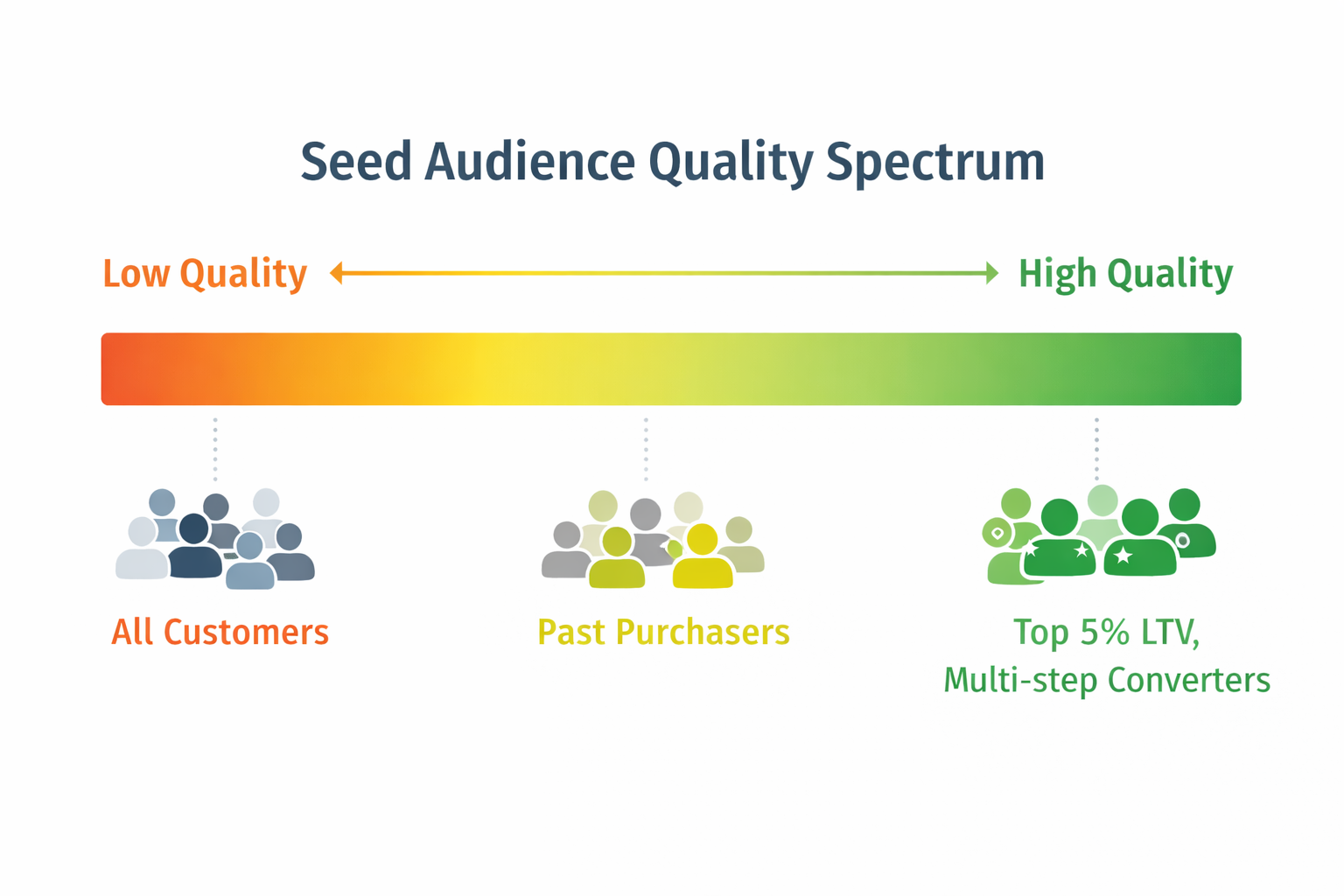
Build audiences using refined criteria, such as:
-
Top 5% of customers by lifetime value — Rather than all purchasers, focus on those with strong retention or repeat behavior.
-
Multi-step converters — Users who clicked an ad, watched a product demo, and then purchased.
-
High-engagement users — People who interacted with long-form content, video walkthroughs, or testimonials.
Learn how to build and scale smarter lookalikes with Lookalike Audiences: How to Seed, Train, and Scale.
Broad Targeting Without Structured Data Is Just Guesswork
You can’t run efficient campaigns at scale without clearly defining what a valuable customer looks like.
Broad targeting opens reach, but it also increases the risk of waste — unless you give Meta precise indicators of performance.
Think of the algorithm as a smart, fast-learning assistant. It’s not lazy or random, but it does need direction. Better data gives it that direction.
How to Make Broad Targeting Work
Broad targeting works best when paired with disciplined setup and strong creative. Below are three expert-level recommendations to improve your outcomes:
1. Conduct a Signal Audit
Before scaling with broad targeting, review your event tracking and platform settings. Focus on:
-
Signal consistency — Ensure Meta is receiving events for every key conversion.
-
Event health — Check for warning flags in Events Manager, such as unmatched URLs or low firing frequency.
-
Attribution settings — Use appropriate windows based on your customer journey (e.g., 7-day click for eCommerce; 1-day click for lead gen).
Need a deeper checklist? See How to Optimize Campaign Performance With Facebook Ads.
2. Rebuild Custom Conversions for Granularity
Don’t rely on the default Purchase or Lead events alone. Instead, structure new conversions with added filters or value thresholds.
Examples include:
-
Cart Value > $100 — Focuses optimization on users more likely to generate higher revenue.
-
Page URL + Action Combo — E.g., users who completed a form and then visited the pricing page.
-
Custom UTM-Based Events — Useful for tracking conversions from specific campaign types (e.g., brand vs. retargeting).
This level of granularity allows you to optimize for different business goals within the same account.
3. Align Creative Strategy With Broader Reach
When targeting is wide, creative becomes the main qualifier. You must communicate relevance immediately — without assuming prior knowledge or familiarity.
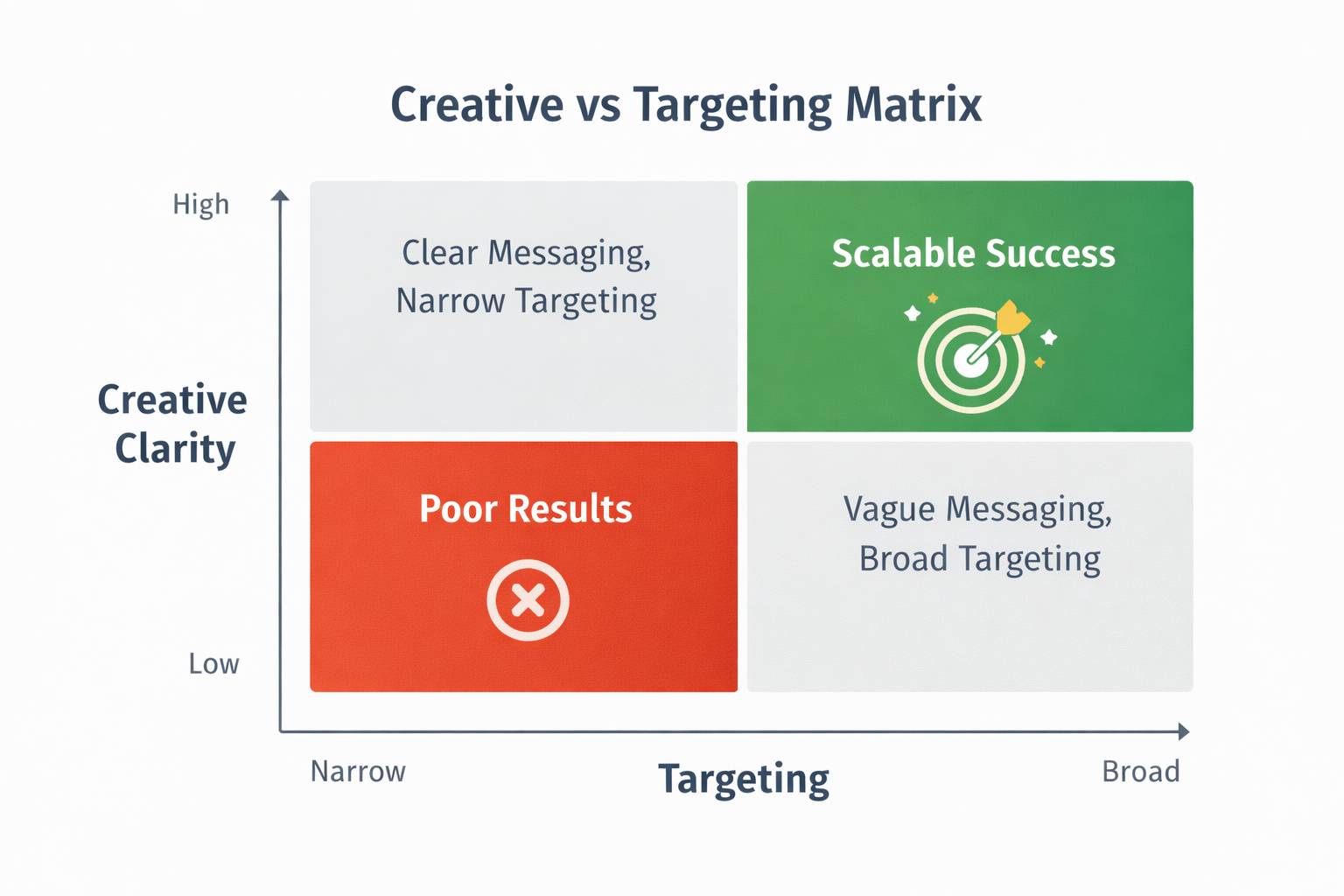
Ensure your ad creative includes:
-
Clarity — Explain the offer and value proposition within the first few seconds.
-
Social proof or product demonstration — Show how it works, who it’s for, and why it’s trusted.
-
Strong visual contrast — Use design to stand out in the feed and increase scroll-stopping power.
In a broad audience, you need to attract and qualify attention at the same time. Creative must carry that weight.
Closing Thoughts: Broad Targeting Is Scalable — But Only With Structure
Broad targeting is not a low-effort alternative to precise segmentation. It’s a scalable framework that relies on system-driven optimization — and that optimization depends entirely on what you feed the system.
If your conversion events are vague, your data noisy, and your creative generic, the algorithm will struggle. But with clear signals, refined events, and audience-informed creative, broad targeting becomes a high-performance tool.
Meta’s automation isn’t going away. The best advertisers are the ones who learn how to guide it — not fight it.
