Not all prospects are at the same stage of awareness. Showing the same creative to a first-time visitor and a returning buyer often results in wasted spend and weak performance. Funnel-specific creatives align message, format, and call-to-action with user intent.
Industry data consistently shows that campaigns tailored to funnel stages outperform generic approaches. For example, studies indicate that ads aligned with user intent can increase click-through rates by 30–50%, while conversion rates can improve by over 70% when creatives are adapted for consideration and decision stages.
The Three Core Funnel Stages
Top of Funnel (Awareness)
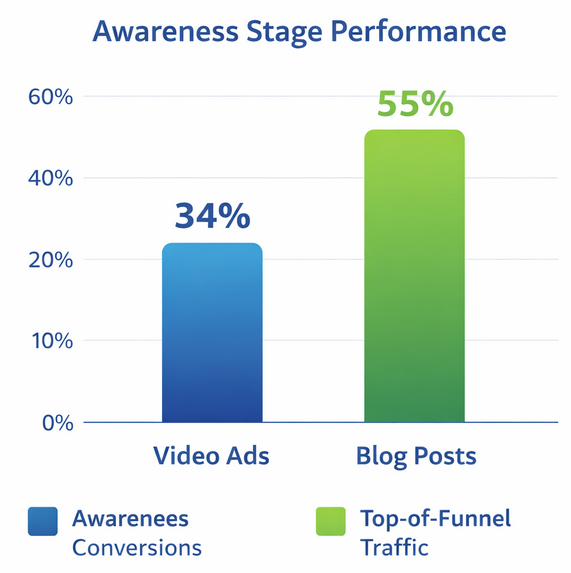
Comparison of awareness stage performance: blog content boosts traffic by 55% on average, while video ads increase conversions by 34%
At the awareness stage, users are discovering a problem or opportunity. They are not ready to buy and may not recognize your brand yet.
Creative goals:
-
Capture attention quickly
-
Educate or spark curiosity
-
Build initial trust
Effective formats:
-
Short videos and animations
-
Bold visuals with minimal text
-
Educational or problem-focused messaging
Key statistic: Awareness-focused video ads typically generate up to 2× higher engagement than static images when targeting cold audiences.
Middle of Funnel (Consideration)
At this stage, users are evaluating options and comparing solutions. They need clarity, proof, and relevance.
Creative goals:
-
Demonstrate value and differentiation
-
Address objections
-
Reinforce credibility
Effective formats:
-
Carousel ads highlighting features or use cases
-
Short explainer videos
-
Testimonials or performance highlights
Key statistic: Ads that include social proof or product benefits can improve click-through rates by approximately 40% compared to generic brand messaging.
Bottom of Funnel (Conversion)
Bottom-of-funnel users are close to taking action. Creatives should remove friction and encourage a clear next step.
Creative goals:
-
Drive immediate action
-
Emphasize outcomes and urgency
-
Reduce perceived risk
Effective formats:
-
Direct response ads with strong CTAs
-
Offer-focused visuals
-
Retargeting creatives tailored to prior behavior
Key statistic: Retargeting creatives optimized for conversion typically deliver 2–3× higher conversion rates than creatives used for cold traffic.
How to Adapt Creatives Across the Funnel
Adjust the Message
As users move down the funnel, shift from broad education to specific value propositions and outcomes. Avoid repeating awareness-level messaging in conversion campaigns.
Change Visual Complexity
Top-of-funnel creatives should be visually simple and scroll-stopping. Bottom-of-funnel creatives can include more details, metrics, or feature highlights because the audience is already engaged.
Evolve the Call-to-Action
Use soft CTAs like “Learn More” or “Discover” at the top, and stronger CTAs such as “Get Started” or “Request Access” closer to conversion.
Test Creatives by Funnel Stage
Creative testing should be structured by funnel level. A/B testing different headlines or visuals at each stage often reveals that winning awareness creatives rarely perform best at the conversion stage.
Common Mistakes to Avoid
-
Using one creative for all audiences
-
Pushing sales messages too early
-
Ignoring creative fatigue in retargeting campaigns
-
Measuring success with the wrong KPIs for each funnel stage
Measuring Funnel-Specific Creative Performance
Success metrics should change with the funnel:
-
Awareness: Reach, impressions, video views, engagement rate
-
Consideration: Click-through rate, time on site, content interaction
-
Conversion: Conversion rate, cost per acquisition, return on ad spend
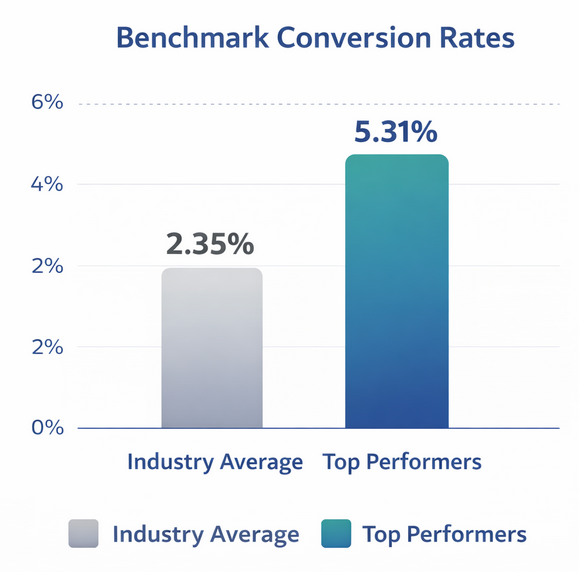
Conversion rate benchmarks showing how top-performing landing pages outperform the industry average
Aligning metrics with creative intent ensures clearer optimization decisions and better budget allocation.
Recommended Articles
For deeper insights on improving targeting and creative performance, consider reading:
Final Thoughts
Building funnel-specific creatives is not about producing more ads, but about producing more relevant ones. By aligning visuals, messaging, and CTAs with user intent at each stage, marketers can significantly improve performance, reduce wasted spend, and create a smoother path from awareness to conversion.