Audience expansion feels safe. You open targeting to give the algorithm more room to find conversions. Then delivery drops, CPM rises, or conversions slow down.
This shift confuses many advertisers. The audience is larger, yet performance weakens. The reason sits inside how Meta distributes impressions, not in audience size alone.
What Audience Expansion Actually Changes
When you expand an audience in Meta Ads Manager, you change more than reach. You change how the system prioritizes impressions.
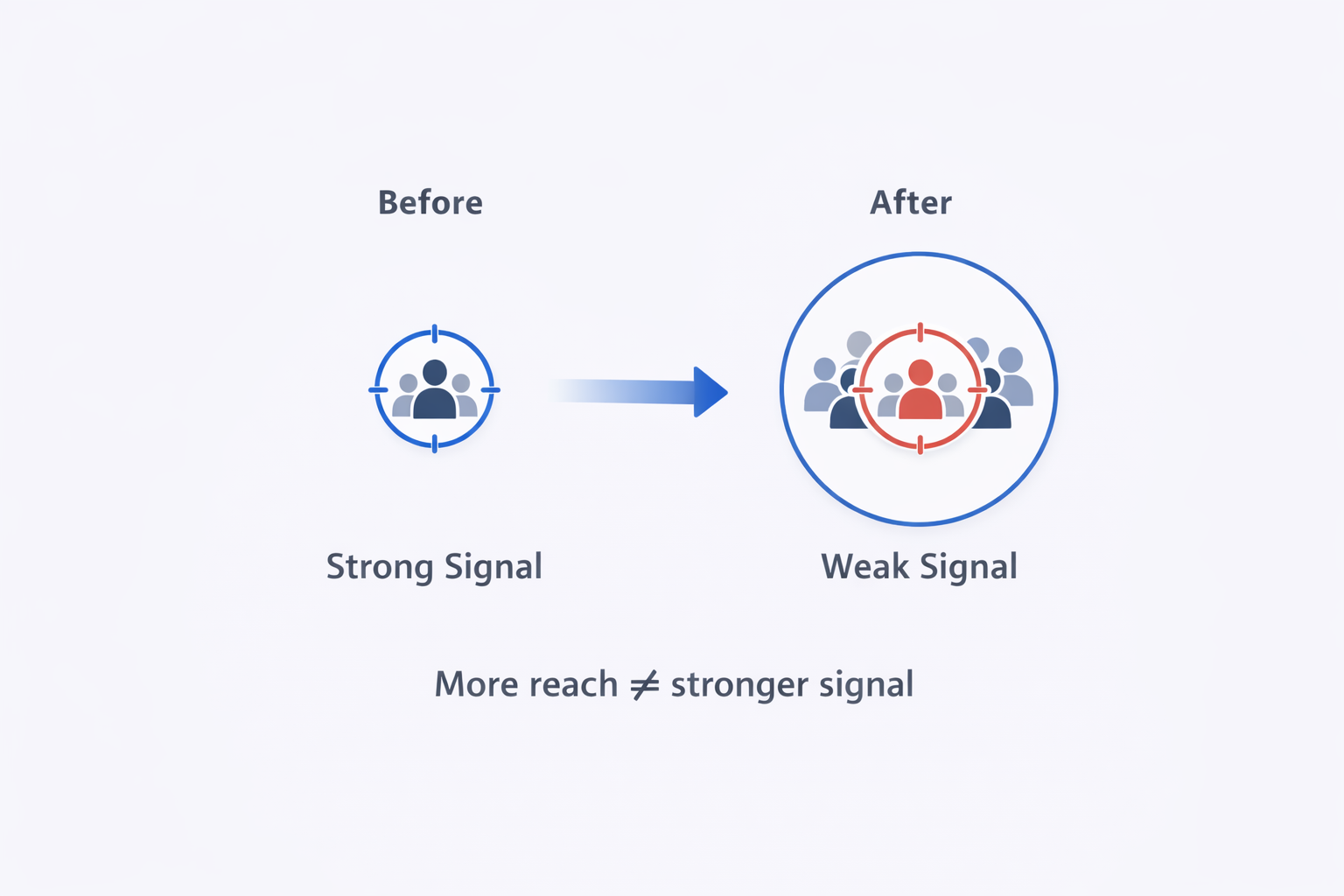
Meta shifts from narrow intent matching to probabilistic exploration. It starts testing new clusters with weaker historical signals. That exploration phase often lowers short-term efficiency.
If you want a deeper breakdown of mechanics, read why audience expansion sometimes lowers Facebook Ads ROI.
Expansion introduces three structural changes:
-
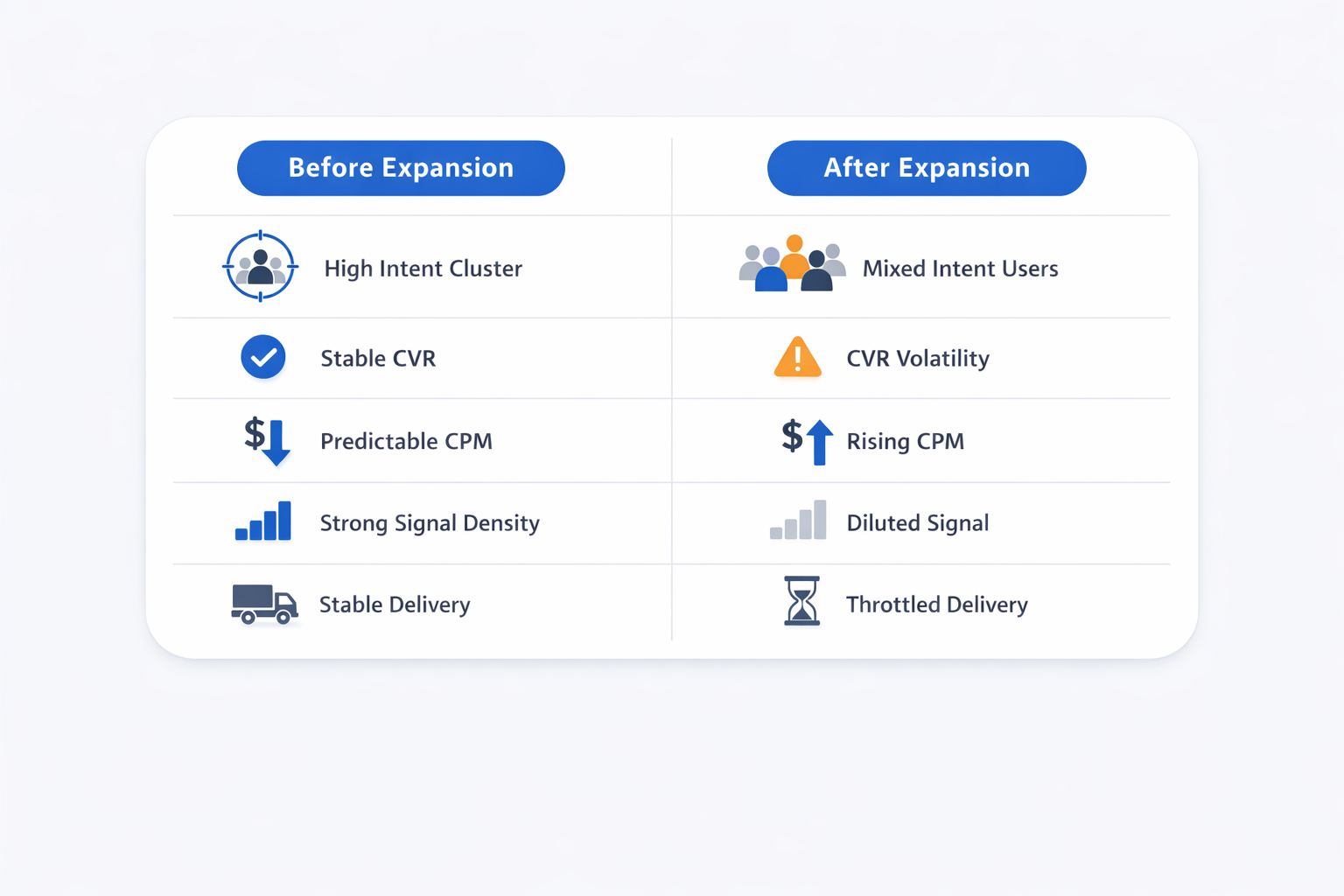
Lower baseline intent. Broader users have weaker purchase signals; early impressions go to less responsive segments while the system searches for pockets of demand.
-
Higher auction competition. Expanded segments often overlap with many advertisers; CPM increases before conversion rates stabilize.
-
Data dilution. Strong conversion patterns from your original audience get blended with weaker signals; optimization becomes less precise.
Delivery does not drop because scale is bad. It drops because signal strength decreases during redistribution.
Why Delivery Drops Instead of Increasing
Many expect volume to rise after expansion. In practice, delivery can stall or decline.
Learning Phase Reset and Signal Instability
When audience composition changes significantly, the learning phase may reset. Even if the campaign status does not show it clearly, internal weighting shifts.
Meta re-evaluates conversion probabilities. Early results often fluctuate because the model recalculates expected value per impression. If conversions slow during this window, delivery throttles.
If this pattern sounds familiar, review what “Learning Limited” means in Facebook Ads and compare your event volume against stability thresholds.
Delivery follows predicted performance. If predicted conversion value declines, the system reduces exposure.
Budget Fragmentation Across Weaker Segments
Expansion spreads budget across more micro-segments. Some segments convert poorly but still consume impressions.
This redistribution creates two problems:
-
High-intent clusters receive fewer impressions than before.
-
Low-intent clusters consume spend without generating stable signals.
The net effect is slower learning and unstable pacing.
Increased CPM Without Conversion Lift
Broader audiences often overlap with competitive targeting pools. You enter auctions against brands with higher budgets.
If conversion rate does not increase proportionally, effective cost per result rises. The algorithm reacts by limiting delivery.
To understand auction pressure, study what influences CPM on Facebook Ads and compare your post-expansion cost structure.
Meta optimizes for expected outcome value. If value drops relative to cost, reach contracts.
Hidden Causes Most Advertisers Miss
Some delivery drops are not purely algorithmic. They are structural issues triggered by expansion.
Creative-Audience Misalignment
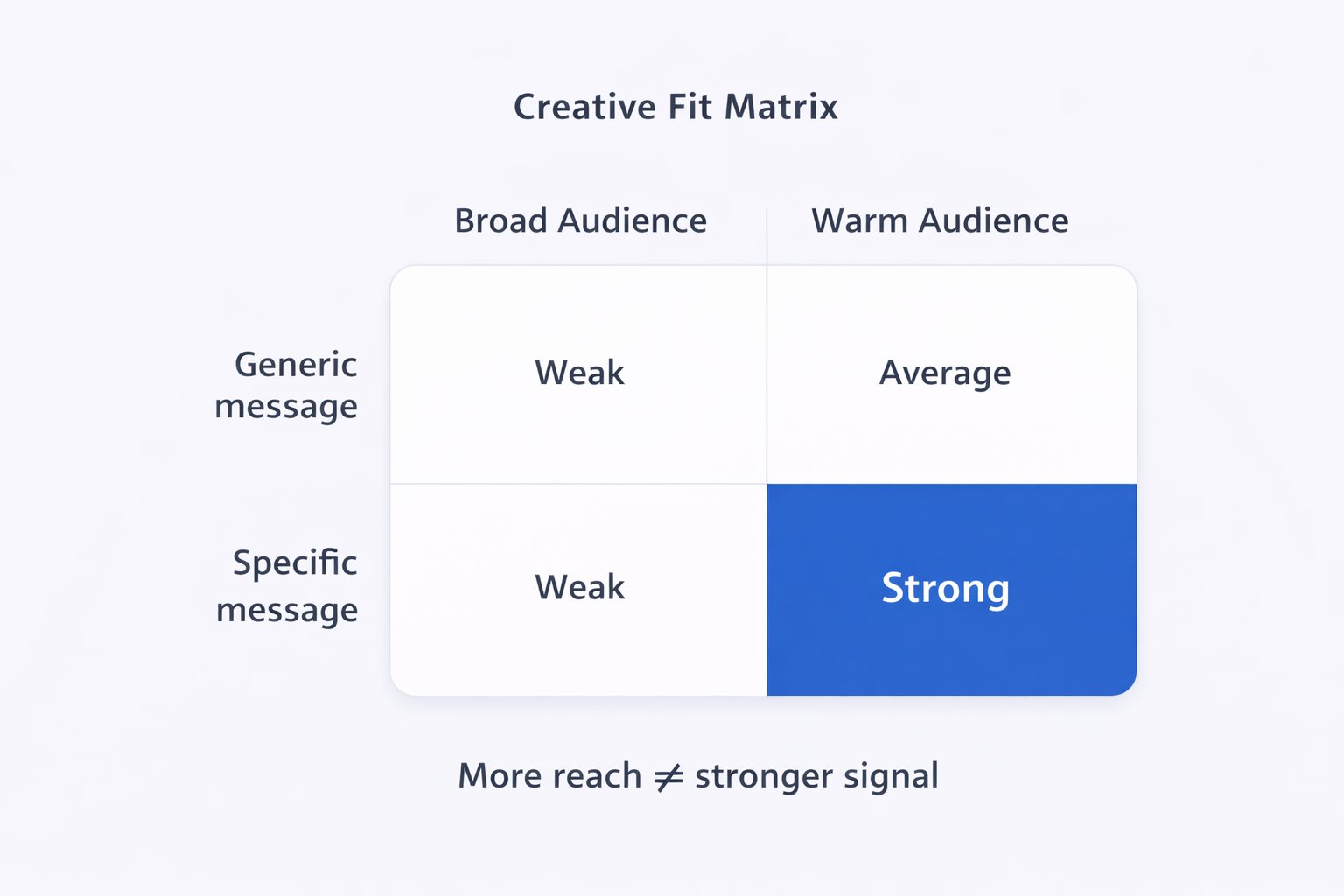
Creative that works for a narrow audience often fails in broader pools. Messaging assumes awareness, urgency, or specific pain points.
When shown to colder users, engagement falls quickly. That decline reduces predicted relevance and limits distribution.
Ask yourself:
-
Does the hook rely on insider knowledge?
-
Does the offer assume prior familiarity?
-
Does the call to action require high intent?
If yes, broader delivery will struggle. This is the same dynamic explained in why high-intent audiences convert better than broad ones.
Conversion Event Sensitivity
Expansion increases exposure to users less likely to convert. If you optimize for a deep event like Purchase, signal becomes sparse.
Sparse events slow optimization. The system struggles to estimate probability across weak segments.
A practical adjustment includes:
-
Testing a higher-funnel optimization event temporarily; Lead or Add to Cart often restores signal density.
-
Using value-based optimization only when conversion volume remains stable; otherwise the model underestimates broader users.
-
Segmenting campaigns by funnel stage instead of forcing one expanded pool to serve all intent levels.
Overlapping Campaign Structures
Expanded audiences frequently overlap with other ad sets. Internal competition drives up CPM and fragments learning.
If multiple campaigns target similar segments, delivery can throttle. Review why audience overlap is killing your Facebook ad performance and audit overlap before blaming expansion itself.
Consolidation restores signal concentration. Fewer competing ad sets produce clearer optimization paths.
When Audience Expansion Works
Expansion is not inherently flawed. It works under specific conditions.
It performs best when:
-
Creative speaks to broad pain points; messaging must resonate without niche assumptions.
-
Conversion volume already exceeds learning thresholds; stable data protects optimization.
-
Budget can absorb exploration volatility; small budgets amplify instability.
Expansion also performs better in mature accounts. Accounts with long conversion history give the algorithm richer priors.
How to Diagnose the Real Cause
Avoid reacting emotionally to short-term drops. Diagnose structurally.
Follow this sequence:
Step 1: Compare Segment Performance
Break down results by age, placement, and region. Identify which new segments underperform.
If only expanded clusters struggle, the issue is intent dilution. If all segments drop, creative fatigue may be present.
Step 2: Analyze CPM vs Conversion Rate
Look at three numbers:
-
CPM trend after expansion;
-
Conversion rate trend;
-
Cost per result change.
If CPM rises while conversion rate stays flat, auction pressure is the driver. If conversion rate falls sharply, creative mismatch is likely.
Step 3: Check Learning Status and Event Volume
Review learning phase indicators and weekly conversion totals. If events fall below stability thresholds, optimization weakens.
Consider narrowing temporarily to rebuild signal strength.
Strategic Alternatives to Blind Expansion
Instead of expanding broadly, use controlled scaling.
Layered Expansion
Increase audience size incrementally. Add one interest cluster or broad setting at a time.
Monitor performance before adding more reach. This preserves signal clarity.
Separate Prospecting Structures
Keep high-intent audiences in one campaign. Test broader expansion in a separate structure.
Isolation prevents strong segments from being diluted.
Creative Variation for Broader Pools
Build variants specifically for cold audiences. Focus on problem awareness rather than product detail.
Broader users need context. They do not share the same urgency as retargeted segments.
The Core Principle
Delivery follows predicted value. Audience expansion reduces average predicted value until new patterns emerge.
If signal recovers, delivery stabilizes. If it does not, the system protects budget by limiting reach.
Expansion is a structural decision, not a volume lever. Treat it as a controlled experiment, not a default scaling tactic.