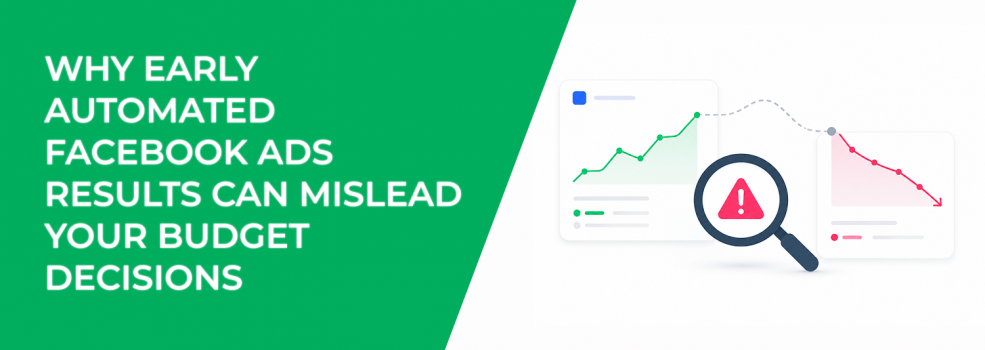
Early Automated Ads results can look more meaningful than they really are.
You may see a low CPC in the first few hours and assume the campaign is efficient. Or you may see a high CPA on day one and cut the budget before Meta has enough data to understand who responds.
Both decisions can hurt performance.
Automated Ads are designed to simplify setup, but they still rely on Meta’s delivery system. That system needs time to test users, placements, creatives, and conversion patterns. During that period, early numbers can move sharply without showing the campaign’s real potential.
Why early Automated Ads data is unstable
The first stage of delivery is mostly exploration.
Meta has not yet seen enough responses to know which users are most likely to take the action you want. So it tests different pockets of the audience, different placements, and different delivery moments.
That means early metrics can swing fast.
A campaign may start with cheap clicks because Meta finds users who engage easily. But those users may not become leads or buyers. Another campaign may start with expensive clicks, then improve once Meta finds users who convert at a higher rate.
This is why early CPC, CTR, CPA, and ROAS should not be treated as final signals. They are early delivery signals, not stable performance proof.
For a deeper timing framework, connect this with how long Facebook Ads should run before judging results.
The budget mistake advertisers make in early delivery
The common mistake is reacting to early data as if it represents the full campaign.
If the first results look good, advertisers often increase budget too soon. That can push the campaign into wider delivery before the audience pattern is clear.
If the first results look bad, they may pause the ad too early. That can kill a campaign before it has enough data to improve.
Neither reaction is based on a clean read.
A small number of clicks or leads can make CPA look better or worse than reality. One cheap lead can make the campaign look strong. One expensive conversion can make it look broken. In both cases, the sample is too small.
What early metrics can and cannot tell you
Early metrics still matter, but they need context.
They can show whether the campaign is delivering, whether people are reacting to the creative, and whether spend is being used. They cannot always prove whether the campaign will hit your target CPA or ROAS.
Use early metrics this way:
- CPC shows auction and click behavior. A low CPC can help, but it does not prove lead quality or purchase intent.
- CTR shows whether the creative gets attention. It does not prove that the offer is strong enough to convert.
- CPA shows early conversion cost. It is unreliable when the campaign has only a few conversions.
- ROAS shows purchase value. It can be distorted by one high-value or low-value order.
This is where Automated Ads can be tricky. The setup feels simple, so advertisers expect the results to be simple too. But early performance still needs the same diagnostic thinking as any Meta campaign.
Why cheap early traffic can become expensive later
A campaign can start strong because Meta finds the easiest responders first.
These users may click quickly, submit forms easily, or engage with many ads. That can make the first results look efficient. But once Meta exhausts that easy pocket, the campaign has to compete for harder-to-convert users.
That is when CPA can rise.
This does not always mean the campaign got worse. It may mean the first audience pocket was not large enough to sustain performance. It may also mean the creative attracted curious users instead of qualified buyers.
For lead generation, this often shows up as cheap form fills that do not answer calls or pass sales review. For e-commerce, it can show up as clicks and add-to-carts without enough purchases.
That is why early budget increases can be risky. You may scale a pattern that has not proved it can hold.
Why bad early results do not always mean the ad is failing
The opposite problem also happens.
An Automated Ad may spend for a day or two without enough conversions. CPC may look high. CPA may look far above target. The campaign may seem like an obvious pause.
But early delivery can be noisy, especially when the conversion event is harder to achieve.
A B2B demo request, high-ticket purchase, booked consultation, or qualified lead may take longer than a link click or engagement. Meta needs more time to find users who match that behavior.
This is why advertisers should separate “no signal” from “bad signal.”
No signal means the campaign has not collected enough meaningful data yet. Bad signal means the campaign is collecting data, but the wrong users are responding.
The next step is different in each case. No signal may need more time or a cleaner setup. Bad signal may need a better audience, offer, or creative angle.
You can connect this section naturally to why Meta Ads take time to work.
Read early results by signal quality, not just cost
A low CPL is not always good. A high CPL is not always bad.
The better question is whether the campaign is bringing signals Meta can learn from. If the early leads are unqualified, Meta may optimize toward more people like them. If the first purchases are low-margin, ROAS may look acceptable while profit stays weak.
LeadEnforce becomes useful when the early signal problem comes from audience quality.
If Automated Ads are pulling broad, low-intent traffic, advertisers can test a more precise audience built from Facebook groups, Instagram followers and engagers, or social profile data. This gives Meta a stronger starting point than a generic audience suggestion.
For example, a B2B advertiser can compare a broad Automated Ads-style audience against an audience built from relevant Facebook groups. If the second audience has higher CPC but better sales acceptance, the budget decision should favor qualified pipeline over cheap clicks.
How to make budget decisions during early delivery
Do not change budget because one early metric looks good or bad.
Set a review window before the campaign starts. Then judge results against the amount of data collected, not just the number of days passed.
A practical early review should check:
- Whether the campaign spent enough to produce meaningful delivery data.
- Whether clicks, leads, or purchases came from the right audience type.
- Whether CPA or ROAS is based on enough conversions to trust.
- Whether sales quality or post-click behavior supports the platform metrics.
If the campaign has clicks but no conversions, check the offer and landing page. If it has leads but poor sales quality, check audience and form friction. If it has no delivery, check budget, audience size, approval status, and optimization event.
This is how you avoid cutting budget too early or scaling weak signals too fast.
Do not trust reporting too quickly
Some results appear after the click.
A person may click today and convert tomorrow. A lead may submit a form now but only become qualified after sales follow-up. A purchase may be attributed after Meta processes the event.
That delay can make early CPA and ROAS look worse than they are.
It can also make performance look better than it is if the campaign gets low-quality leads quickly, but those leads fail later in the funnel. Platform reporting shows the form submission. Your business still needs to check whether that lead became useful.
This is why Facebook Ads reporting does not always reflect real performance. Budget decisions should include CRM data, purchase quality, lead follow-up results, and actual revenue.
Final takeaway
Early Automated Facebook Ads results can mislead advertisers because the campaign is still finding its delivery pattern.
A cheap CPC does not prove efficiency. A high CPA does not prove failure. A strong first day does not prove the campaign can scale.
The safer approach is to define a review window, check signal quality, compare platform metrics with business outcomes, and avoid major budget changes until the data is strong enough to trust.
For advertisers moving away from Automated Ads, this becomes even more important. The less control the setup gives you, the more carefully you need to read early performance before changing spend.