Advertisers often ask, “How long should I let my Facebook ad run before deciding if it’s working?”
It’s a valid question, especially when you’re spending real money and results aren’t immediate.
But judging too soon is a common and costly mistake. Facebook’s system needs time to collect data, learn from user behavior, and optimize delivery. If you start tweaking or turning off ads too early, you risk cutting off campaigns that could have become profitable.
Instead of reacting to surface-level metrics, it’s better to understand how Facebook advertising works behind the scenes. Then you can make decisions with confidence, not guesswork.
What Happens Right After You Launch an Ad
Facebook’s Learning Phase, Simplified
When you launch a new ad set, Facebook enters a “learning phase.” This is the adjustment period when the algorithm tests delivery — different users, placements, and bidding strategies — to find what works best.
During this time, you’ll likely see:
-
Unstable results. Your cost per result might swing from $5 one day to $15 the next.
-
Lower efficiency. Facebook is still figuring out where and how to place the ad.
-
Slower optimization. The system hasn’t collected enough feedback to improve performance.
The learning phase typically ends after 50 optimization events, such as purchases or leads, within a 7-day window. Until you reach that point, don’t expect stable or reliable results.
If you make major changes — like adjusting the budget, switching creative, or changing the audience — the learning phase resets. That delays progress and clouds performance even more.
For a closer look at how to use the learning phase to your advantage, read this article on mastering Facebook’s learning phase.
Minimum Run Times by Campaign Type
The time it takes to evaluate performance depends on your objective, offer type, and budget. Below are proven timeframes for judging ads fairly.
If you’re trying to understand what’s happening in the early days of your campaign, you might also want to check out what to monitor in the first 24 hours.
For Conversion-Focused Campaigns
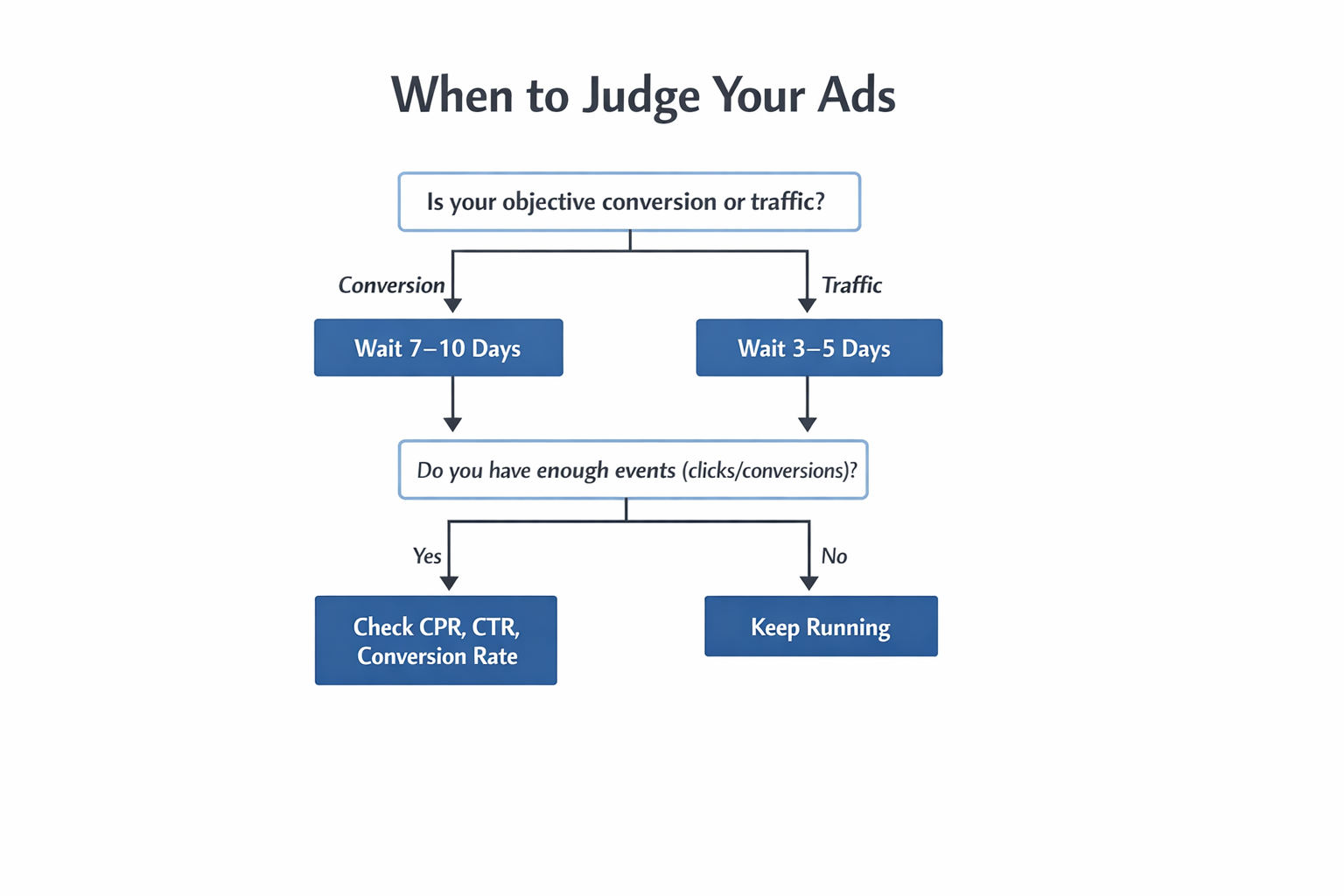
- Minimum run time: 7–10 days
- Data goal: At least 50–100 conversions per ad set
These campaigns often need more time to stabilize, especially when:
-
Your product is high-ticket, such as $200 or more.
-
You’re targeting cold audiences unfamiliar with your brand.
-
You’re optimizing for events that don’t happen immediately, like trial signups or purchases.
Example:
A software brand offering a free trial may need 10 days for results to show. People don’t always convert right after clicking. Some will browse, compare, and return days later.
Avoid turning off the campaign just because you don’t see conversions right away. Check whether your cost per result is improving. Watch how users move through the funnel. Look at lead quality, not just volume.
For Traffic or Engagement Campaigns
- Minimum run time: 3–5 days
- Data goal: Around 2,000–3,000 impressions and 100+ clicks
These campaigns are optimized for faster actions, such as link clicks or post engagement. But that doesn’t mean you can evaluate them in 24 hours. Even with quicker objectives, the algorithm still needs a few days to settle.
Example:
If you're promoting a blog post, give the campaign time to gather meaningful click data. Cost per click might look high early on, then drop once Facebook identifies better users to target.
Always evaluate performance after enough impressions and interactions, not just based on day-one numbers.
What Metrics Actually Matter
Not every metric tells a useful story. Focus on the ones that reveal how your ad is performing and where improvements are needed.
If you're trying to spot winning ads early — even before they’ve left the learning phase — you’ll want to study these indicators of high-potential ads.
1. Cost Per Result (CPR)
This is your primary performance number. Whether it’s a lead, purchase, or booking, CPR shows whether your ad is delivering within budget.
Example:
If you’re paying $10 for a lead and that lead is worth $30 over time, your ad is working well. But if your cost keeps climbing without improvement, you may need to pause and reevaluate.
Track CPR over several days and make sure you’re measuring final outcomes, not just early-stage clicks.
2. Click-Through Rate (CTR)
CTR reflects how relevant and engaging your ad is to your audience. It’s also one of the strongest early indicators of creative success.
A CTR below 0.5% often points to a disconnect — weak hook, poor targeting, or uninteresting visuals.
Try new formats or angles. Use stronger value props. Don’t just switch images, rethink how the ad grabs attention.
3. Frequency
Frequency shows how many times the same person has seen your ad. Once it reaches 2.5 or higher, your audience may start ignoring the message.
If you see CTR dropping while frequency climbs, it’s time to refresh the creative or expand your reach.
4. On-Site Conversion Rate
Sometimes, the ad is doing its job, but the landing page is the problem. If people click but don’t convert, check:
-
Page load speed on mobile,
-
Confusing copy or unclear CTAs,
-
Long or complex forms,
-
Disconnect between ad promise and page content.
Example:
An ad with a 3% CTR but no conversions could be pointing to a slow, clunky form page that turns people away.
What to Do Once You Have Enough Data
Once you’ve gathered a full week of data and the campaign has exited the learning phase, you can decide how to move forward.
For a more in-depth framework, check out this guide to pausing, scaling, or killing Facebook ad sets.
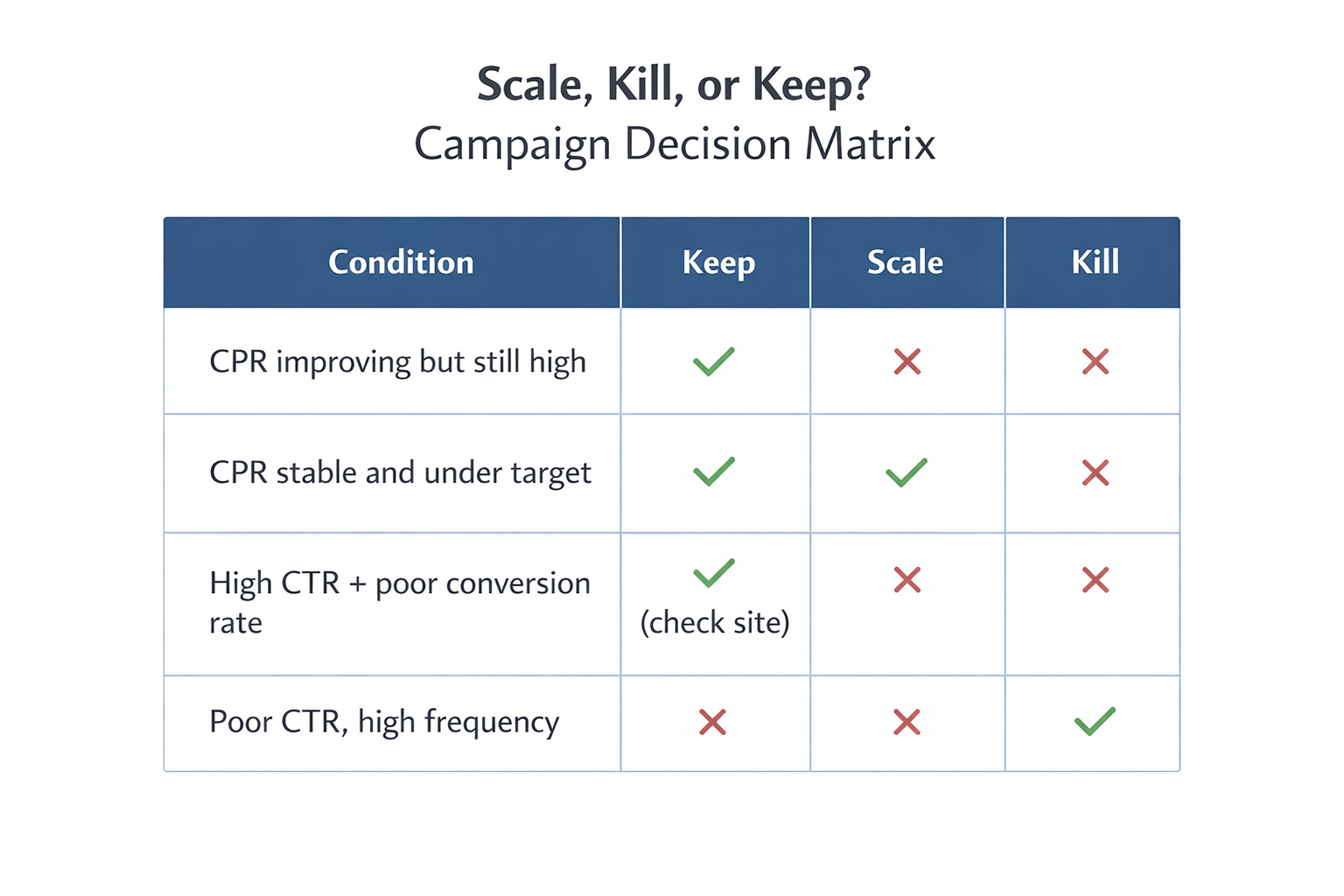
Kill the Ad If:
-
Your cost per result is far above your acceptable range,
-
You’ve tested multiple creative versions without improvement,
-
You’re getting clicks, but the conversion rate stays below 1%, even after page tweaks.
There’s no value in keeping an ad running just because it “might improve later.” Use clear thresholds and move on when performance stays weak.
Keep the Ad Running If:
-
The ad is still within the first 7 days and metrics are stabilizing,
-
CPR is slightly above goal, but improving over time,
-
Lead quality is high, even if volume is low.
Sometimes a campaign builds momentum over time. If the numbers are trending in the right direction, give it more runway before pulling the plug.
Scale the Ad If:
-
You’ve exited the learning phase and results are consistent,
-
Your CPR is well below target,
-
CTR and conversion rates are strong, with no signs of fatigue.
Instead of increasing the budget all at once, duplicate the ad set and raise the budget by 20 to 30 percent. That keeps the algorithm stable and avoids performance drops from sudden changes.
Don’t Just React — Read the Patterns
The biggest difference between new advertisers and experienced ones is how they read early data.
New advertisers react too quickly. Experienced ones know when to wait and when to act.
Here’s the core principle: don’t make decisions until your ads have enough data to tell a story.
That usually takes 3 to 5 days for traffic campaigns and 7 to 10 days for conversion campaigns.
Look at how key metrics behave over time. Are costs going down? Are conversions improving? Is engagement holding steady? One bad day doesn’t make a bad campaign.
If you want profitable campaigns, don’t just optimize fast. Optimize smart.