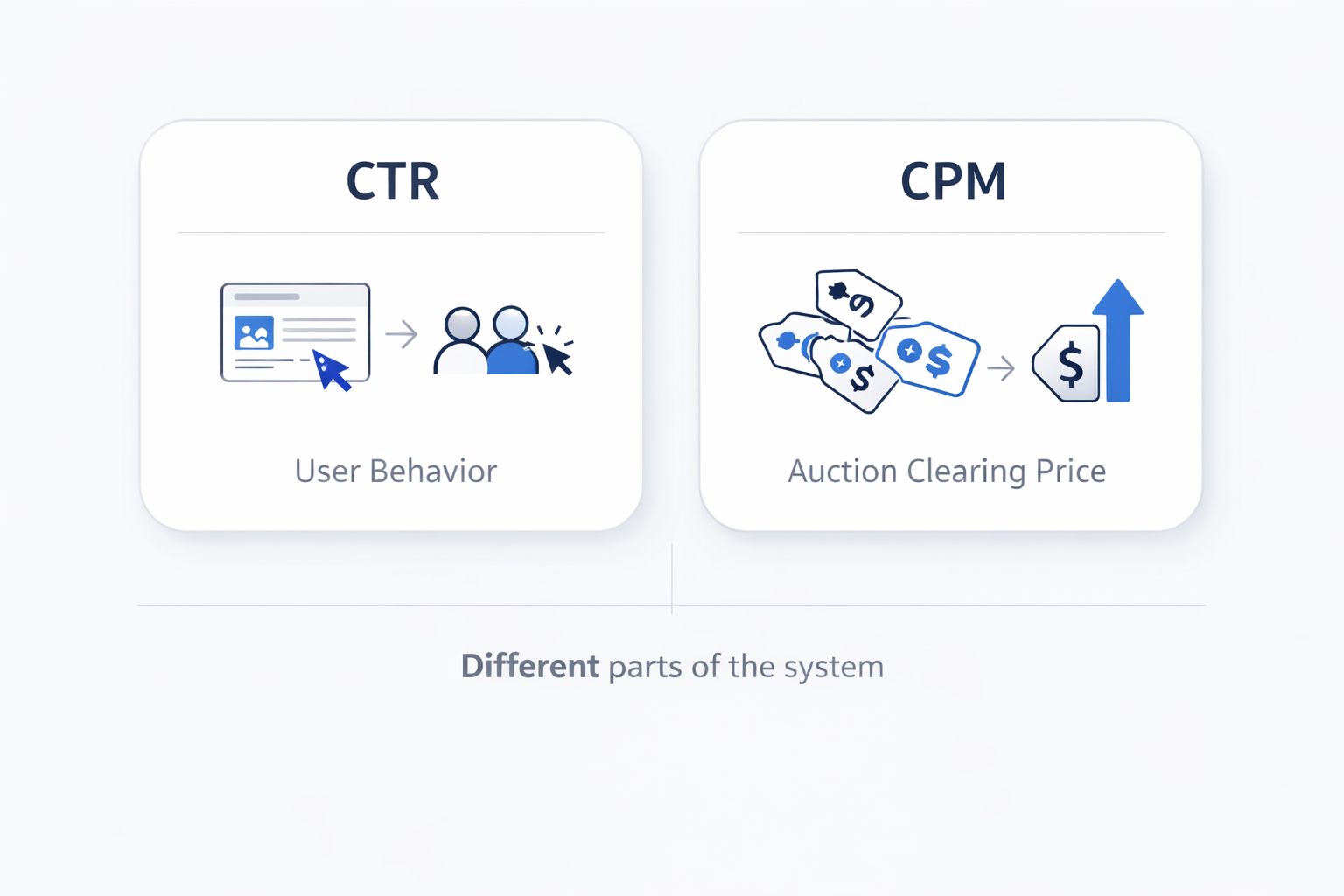
A steady CTR usually feels like a sign of stable performance. People still stop, click, and interact with your ads at the same rate. Yet CPM can rise even when engagement does not change. This happens because CTR reflects interest, while CPM reflects auction pressure and predicted value. When the auction environment shifts, CPM reacts immediately, even if your ad stays exactly the same.
How the Meta Auction Shapes Your CPM
Meta evaluates each impression through a real-time auction. It considers your bid, expected performance, and overall ad quality. CTR influences only one part of this formula. CPM increases when the system believes impressions now require more budget or carry greater performance risk.
Higher Competition Raises Impression Costs
CPM often rises because other advertisers change their behavior, not because your ad declines. When more bidders enter your audience, impressions become more expensive.
-
Seasonal events can cause heavy budget spikes as brands compete for the same users; higher demand raises clearing prices.
-
New advertisers targeting your audience push the auction upward; even small budget increases can shift costs inside narrow segments.
-
Smaller audiences react strongly to competition because a few aggressive bids can quickly inflate CPM.
In these moments, CTR stays stable because users still respond normally. The issue is that the auction must now pay more for the same reach. You start winning more expensive placements, and CPM climbs as a result. To understand how these shifts happen in practice, it helps to see how ad sets compete inside Meta’s system. The article on Facebook ad auction competition explains this dynamic clearly.
Audience Saturation Makes Delivery Less Efficient
CTR does not reveal whether your audience is still healthy. It only shows that the people who continue seeing your ads still click. The system may still struggle to find new impressions at a reasonable cost.
-
Higher frequency signals that reach is no longer expanding; repeatedly hitting the same users requires higher bids.
-
Activity inside the audience changes; when fewer people scroll or engage, cheap impressions disappear first.
-
Relying on a narrow set of placements forces the auction to fight over limited inventory.
As saturation grows, Meta must push deeper into the audience or into more competitive placement pools. These segments typically cost more, so CPM rises even though CTR stays unchanged. If you want to evaluate whether saturation is contributing to a cost increase, the guide on detecting audience saturation is a useful resource.
Why CPM Changes Even When CTR Holds Steady
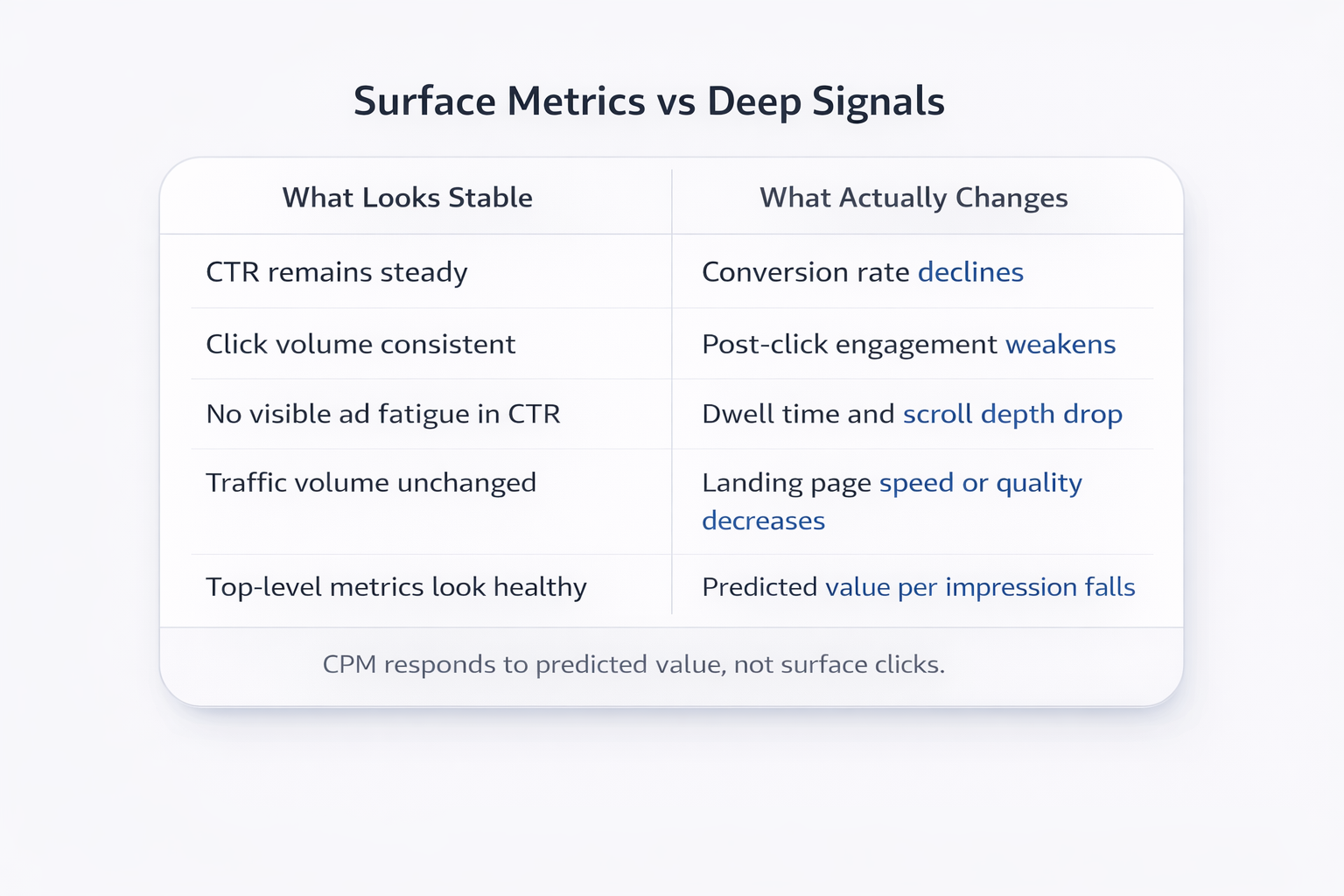
CTR shows interest. CPM shows the auction’s confidence in future outcomes. When deeper signals decline, CPM rises because the system becomes more cautious with your budget.
Lower Conversion Quality Reduces Predicted Value
If people still click but convert less often, the auction sees weaker results and increases CPM to stabilize delivery.
-
A lower conversion rate signals that your impressions generate less value; the system raises CPM accordingly.
-
Slow or unstable landing pages reduce post-click behavior quality; this lowers predicted value.
-
Account-level results influence learning; poor performance in other campaigns reduces system confidence.
Because CTR does not reflect post-click performance, it often hides decline until CPM rises. A conversion drop or data with missing tracking signals makes every impression riskier for the system.
Creative Fatigue Without a CTR Drop
Creative fatigue rarely appears first in CTR. The earliest warning signs happen deeper in engagement metrics, long before users stop clicking.
-
A small group of heavy clickers can keep CTR stable while new users engage less.
-
Scroll-stop time and dwell-time weaken even though click behavior stays unchanged.
-
Reduced freshness makes each impression less valuable, and CPM rises to compensate.
This is one reason advertisers experience rising CPM even when creative still seems to perform. A related breakdown of early fatigue patterns appears in the article on ad fatigue signals.
Platform and System Factors That Raise CPM
Some CPM increases come from changes happening inside Meta, not from anything in your campaign.
Inventory Rebalancing Across Placements
Facebook and Instagram adjust where impressions appear across feed, stories, and other placements.
-
When high-quality inventory shrinks, delivery shifts toward more expensive impressions.
-
New ad formats take screen space that previously belonged to older formats, increasing competition.
-
Experiments on placement distribution can tighten available supply without any change in your setup.
Even though CTR stays stable, CPM rises because the cost of available impression slots increases.
Signal Loss Makes Optimization Less Accurate
The system relies on accurate conversion data to optimize bids. When signals weaken, CPM increases to offset uncertainty.
-
Fewer conversion events reduce optimization accuracy and inflate CPM.
-
Attribution gaps delay learning and drive cost volatility.
-
Missing or low-quality data makes each impression harder to predict.
CTR continues to look normal, but the auction operates with far less confidence behind the scenes.
How to Diagnose a CPM Spike When CTR Is Stable
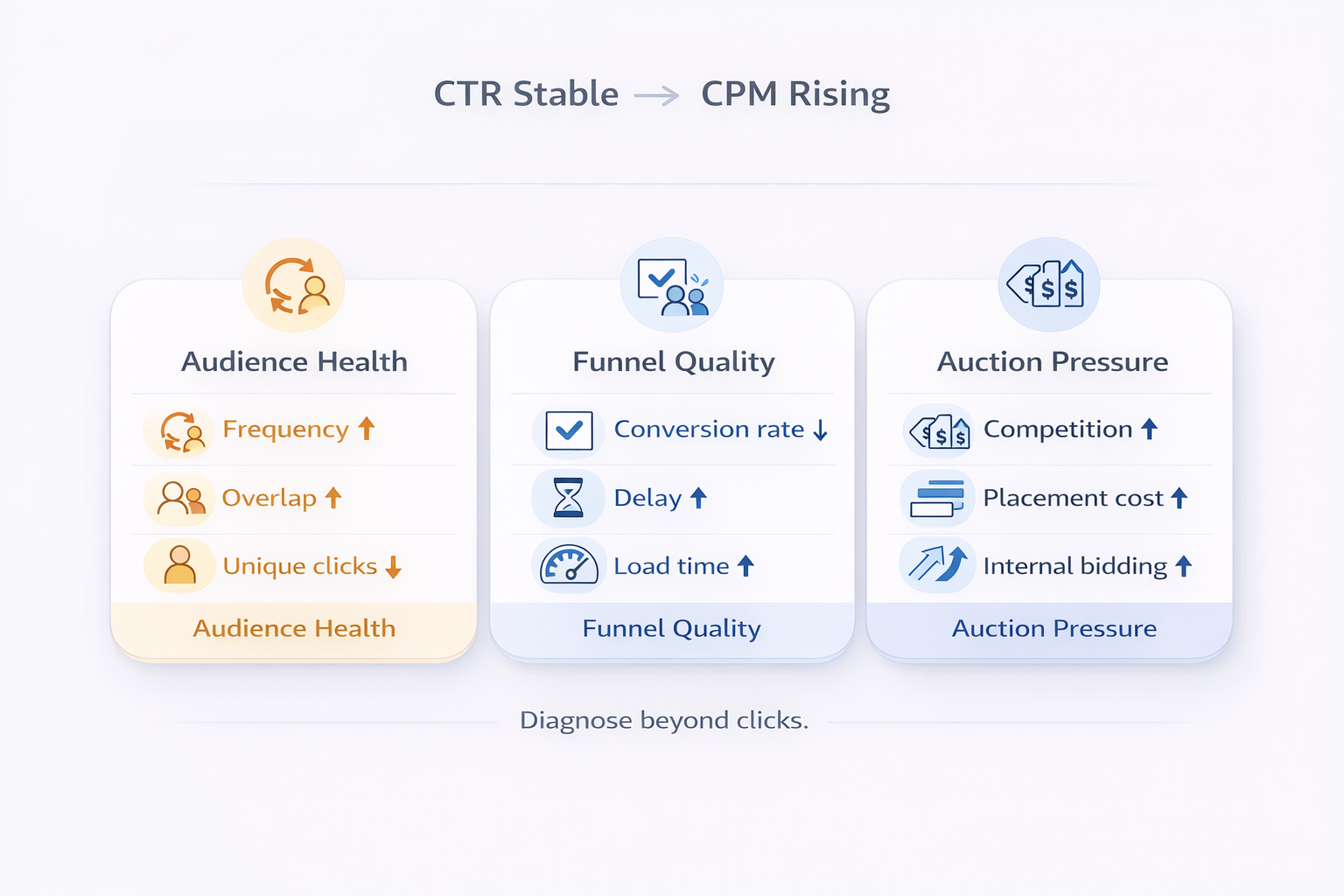
When CTR is steady but CPM climbs, analysis must go deeper. The issue usually appears in audience health, funnel quality, or auction pressure.
Review Audience Performance Indicators
Audience metrics reveal if your stable CTR hides deeper problems.
-
Rising frequency paired with flat reach usually signals saturation.
-
Audience overlap increases CPM because your campaigns compete against each other.
-
A decline in unique clicks shows that only a small group remains actively engaged.
These signs help clarify whether CPM is rising naturally because the system is running out of efficient impressions.
Evaluate What Happens After the Click
Post-click behavior influences CPM heavily. Even small drops can create fast cost spikes.
-
Falling conversion rates reduce predicted value.
-
Longer delays between click and conversion disrupt optimization.
-
Technical issues like slow load time reduce engagement and inflate CPM.
If the funnel weakens while CTR stays stable, CPM often climbs as the system compensates for uncertain outcomes.
Look for New Competitive Pressure
Competition often explains sudden CPM jumps during otherwise stable performance.
-
Seasonal periods attract more advertisers, raising cost for everyone.
-
Placement shifts push your ads toward more expensive inventory.
-
Internal budget changes cause your own campaigns to bid against each other.
This pressure usually shows up first in CPM long before CTR changes.
How to Bring CPM Back Down
You cannot control competition, but you can strengthen the signals the auction uses to price impressions.
Expand Reach and Give the System More Flexibility
A broader or more flexible setup helps the system find cheaper impressions.
-
Expand audiences to reduce saturation and introduce new users.
-
Open more placements so delivery can adjust dynamically.
-
Refresh creatives to inject stronger early engagement signals.
When the system has more room to explore, CPM often settles back to efficient levels.
Improve Post-Click Experience and Tracking Accuracy
Better funnel performance raises predicted value, which lowers CPM naturally.
-
Increase page speed to prevent early drop-off.
-
Fix tracking gaps so the system receives clean data.
-
Simplify your funnel so users convert faster.
If the system sees strong, reliable signals, CPM declines even without changing CTR.
Reduce Internal Competition in Your Account
Overlapping audiences and fragmented structures increase CPM unnecessarily.
-
Remove overlaps so campaigns stop bidding against each other.
-
Consolidate similar ad sets to strengthen learning.
-
Scale budgets gradually to avoid destabilizing the algorithm.
A cleaner structure gives Meta clearer signals, which improves cost efficiency.
Final Thoughts
A stable CTR often hides deeper issues. CPM reveals changes in competition, predicted value, and delivery efficiency long before CTR moves. Once you understand how these forces shape cost, CPM spikes become easier to diagnose — and far easier to fix.