For years, Facebook advertising was synonymous with precision. Advertisers could reach users based on granular interests, behaviors, demographics, and even life events. Today, many marketers report a different experience: ads feel less relevant, performance is harder to predict, and targeting options appear increasingly limited.
This is not a coincidence. A combination of privacy regulation, platform strategy, and technological change has fundamentally altered how Facebook advertising works.
The Impact of Privacy Changes
One of the most significant drivers of reduced perceived targeting is the shift toward user privacy.
In 2021, Apple introduced App Tracking Transparency (ATT), requiring iOS users to explicitly opt in to cross‑app tracking. According to industry estimates, more than 75% of iOS users globally chose to opt out. As a result, Facebook lost visibility into a large portion of off‑platform user behavior, including website visits and app activity.
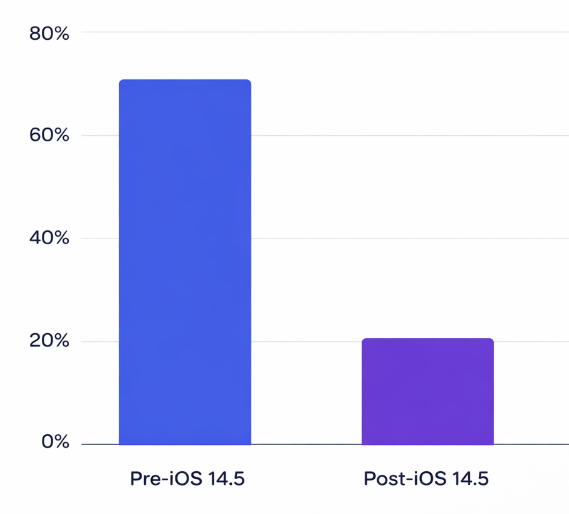
Opt-in rates for cross-app tracking fell from over 70% to roughly 25% after Apple’s ATT, shrinking advertiser access to audience data
This data loss directly affects:
-
Conversion tracking accuracy
-
Retargeting pool size
-
Audience signal quality for optimization
Meta itself has stated that these changes reduced the amount of actionable data available for ad personalization and measurement, particularly for mobile-driven businesses.
Shrinking and Simplified Targeting Options
Over time, Facebook has removed or restricted many detailed targeting categories. Sensitive attributes such as health conditions, political affiliation, and certain behavioral signals are no longer available. Even broader interest categories have been consolidated.
While these changes reduce the risk of misuse, they also mean advertisers have fewer levers to define precise audiences. Instead of layering dozens of filters, campaigns now rely on broader audience definitions.
This creates the impression that ads are less targeted, even though Facebook’s systems are still attempting to match ads to likely converters behind the scenes.
Algorithm-First Delivery
Facebook’s ad delivery has shifted from advertiser-defined targeting to algorithm-driven optimization.
Today, the platform prioritizes:
-
Broad audiences
-
Fewer manual targeting constraints
-
Machine learning-based prediction of conversion likelihood
Meta reports that campaigns using broad targeting and conversion optimization often outperform heavily restricted audiences, especially when supported by sufficient conversion volume. However, this approach reduces advertiser control and makes targeting feel opaque.
Instead of selecting exactly who sees an ad, advertisers are increasingly selecting outcomes and trusting the algorithm to decide who is most likely to deliver them.
Less Reliable Attribution and Reporting
Another reason ads feel less targeted is the decline in reporting clarity.
Delayed conversions, modeled data, and aggregated event measurement mean that advertisers see fewer direct cause‑and‑effect relationships. According to Meta, modeled conversions can represent a significant portion of reported results in some accounts.
When advertisers cannot clearly see who converted and why, campaigns feel less precise—even if performance remains stable.
Audience Saturation and Creative Fatigue
As targeting becomes broader, creative relevance becomes more critical.
At the same time, competition for attention has increased. The average Facebook user sees dozens of ads per day, and repeated exposure to similar messaging leads to fatigue. Even well-targeted ads can feel irrelevant if creative is generic or overused.
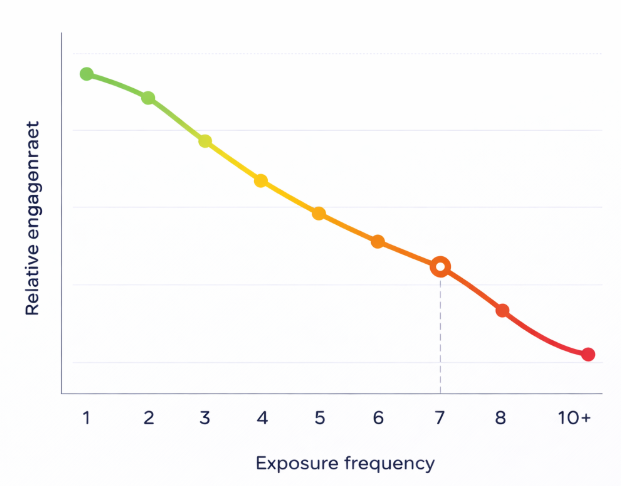
Engagement drops sharply after users see the same ad 7–8 times, often leading to a 40% decline in click-through rates
Industry benchmarks show that ad frequency above 2.5–3 within short time frames often correlates with declining click‑through rates, reinforcing the perception that ads are “missing the mark.”
What This Means for Advertisers
Facebook ads are not necessarily less effective—but they are different.
Precision has shifted from manual targeting to:
-
High-quality first‑party data
-
Strong conversion signals
-
Clear campaign objectives
-
Iterative creative testing
Advertisers who adapt to this model tend to see more consistent results than those attempting to replicate legacy targeting strategies.
Suggested Reading
To explore related topics in more depth, consider these articles:
Facebook advertising no longer rewards micromanaged audiences. Instead, it favors systems thinking—where data quality, creative relevance, and algorithmic learning work together. Understanding this shift is essential for setting realistic expectations and building sustainable campaigns.