Interest-based targeting has long been a default method for identifying potential buyers. While it provides reach, it increasingly lacks precision. As platforms shift how they track user behavior and as consumer journeys become more fragmented, marketers need signals that reflect real intent—not just casual browsing patterns.
Group membership offers that signal. Online groups—whether topic-specific communities, brand fan groups, or professional spaces—attract individuals who share a deeper motivation, a stronger problem-awareness level, and often a higher likelihood to buy. This makes group membership a powerful, underused predictor of purchase intent.
Why Interests Alone Fall Short
Interests are broad, algorithmically inferred, and often outdated. A single page visit or a brief interaction can add a user to an interest category, even if they have no buying intent.
Key challenges with interests include:
-
High ambiguity: Interests may reflect curiosity, entertainment, or research—not product consideration.
-
Low recency value: Many interest categories remain attached to users for months or years after behavior changes.
-
Weak correlation to purchasing: Studies show that only about 14–20 percent of interest-targeted users demonstrate measurable buying intent.
As a result, interest-based targeting often casts too wide a net and dilutes campaign performance.
Why Group Membership Signals Stronger Intent
Groups form around specific identities, needs, and goals. Joining a group is an action that requires more intention than passively consuming content.
1. Higher Commitment Behavior
Users who join a niche group self-select into a topic at a deeper level. Research indicates that community members are 2.4× more likely to engage with product-focused content than users identified only by interests.
2. Problem-Aware and Solution-Seeking Audiences
Many groups form around shared challenges—fitness goals, business scaling, parenting needs, software tools, professional development, and more. That problem-awareness translates directly into commercial intent.
A survey of digital communities found that 58 percent of members join groups specifically to find recommendations or solutions.
3. Stronger Social Proof Influence
Group environments foster discussion, reviews, and peer recommendations. These interactions amplify purchase motivation.
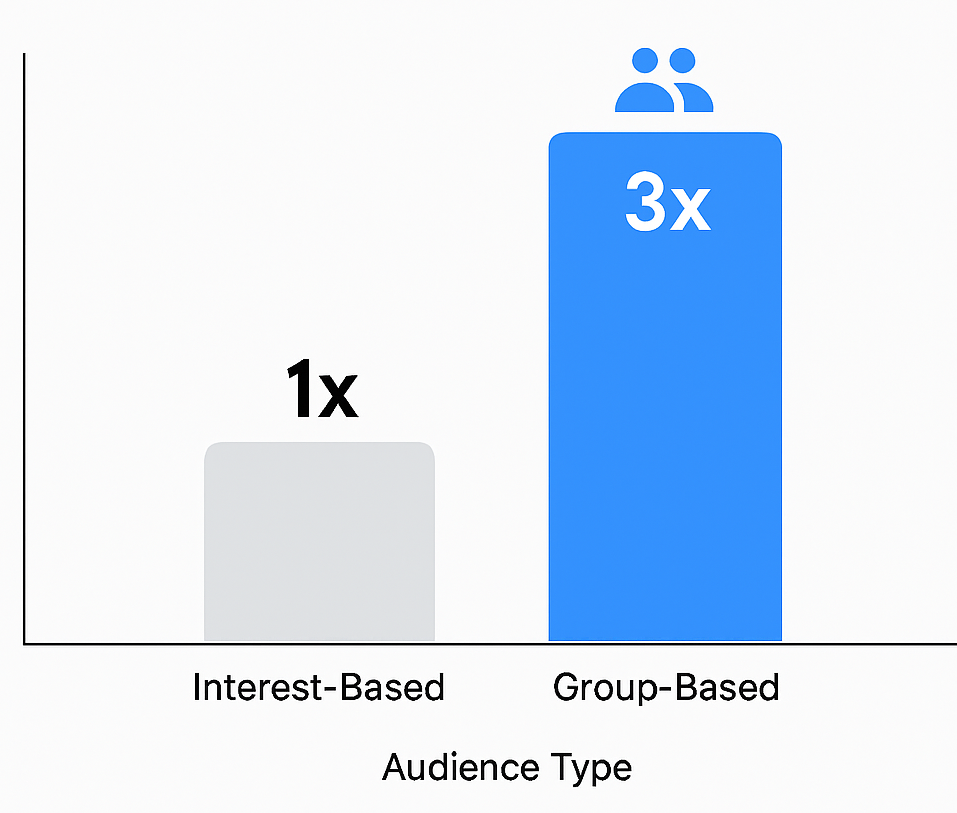
Community-led referrals are shown to produce up to 3× higher conversion rates compared to standard interest-based ads.
How Group Membership Improves Targeting Quality
1. More Precise Audience Segmentation
Groups create natural micro-segments organized by:
-
pain points
-
stage of awareness
-
professional role or niche interest
-
product category
This precision allows campaigns to reach highly relevant prospects without relying on algorithmic assumptions.
2. Higher Engagement Rates
Campaigns built on group-based audiences consistently outperform interest-based audiences, with reported performance lifts such as:
-
20–40 percent lower CPC
-
30–60 percent higher CTR
-
Up to 70 percent higher conversion intent in retargeting campaigns
These lifts occur because group membership reflects real behavior, not inferred interests.
3. Better Performance in Always-On Campaigns
Group audiences remain fresh for longer periods due to active community participation. This provides stable performance for long-running or evergreen campaigns—something interest targeting struggles to maintain.
When Group Membership Outperforms Interests Most
Group-based audiences show especially strong results when:
-
launching niche products or specialized services
-
retargeting users who already show high-level engagement
-
promoting B2B tools or solutions with specific user communities
-
scaling lookalike audiences that require strong seed data
-
targeting audiences with well-defined problems or passions
Practical Examples of Elevated Intent
While interest targeting might reach someone who casually browsed content, group membership reveals users who:
-
ask for recommendations
-
participate in problem-solving
-
follow specialized topics daily
-
share insights or expertise
This active behavior correlates with higher-quality traffic and stronger bottom-funnel performance.
Useful Statistics That Highlight the Difference
-
Groups produce up to 3× more repeat engagement than interest-based audiences.
-

62 percent of users say communities help them make purchasing decisions. -
Interest categories decay in accuracy by 25–40 percent within six months, while group engagement stays consistent.
These numbers reinforce that online communities are not simply social spaces—they are commercial ecosystems.
Best Practices for Using Group-Based Audiences
-
Focus on smaller, niche groups with clear identity or purpose.
-
Use group membership to create mid‑funnel audiences that filter out low‑intent users.
-
Combine group-based audiences with behavioral signals such as page views, video engagement, or lead form activity.
-
Refresh groups periodically to maintain audience relevance.
Conclusion
In a privacy-focused, signal-restricted advertising environment, marketers must rely on behavioral indicators that genuinely predict intent. Group membership is one of the strongest of these indicators. By targeting people who intentionally join communities around specific needs or interests, marketers can access deeper commercial motivation, better engagement, and significantly improved conversion outcomes.
Suggested Reading
Here are three additional articles that deepen strategic understanding: