Retargeting has evolved far beyond serving generic ads to previous website visitors. In competitive B2B markets, decision-makers expect relevance, precision, and timing aligned with their buying stage. Advanced retargeting with dynamic content enables marketers to tailor messaging, creative, and offers based on behavioral signals, firmographic attributes, and engagement depth.
According to industry benchmarks, retargeted visitors are 70% more likely to convert compared to new visitors. Additionally, personalized ads can improve click-through rates (CTR) by up to 2–3x compared to static creatives. However, these results depend heavily on segmentation accuracy and dynamic content orchestration.
The Evolution of Retargeting
Traditional retargeting relied primarily on website pixel tracking. All visitors were grouped into broad audiences and shown identical creatives. While effective at generating incremental conversions, this method often leads to ad fatigue, wasted impressions, and declining ROI.
Advanced retargeting integrates:
-
Behavioral segmentation (page depth, time on site, resource downloads)
-
Account-level firmographics (industry, company size, revenue)
-
Funnel stage classification
-
Dynamic creative optimization (DCO)
-
Cross-channel coordination
By aligning these components, campaigns become predictive rather than reactive.
Core Components of Advanced Retargeting
1. Granular Audience Segmentation
Segmentation should reflect buyer intent and qualification level. For example:
-
High-intent users: pricing page visits, demo requests started
-
Mid-funnel users: whitepaper downloads, webinar attendance
-
Early-stage users: blog engagement, homepage exploration
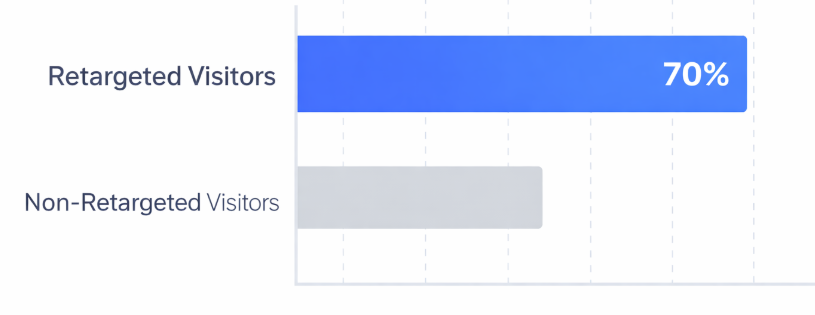
Retargeted website visitors are 70% more likely to convert than non-retargeted visitors
Segment-specific messaging can increase conversion rates by over 50% compared to uniform retargeting campaigns.
2. Dynamic Creative Optimization (DCO)
Dynamic content adapts headlines, visuals, calls-to-action, and offers based on audience data. This may include:
-
Industry-specific value propositions
-
Personalized product recommendations
-
Case studies aligned to vertical
-
Messaging tailored to company size
Studies show that dynamic creatives reduce cost per acquisition (CPA) by up to 30% when paired with strong audience segmentation.
3. Funnel-Based Messaging Strategy
Effective advanced retargeting mirrors the buyer journey:
-
Awareness stage: educational content and thought leadership
-
Consideration stage: case studies and solution comparisons
-
Decision stage: demos, consultations, ROI calculators
This alignment shortens sales cycles and increases sales-qualified lead (SQL) conversion rates.
Data Infrastructure Requirements
Dynamic retargeting is only as effective as its data foundation. Essential components include:
-
CRM integration
-
Marketing automation synchronization
-
Account enrichment data
-
Clean event tracking architecture
Marketers that integrate CRM and ad platforms typically see 20–35% higher revenue attribution accuracy. Without synchronized data, personalization becomes inconsistent and unreliable.
Cross-Channel Retargeting Strategy
Advanced campaigns operate across multiple channels:
-
Display networks
-
Paid social
-
Video platforms
-
Email remarketing
Cross-channel frequency management prevents overexposure while maintaining message consistency. Research indicates that omnichannel campaigns can generate up to 90% higher customer retention rates compared to single-channel efforts.
Avoiding Common Pitfalls
-
Over-segmentation without sufficient audience size
-
Static creatives within "dynamic" campaigns
-
Ignoring frequency caps
-
Failing to exclude converted users promptly
-
Lack of creative rotation leading to fatigue
Ad fatigue can reduce CTR by more than 40% within weeks if creative refresh cycles are not implemented.
Measurement and Optimization Framework
Advanced retargeting requires layered performance analysis:
-
View-through conversions
-
Assisted conversions
-
Account engagement scoring
-
Pipeline velocity impact
-
Revenue attribution modeling
Rather than optimizing solely for CTR, high-performing teams evaluate pipeline contribution and closed-won revenue influence.
A/B testing should focus on:
-
Dynamic vs. static messaging
-
Offer sequencing
-
Industry-specific positioning
-
CTA language variations
Incremental lift testing can validate true retargeting impact and eliminate over-attribution bias.
Advanced Use Cases
Account-Based Retargeting
Serving dynamic ads to specific high-value accounts based on engagement signals increases enterprise deal velocity and improves win rates.
Predictive Retargeting
Machine learning models can prioritize accounts showing early buying signals, reallocating budget dynamically to high-propensity segments.
Sequential Storytelling Campaigns
Ads delivered in planned sequences increase message recall and brand consideration by up to 30%.
Strategic Impact
When executed correctly, advanced retargeting with dynamic content delivers:
-
Higher marketing-qualified lead (MQL) to SQL conversion
-
Reduced customer acquisition cost
-
Improved return on ad spend (ROAS)
-
Shorter sales cycles
-
Stronger brand recall among decision-makers
Organizations that implement structured personalization frameworks consistently outperform competitors relying on static retargeting approaches.
Recommended Reading
To further deepen your expertise, consider reading:
Conclusion
Advanced retargeting with dynamic content represents a shift from broad remarketing tactics to precision-driven revenue acceleration. By integrating behavioral intelligence, firmographic insights, and dynamic creative frameworks, marketers can transform retargeting from a supplementary tactic into a primary growth engine.
Success depends on disciplined segmentation, synchronized data infrastructure, cross-channel orchestration, and continuous performance validation. In a landscape where attention is scarce and competition is intense, relevance is the ultimate differentiator.