Facebook’s advertising ecosystem is built on data. At the core of its optimization engine are conversion signals—actions such as purchases, sign-ups, and other measurable outcomes that inform the algorithm how to deliver ads effectively. When these signals are lost or degraded, the entire optimization process begins to fail, often resulting in higher costs, reduced performance, and unstable campaign results.
Understanding how conversion signals work and why their absence disrupts performance is essential for maintaining efficient campaigns in today’s privacy-first environment.
What Are Conversion Signals?
Conversion signals are user actions tracked by Facebook that indicate valuable outcomes for advertisers. These include:
-
Purchases
-
Add-to-cart events
-
Lead form submissions
-
App installs
-
Page views tied to specific goals
These signals are typically collected via the Facebook Pixel, Conversion API, or SDK integrations. They allow Facebook’s machine learning system to identify patterns and optimize delivery toward users most likely to convert.
Why Conversion Signals Matter for Optimization
Facebook’s algorithm relies heavily on feedback loops. When users convert, the system learns which audiences, placements, and creatives are most effective.
Without consistent signals:
-
The algorithm struggles to exit the learning phase
-
Targeting becomes broader and less precise
-
Budget allocation becomes inefficient
According to industry benchmarks, campaigns with strong conversion tracking can see up to 30–50% lower cost per acquisition compared to campaigns with weak or incomplete data.
Additionally, Meta has reported that advertisers using both Pixel and Conversion API together see a median increase of 13% in conversion events captured, directly improving optimization performance.
What Causes Loss of Conversion Signals?
Several factors contribute to signal loss:
1. Privacy Changes
Updates like Apple’s App Tracking Transparency (ATT) framework have significantly reduced user-level tracking. Studies suggest that up to 60–70% of iOS users opt out of tracking, limiting the data available for optimization.
2. Browser Restrictions
Modern browsers such as Safari and Firefox block third-party cookies by default, reducing pixel-based tracking accuracy.
3. Incomplete Tracking Setup
Misconfigured pixels, missing events, or lack of server-side tracking can lead to partial or missing data.
4. Attribution Window Limitations
Shorter attribution windows (e.g., 7-day click vs. 28-day click) reduce the number of recorded conversions, weakening the signal pool.
The Impact on Campaign Performance
When conversion signals are lost, several negative effects emerge:
Increased Cost Per Result
With less data to optimize against, the algorithm becomes less efficient. Many advertisers report cost increases of 20–40% after signal loss events.
Volatility in Performance
Campaigns may show inconsistent results, with fluctuations in CPA, ROAS, and conversion volume.
Longer Learning Phases
Facebook requires approximately 50 conversion events per ad set per week to stabilize performance. Without sufficient signals, campaigns remain in the learning phase longer, reducing effectiveness.
Reduced Audience Quality
Targeting becomes less precise, leading to impressions served to users with lower intent.
Why Facebook’s Algorithm Breaks Without Signals
At a technical level, Facebook’s optimization system depends on supervised machine learning. Conversion signals act as labeled data points.
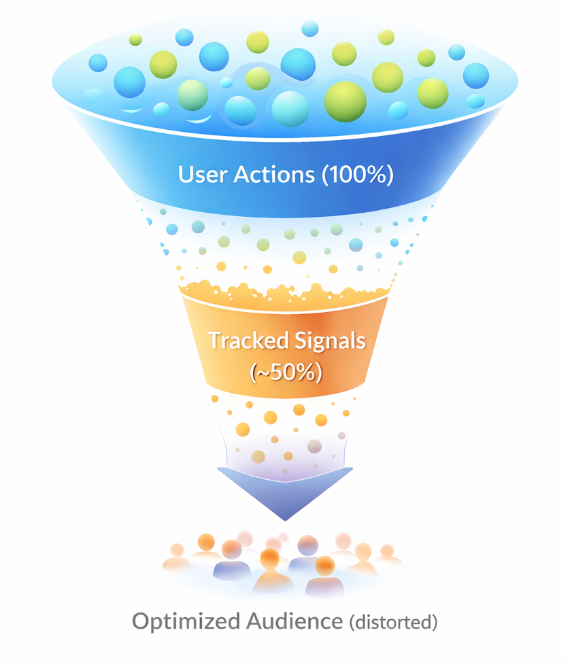
When conversion signals are incomplete, optimization models rely on partial data, leading to inaccurate targeting and reduced campaign performance
When these labels are missing:
-
Models cannot accurately predict high-value users
-
Lookalike audiences become less effective
-
Automated bidding strategies lose efficiency
In essence, the algorithm is forced to operate with incomplete or noisy data, leading to suboptimal decisions.
How to Mitigate Signal Loss
Although signal loss cannot be entirely avoided, several strategies can reduce its impact:
Strengthen First-Party Data
Collect and utilize first-party data such as email lists and CRM data. This improves match rates and enhances signal quality.
Implement Server-Side Tracking
Using Conversion API alongside pixel tracking helps recover lost data and provides more reliable event tracking.
Prioritize High-Value Events
Focus on optimizing for meaningful conversions rather than low-intent actions. This ensures that limited signals still carry strong value.
Optimize Event Configuration
Ensure that key events are properly prioritized within Facebook’s Aggregated Event Measurement framework.
Use Broader Targeting with Strong Creatives
When data is limited, creative performance plays a larger role. Broad targeting combined with compelling creatives can help stabilize results.
Future Outlook
The trend toward privacy-first advertising will continue, meaning signal loss will remain a long-term challenge. Advertisers who adapt by improving data infrastructure and focusing on signal quality will maintain a competitive advantage.
Industry forecasts suggest that by 2026, over 80% of digital advertising measurement will rely on modeled or aggregated data rather than user-level tracking.
Recommended Reading
To deepen your understanding, consider exploring the following articles:
Conclusion
Conversion signals are the foundation of Facebook ad optimization. When they are lost, the algorithm’s ability to learn and improve is severely compromised. This leads to higher costs, unstable performance, and reduced efficiency.
Advertisers who recognize the importance of signal integrity and invest in robust tracking and data strategies will be better positioned to succeed in an increasingly complex advertising environment.