
Event Match Quality (EMQ) reflects how effectively your server or pixel data can be matched to real user profiles. Platforms rely on identifiers such as email, phone number, IP address, and browser data to attribute conversions.
When identifiers are incomplete or inconsistent, match rates drop. That weakens attribution accuracy.
Meta reports that advertisers who implement advanced matching and Conversions API correctly can improve attributed conversions by up to 10–20 percent. Accounts with strong match parameters consistently report more stable return on ad spend.
Low EMQ does not always reduce conversions. It reduces visibility into them.
Why Low EMQ Destroys Attribution Accuracy
Attribution models depend on identity resolution. If the platform cannot confidently connect an event to a user, several structural problems emerge.
1. Underreported Conversions
When match quality drops, fewer conversions are tied back to campaigns. This makes cost per result appear higher than reality. Budget decisions then shift based on incomplete data.
2. Inflated CPA Volatility
Weak match rates create reporting lag and inconsistency. One day performance appears profitable. The next day it collapses. The issue is often signal instability, not demand change.
3. Algorithmic Learning Disruption
Optimization models depend on dense, high-quality feedback loops. Meta recommends at least 50 optimization events per ad set per week for stable learning. If EMQ reduces attributable events, ad sets struggle to exit learning phase.
Lower match quality effectively fragments signal density.
Common Causes of Low Event Match Quality
Several structural issues typically reduce EMQ:
-
Missing customer identifiers in form submissions, especially email or phone.
-
Inconsistent hashing or formatting of server-side parameters.
-
Multiple pixels firing duplicate or conflicting events.
-
Poor Conversions API configuration with mismatched event IDs.
-
Domain inconsistencies between landing pages and checkout flows.
Each issue reduces deterministic matching confidence.
The Statistical Impact of Signal Loss
Industry analyses show that privacy restrictions and browser limitations can reduce observable conversion signals by 15–30 percent without server-side tracking reinforcement.
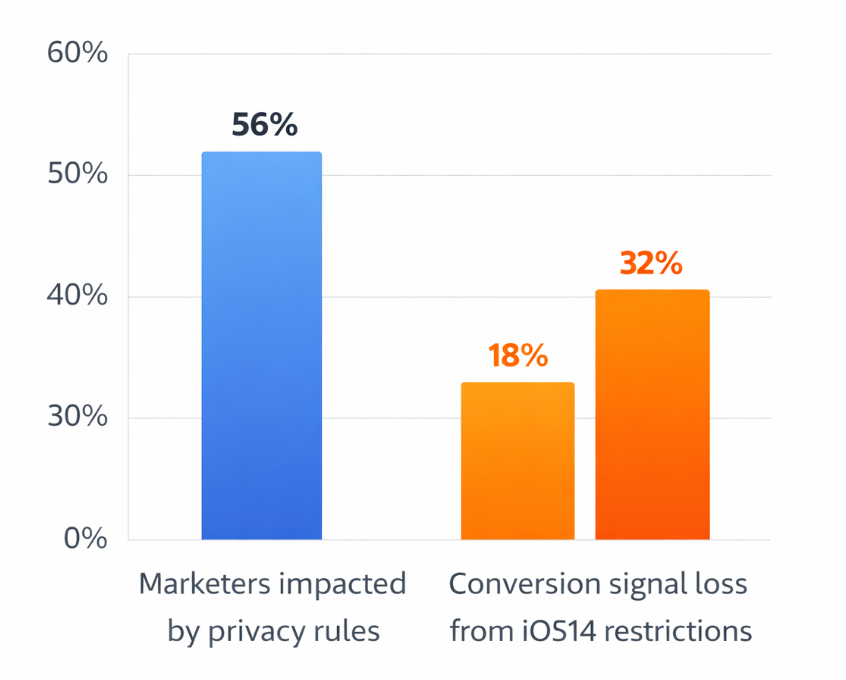
Privacy changes are a major challenge: over half of marketers report harder attribution due to privacy rules, and iOS14 restrictions can cut observable conversion signals by up to 32%
Advertisers that migrate from pixel-only tracking to combined pixel plus Conversions API often recover a significant portion of lost attribution data. In structured accounts, this recovery directly improves reported ROAS stability.
Signal recovery does not create new conversions. It restores visibility.
Three Practical Fixes to Improve EMQ
1. Implement Full Conversions API With Event Deduplication
Server-side tracking increases match reliability by sending hashed first-party data. Ensure event IDs are consistent across browser and server events to prevent duplication.
Audit whether every purchase, lead, and subscription event includes email, phone, and external ID where possible.
2. Standardize Data Formatting and Hashing
All identifiers must be normalized before hashing. Remove spaces, lowercase emails, and standardize phone formats with country codes. Even minor formatting inconsistencies reduce match probability.
Perform controlled test events to validate match scores inside Events Manager.
3. Consolidate Domains and Event Sources
Attribution weakens when users move across subdomains or third-party checkout pages without proper domain verification.
Ensure:
-
Verified primary domain.
-
Consistent event naming conventions.
-
Single source of truth for purchase events.
-
Removal of redundant legacy pixels.
Signal consolidation improves optimization stability.
Structural Perspective: EMQ Is Not a Technical Detail
Low Event Match Quality is often misclassified as a tracking issue. In reality, it is a structural performance variable.
If match quality drops, reported ROAS declines. When ROAS declines, advertisers restructure campaigns. That restructuring reduces event density. Reduced density further destabilizes optimization.
The root cause remains signal integrity.
Strong attribution begins with strong matching.
How to Diagnose Whether EMQ Is Your Core Problem
Ask three diagnostic questions:
-
Did performance drop without a corresponding traffic decline?
-
Did reporting volatility increase after site changes or checkout adjustments?
-
Are attributed conversions significantly lower than backend sales?
If the answer to two or more is yes, match quality deserves investigation.
Final Thoughts
Attribution accuracy depends on signal precision. Budgets and creative strategy cannot compensate for weak identity resolution.
Before restructuring campaigns or cutting spend, audit Event Match Quality. Strengthening match signals often restores performance clarity faster than strategic overhauls.
When reporting becomes stable, optimization becomes predictable.