Click‑through rate (CTR) has long been considered a key indicator of ad performance. Many marketers assume that higher CTR automatically means better results and stronger ad delivery. However, Meta’s advertising system evaluates far more than clicks alone. In some cases, ads with lower CTR can actually receive broader distribution and deliver better business outcomes.
Understanding why this happens requires examining how Meta’s ad auction works, how conversion signals influence delivery, and how engagement quality affects optimization.
The Role of the Meta Ad Auction
Meta’s ad delivery system is based on a value‑based auction. Every time an ad competes for a placement, Meta evaluates several factors simultaneously. The system considers:
-
Advertiser bid
-
Estimated action rate
-
Ad quality and user feedback
Estimated action rate is particularly important. Instead of optimizing only for clicks, Meta predicts the likelihood that a user will complete the advertiser’s chosen objective, such as a purchase, signup, or lead submission.
If an ad generates fewer clicks but produces stronger conversion signals, Meta may prioritize it over ads with higher CTR but weaker post‑click behavior.
CTR Does Not Measure Business Value
A high CTR does not always translate into meaningful outcomes. For example, curiosity‑driven ads or sensational headlines often generate many clicks but lead to poor conversion rates or short session durations.
Industry studies have shown that up to 30–40% of high‑CTR ads experience weak post‑click engagement, meaning users leave quickly or fail to complete meaningful actions.
Meta’s optimization models detect these patterns. When the system sees that users frequently click an ad but rarely convert, the ad’s predicted value decreases.
Conversion Optimization Can Lower CTR
When campaigns optimize for conversions instead of clicks, the algorithm intentionally targets users who are more likely to complete the desired action. These audiences may click less frequently but convert at significantly higher rates.
According to aggregated advertising benchmarks, conversion‑optimized campaigns can produce:
-
20–30% lower CTR compared with traffic campaigns
-
2–3× higher conversion rates
-
40–60% lower cost per acquisition
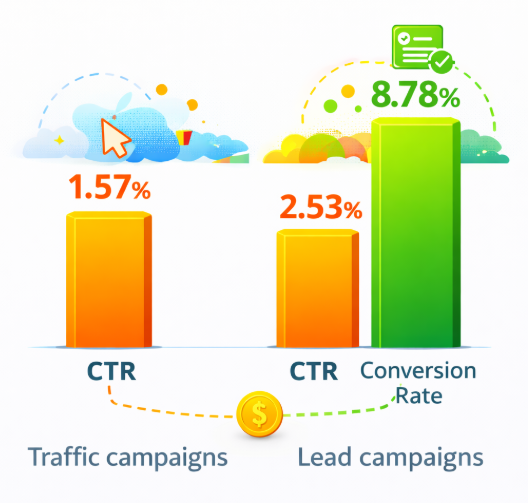
Average CTR and conversion benchmarks across Meta campaign objectives
From the algorithm’s perspective, the ad with fewer clicks but more conversions provides greater advertiser value.
Quality Signals Influence Delivery
Meta also evaluates quality signals beyond basic engagement metrics. Ads that receive negative feedback, misleading impressions, or accidental clicks can be penalized even if CTR appears strong.
Key quality indicators include:
-
User hide or report actions
-
Time spent after clicking
-
Landing page experience
-
Conversion consistency
If an ad generates authentic engagement and positive user experience, it can outperform high‑CTR ads that rely on aggressive clickbait tactics.
Audience Intent Matters
Lower CTR ads sometimes appear when targeting high‑intent audiences. These users often evaluate offers more carefully before clicking.
For instance, a broad awareness campaign might achieve a CTR above 3–4%, while a high‑intent lead generation campaign targeting decision‑makers may generate only 0.8–1.2% CTR but deliver far higher conversion rates.
In this context, lower CTR reflects stronger purchase intent rather than poor performance.
How Advertisers Should Evaluate Performance
Because CTR alone can be misleading, advertisers should rely on a broader set of metrics when assessing campaign success. The most important indicators typically include:
-
Cost per acquisition (CPA)
-
Conversion rate
-
Return on ad spend (ROAS)
-
Lead quality
CTR still provides useful information about creative relevance, but it should not be treated as the primary optimization metric.
Practical Strategies for Advertisers
Advertisers can adapt their approach to better align with Meta’s optimization system.
1. Optimize for Real Outcomes
Whenever possible, campaigns should optimize for conversions rather than clicks. This allows the algorithm to prioritize users most likely to complete valuable actions.
2. Evaluate Post‑Click Behavior
Tracking events such as page depth, session duration, and form completion helps identify whether clicks translate into real engagement.
3. Focus on Creative‑Audience Fit
Ads that clearly communicate the offer tend to attract more qualified clicks. While this may slightly reduce CTR, it improves conversion quality.
Conclusion
Lower CTR does not necessarily indicate poor ad performance. Meta’s advertising system prioritizes predicted outcomes, user experience, and conversion signals rather than simple engagement metrics.
In many cases, ads that generate fewer but more qualified clicks ultimately deliver stronger results and receive greater distribution in the auction.