Ad accounts rarely collapse overnight. Most issues accumulate gradually:
-
Audience fatigue from repeated exposure
-
Learning phase disruptions caused by frequent edits
-
Tracking inconsistencies after platform or privacy updates
-
Campaign structures that no longer match business goals
By the time performance drops sharply, inefficiencies are already deeply embedded in the account.
Q1 Offers Lower Competitive Pressure
The first quarter typically sees reduced advertising competition compared to Q3 and Q4. Many advertisers pause or reduce spend after holiday campaigns, leading to:
-
Lower average cost per thousand impressions (CPM)
-
More stable auction dynamics
-
Faster learning for new campaigns
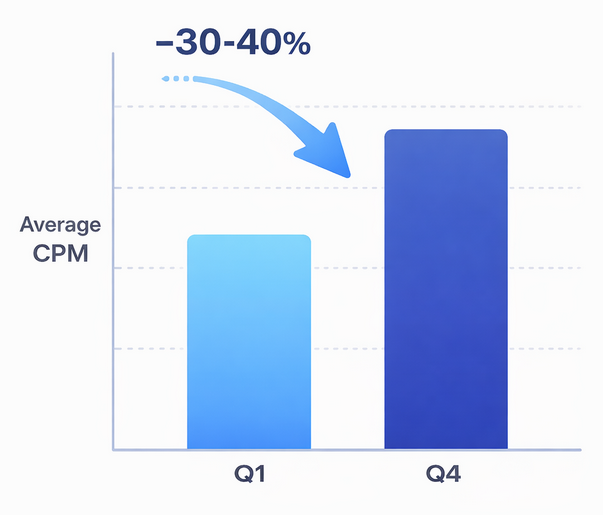
According to industry benchmarks, CPMs in Q1 are often 15–30% lower than peak Q4 levels, giving advertisers more room to test and optimize without excessive cost pressure.
Cleaner Data for Smarter Decisions
Q4 performance data is often distorted by seasonal demand, aggressive bidding, and promotional behavior. Q1 removes much of this noise.
With more predictable user behavior, advertisers can:
-
Identify true audience performance
-
Spot structural campaign issues
-
Evaluate creatives without seasonal bias

Quarterly trend for average digital advertising cost metrics showing stabilization in Q1 compared with adjacent quarters
Marketing analytics reports show that conversion rate volatility drops by up to 25% in Q1 compared to late Q4, making insights more reliable.
Time to Rebuild Account Structure
Fixing a broken ad account often requires more than small tweaks. Q1 is ideal for structural work such as:
-
Consolidating fragmented campaigns
-
Rebuilding conversion-focused funnels
-
Resetting learning phases intentionally
Since budgets are typically more flexible early in the year, advertisers can afford short-term inefficiencies while long-term improvements take effect.
Algorithm Recovery Works Best Early
Ad platforms rely on historical performance signals. When accounts suffer from inconsistent results or frequent resets, algorithms struggle to optimize.
Launching clean campaigns in Q1 helps:
-
Re-establish strong conversion signals
-
Improve delivery stability
-
Shorten learning phases later in the year
Platform data indicates that accounts stabilized in Q1 achieve up to 20% faster optimization cycles during subsequent high-competition quarters.
Testing Without Revenue Pressure
In many industries, Q1 is not the primary revenue-driving quarter. This creates a strategic advantage.
Advertisers can:
-
Test new audiences and creatives
-
Experiment with bidding strategies
-
Validate funnel changes
Research shows that campaigns tested in lower-pressure periods outperform rushed in-season launches by approximately 18% in return on ad spend.
Common Fixes Best Done in Q1
Some optimizations are particularly effective early in the year:
-
Rebuilding pixel and event tracking
-
Refreshing audience definitions
-
Phasing out underperforming creatives
-
Aligning campaign objectives with actual business KPIs
These changes often cause temporary volatility, making Q1 the safest time to implement them.
Set the Foundation for the Whole Year
Ad accounts that enter Q2 with stable structures, validated audiences, and clean data consistently outperform those that rely on reactive fixes later.
Internal marketing performance reviews suggest that accounts fully rebuilt in Q1 generate 25–40% more efficient spend across the remaining three quarters compared to accounts optimized mid-year.
Related Articles You May Find Useful
Final Thoughts
Q1 is not just the beginning of a calendar year; it is the reset point for advertising performance. Lower competition, cleaner data, and strategic flexibility make it the most cost-effective and least risky time to fix broken ad accounts. Advertisers who use this window wisely often spend the rest of the year optimizing growth rather than repairing damage.