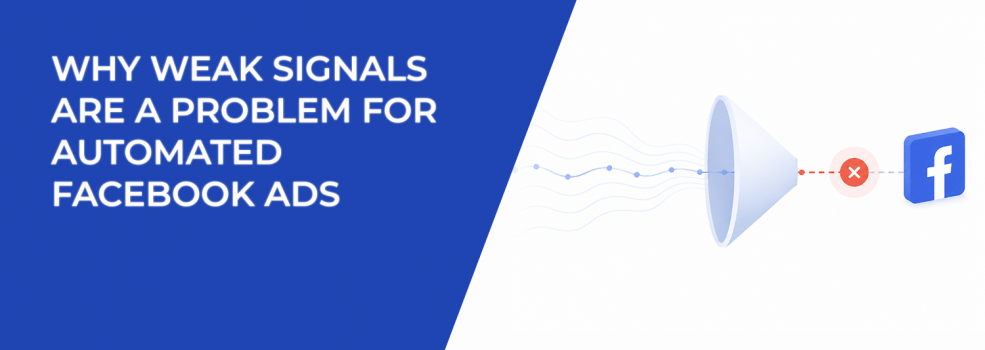
Meta’s automated ad system depends on behavioral signals.
Every conversion event, click pattern, landing page action, and purchase helps the platform understand which users are more likely to generate results in future auctions. When those signals are strong, optimization becomes more stable. When signals become weak, Meta starts making poorer predictions.
A lot of advertisers think campaign problems start with creatives or targeting. In many cases, the real issue is that the algorithm is learning from incomplete, inconsistent, or low-quality signals. That weakens delivery quality across the entire campaign structure.
Problem: Weak Signals Make Meta Optimize Around Unreliable User Behavior
Meta’s automation system relies on pattern recognition.
The algorithm studies conversion clusters and searches for similar users across Facebook and Instagram. That process becomes less accurate when the incoming data lacks consistency or depth.
Weak signals usually appear in campaigns where:
- conversion volume is too low,
- tracking is incomplete,
- lead quality varies heavily,
- campaign goals prioritize shallow engagement,
- important events are missing from the funnel.
Meta then struggles to identify what a “good” conversion actually looks like.
Instead of finding high-intent buyers, the platform starts optimizing around weaker behavioral proxies. Inside Ads Manager, this often creates unstable performance patterns like fluctuating CPA, inconsistent delivery, poor audience expansion, and sudden performance drops after scaling.
The system is still optimizing. It is simply optimizing with low-confidence data.
Why Weak Signals Hurt Automated Campaigns More Than Manual Campaigns
Automation amplifies signal quality problems.
Manual campaigns rely more heavily on advertiser decisions. Automated campaigns rely more heavily on machine prediction. That means weak signals affect automated delivery much faster.
A campaign with strong conversion data gives Meta clear feedback loops. The system quickly identifies which users convert profitably and adjusts bidding behavior accordingly.
Weak signals interrupt those loops.
For example, if lead quality varies heavily inside the same campaign, Meta may group low-intent and high-intent users together during optimization. The platform then prioritizes whichever behaviors generate cheaper conversion volume instead of higher business value.
This creates a common problem in lead generation campaigns. Form submissions increase while sales-qualified leads decline. The campaign looks healthy inside Meta while revenue performance deteriorates outside Meta.
That becomes even more dangerous during scaling because automated systems aggressively reinforce early behavioral patterns.
Solution: Strengthen Conversion Signals Before Scaling Automated Campaigns
Many advertisers try to solve unstable performance by changing creatives constantly, but that usually treats the symptom instead of the cause. The stronger fix is improving signal quality before pushing more budget into automation.
That often includes:
- optimizing around deeper conversion events instead of surface engagement,
- filtering low-quality leads before they enter optimization loops,
- improving event tracking consistency,
- separating campaigns by intent level,
- feeding Meta cleaner behavioral data.
Campaign structure matters here.
If a campaign mixes cold traffic, weak retargeting audiences, and inconsistent lead quality together, Meta receives noisy optimization feedback. The system struggles to detect which behavioral patterns actually predict revenue.
Cleaner campaign segmentation improves learning stability significantly.
Advertisers dealing with unstable optimization should also review why weak conversion signals confuse Meta’s optimization algorithm, because signal quality problems often look like audience or creative issues at first.
Weak Signals Also Distort Audience Expansion
Meta’s automation expands delivery based on detected conversion patterns.
If the underlying signals are weak, expansion quality deteriorates.
This is why some campaigns suddenly start attracting irrelevant traffic after initially performing well. The system gradually widens delivery toward users connected to weaker behavioral clusters.
A common example appears in low-quality lead generation funnels.
The first wave of conversions may contain some legitimate buyers mixed with accidental or low-intent leads. Meta then starts searching for more users who resemble the broader behavioral pool instead of the highest-quality segment.
That slowly lowers lead quality over time.
Some advertisers improve optimization consistency by feeding Meta stronger audience signals before automation expands too aggressively. LeadEnforce helps advertisers build audiences from Facebook groups, Instagram followers, and engaged communities that already demonstrate behavioral alignment around specific interests or industries.
That gives automated systems cleaner starting signals compared to broad cold targeting alone.
How to Detect Weak Signal Problems Early
Weak signal issues usually create recognizable delivery patterns before performance collapses completely.
Several warning signs appear repeatedly:
- stable CTR but falling conversion rates,
- increasing lead volume with lower sales acceptance,
- inconsistent CPA despite stable CPM,
- sudden delivery volatility after scaling,
- campaigns entering repeated learning instability.
A lot of advertisers mistake these patterns for creative fatigue.
Sometimes the issue is actually optimization confidence loss. Meta cannot stabilize delivery when the incoming conversion data becomes inconsistent or unreliable.
That is one reason losing conversion signals breaks Facebook ad optimization, especially in automated campaign environments.
Better Signal Reliability Usually Beats More Aggressive Optimization
A common mistake is forcing automation harder when campaign performance weakens.
Advertisers increase budgets, duplicate campaigns, or expand audiences aggressively hoping the algorithm will recover. Weak signals usually make those actions worse.
Meta performs better with clearer feedback loops, not just more delivery volume.
Improving tracking quality, tightening conversion definitions, and separating audience intent levels often stabilize campaigns faster than adding more budget.
This becomes increasingly important as Meta relies more heavily on predictive automation instead of manual targeting precision.
Advertisers focused on long-term performance stability should prioritize improving signal reliability in Meta ads before pushing campaign scale aggressively.
Final Takeaway
Weak signals create weak optimization.
Meta’s automation system depends on behavioral clarity to predict which users are most likely to convert profitably. When conversion signals become inconsistent, shallow, or noisy, delivery quality gradually deteriorates.
That affects:
- audience quality,
- optimization stability,
- CPA consistency,
- lead relevance,
- scaling efficiency.
A lot of automated Facebook ad problems start with signal quality long before they appear inside campaign reporting.