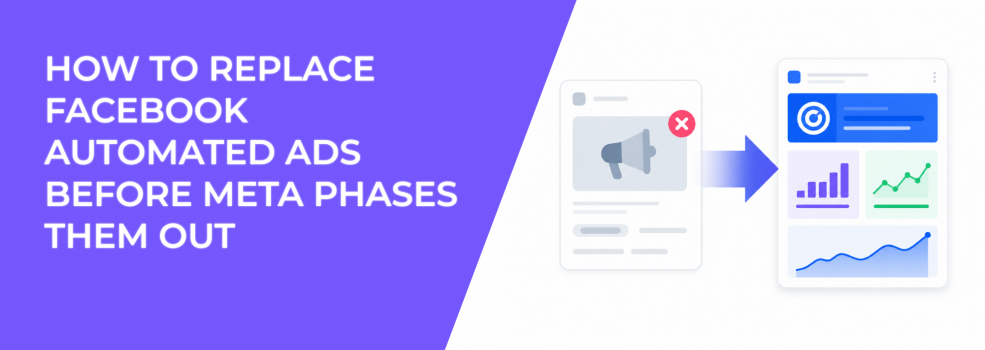
Facebook Automated Ads made campaign setup easier for small businesses. You answered a few questions, added a budget, chose a creative, and Meta handled much of the setup.
But Automated Ads are being phased out in 2026. Some advertisers may lose access earlier, so this is not a feature to build around long term.
The problem is not only losing a simple ad creation flow. Automated Ads also hid many campaign decisions in the background. Once the option disappears, advertisers need to rebuild those decisions inside Ads Manager.
Why replacing Automated Ads is not just recreating the same ad
Many advertisers will try to copy the same image, text, and budget into a manual campaign.
That is not enough.
Automated Ads helped choose the campaign direction, audience setup, placements, and budget flow. If you rebuild the ad without rebuilding that logic, the new campaign can behave differently.
This matters because Meta’s delivery system depends on campaign inputs. If the objective is too broad, Meta may find cheap clicks instead of qualified leads. If the audience is weak, CPC may look fine while CPA gets worse.
A better replacement starts with structure, not creative.
What Automated Ads used to simplify
Automated Ads reduced the number of setup choices. That helped advertisers launch faster, but it also made performance harder to diagnose.
When replacing Automated Ads, rebuild four parts:
- Campaign objective: Choose the action that matches the business goal, such as leads, purchases, messages, or calls.
- Audience direction: Decide whether the campaign should reach broad users, warm users, or a specific high-intent audience.
- Creative inputs: Give Meta clear messages and angles to test. Automation cannot fix an unclear offer.
- Budget controls: Set daily budgets, testing windows, and limits before the campaign starts spending.
This gives you a cleaner version of what Automated Ads handled automatically.
It also makes reporting easier because you can see whether the problem is the audience, creative, offer, or landing page.
Start with the business outcome
Do not start by asking how to recreate the old Automated Ad.
Start with the result you need.
For a service business, the goal may be booked appointments, not just form fills. For e-commerce, the goal may be purchases, not traffic. For B2B, the goal may be qualified demo requests, not cheap leads.
This distinction matters. A campaign can lower CPC and still bring low-intent traffic. A lead campaign can lower CPL and still waste the sales team’s time.
Before replacing Automated Ads, define the metric that actually connects to revenue.
Build a simple Ads Manager replacement
The replacement campaign should be easy to read.
A complicated structure makes early results harder to judge. Too many ad sets and creatives split the budget, slow down learning, and create noisy data.
A simple setup can look like this:
- One campaign with one clear goal.
- One prospecting ad set for new users.
- One retargeting ad set if the audience is large enough.
- Two to four creative angles.
- A fixed testing budget and review window.
This structure gives Meta enough room to learn without hiding what is happening.
If the prospecting ad set gets clicks but no conversions, check the audience, offer, or landing page. If retargeting frequency rises too fast, the audience is probably too small for the budget.
Replace weak audience suggestions with stronger audience inputs
Automated Ads often rely on simplified audience suggestions.
That can work for broad consumer offers. But it is risky for niche products, B2B services, local businesses, or high-ticket offers where intent matters more than reach.
This is where LeadEnforce can help.
LeadEnforce helps advertisers build high-intent audiences from Facebook groups, Instagram followers and engagers. Instead of relying only on broad Meta targeting, advertisers can test audiences built from relevant communities, competitors, influencers, or niche pages.
For example, a B2B advertiser can test a broad ad set against an audience built from relevant Facebook groups. A fitness brand can test followers of specific Instagram accounts. A local service business can build an audience around users connected to local communities.
The point is not to avoid Meta automation. The point is to give Meta better inputs.
That is why campaign inputs matter more than automation. If the audience, offer, and conversion signal are weak, automation only spends against weak inputs faster.
Keep useful automation, but remove blind spots
Replacing Automated Ads does not mean managing every detail manually.
Meta can still automate bidding, placements, budget distribution, and delivery. The issue is not automation itself. The issue is letting automation make every decision without enough control.
You may let Meta test placements, but still choose the right objective. You may use Advantage campaign budget, but still keep the structure clean. You may test broad targeting, but compare it against a more precise custom audience.
A better approach is to define what to automate in Facebook Ads and what should stay under your control.
That balance matters more as Automated Ads disappear.
Watch the first signals after the switch
The new campaign may not perform like the old Automated Ad during the first few days.
That does not always mean the replacement is worse. It may be learning from a different objective, audience, or conversion event.
Do not judge the campaign only by CPC. A higher CPC can still produce a better CPA if the traffic is more qualified. A lower CPL can still be bad if sales rejects most leads.
For lead generation, check lead quality, booked calls, and cost per qualified lead. For e-commerce, check add-to-cart rate, checkout rate, purchase rate, AOV, and ROAS.
This is where Ads Manager gives you more control than Automated Ads. You can see more of the delivery pattern and make better decisions before increasing spend.
Set budget limits before launch
Automated Ads could keep running longer than advertisers expected.
A replacement campaign can create the same issue if it has no clear testing window. The interface changes, but the budget risk stays the same.
Set the review point before launch. For example, run the campaign for seven days, then check cost per qualified lead, conversion rate, and spend distribution.
Meta controls auction delivery, but you still control the objective, budget, audience inputs, creative direction, and decision rules. That is why advertisers need to understand what advertisers still control in Meta Ads.
Those controls become more important once Automated Ads are gone.
Final takeaway
Facebook Automated Ads going away is not just a product update. It forces advertisers to replace a simplified setup with a real campaign structure.
The safest replacement is simple: one clear goal, a readable campaign setup, stronger audience inputs, controlled budgets, and enough automation to let Meta learn.
Do not wait until Automated Ads disappear from your account. Rebuild the campaign logic now, compare results while you still have historical data, and move spend only when the new setup proves it can produce better business outcomes.