Meta’s advertising algorithm is built to optimize toward outcomes. It learns from user interactions, analyzes behavioral patterns, and continuously refines delivery to reach people most likely to convert. However, the system is only as effective as the data it receives.
When conversion signals are weak, sparse, or inconsistent, the algorithm struggles to interpret intent. This leads to inefficient budget allocation, unstable performance, and higher acquisition costs.
What Are Conversion Signals?
Conversion signals are the events that indicate meaningful user actions—such as purchases, sign-ups, or completed forms. These signals act as feedback loops, allowing Meta’s machine learning models to identify patterns among high-value users.
Strong signals share three key characteristics:
-
High volume
-
Consistency over time
-
Clear alignment with business goals
Weak signals, on the other hand, fail to provide enough clarity or data for effective optimization.
Why Weak Signals Disrupt Optimization
1. Insufficient Data Volume
Meta recommends generating at least 50 conversion events per week per ad set to exit the learning phase. Campaigns that fall below this threshold often remain in a perpetual state of learning, leading to volatility.
According to internal benchmarks, ad sets with fewer than 25 weekly conversions experience up to 35% higher cost per acquisition compared to those meeting the recommended threshold.
2. Delayed Feedback Loops
If conversions occur long after the initial interaction—such as in high-consideration purchases—the algorithm receives delayed feedback. This slows down optimization and reduces the system’s ability to identify high-performing audiences.
Data suggests that campaigns with conversion delays longer than 7 days see up to 20% lower efficiency in optimization compared to those with near real-time signals.
3. Signal Noise and Ambiguity
When multiple low-quality events are tracked instead of a single meaningful conversion, the algorithm receives mixed signals. For example, optimizing for "page views" instead of "purchases" introduces ambiguity.
This often results in higher engagement but lower revenue impact.
4. Fragmented Event Tracking
Incomplete tracking setups—such as missing pixel events or improperly configured APIs—lead to gaps in data. With signal loss becoming more common due to privacy restrictions, even small inconsistencies can significantly affect performance.
Industry estimates show that signal loss can reach up to 30% without proper tracking infrastructure.
The Learning Phase Problem
Weak signals keep campaigns stuck in the learning phase. During this stage, performance is inherently unstable as the algorithm tests different audience segments and delivery strategies.
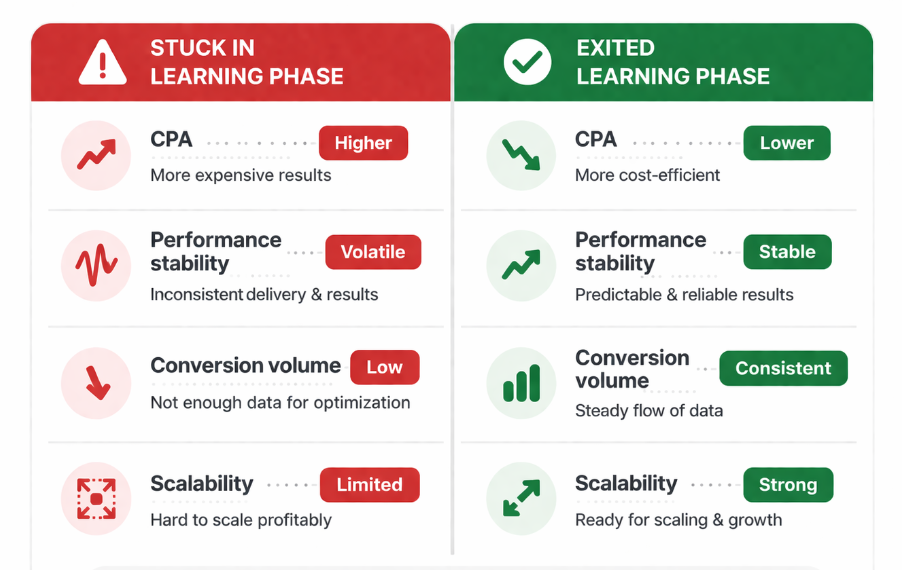
Campaign performance improves significantly once sufficient conversion data allows the algorithm to exit the learning phase
Without sufficient signal strength, campaigns may:
-
Reset learning frequently
-
Fail to scale
-
Deliver inconsistent results
Research indicates that campaigns exiting the learning phase achieve up to 25% more stable performance and 20% lower CPA.
How to Strengthen Conversion Signals
Prioritize High-Intent Events
Focus on events that directly correlate with revenue or core business objectives. Avoid optimizing for vanity metrics unless they are part of a broader funnel strategy.
Consolidate Conversion Events
Reducing fragmentation helps the algorithm learn faster. Instead of optimizing across multiple micro-events, concentrate on fewer, high-value signals.
Improve Tracking Infrastructure
Ensure accurate implementation of tracking tools, including server-side integrations where possible. This minimizes signal loss and improves data reliability.
Shorten the Conversion Window
Where feasible, design funnels that reduce time between click and conversion. Faster feedback enables quicker optimization cycles.
The Cost of Ignoring Signal Quality
Weak conversion signals do not just slow down performance—they actively increase costs. Campaigns with poor signal quality often require more spend to achieve the same results, making scaling inefficient.
In competitive markets, even a 10–15% increase in CPA can significantly impact profitability.
Recommended Reading
Conclusion
Meta’s optimization algorithm depends entirely on the quality of conversion signals it receives. Weak, inconsistent, or delayed signals create confusion, leading to inefficient delivery and higher costs.
By strengthening signal quality—through better tracking, clearer objectives, and faster feedback loops—advertisers can unlock more stable performance and scalable growth.