Your CPM was stable yesterday. Today it is much higher. Nothing dramatic changed, yet your costs jumped.
This happens often in Meta campaigns. A CPM spike usually signals a shift in auction dynamics or ad quality. Most spikes have clear and fixable causes.
What a CPM Spike Really Means
CPM reflects how expensive it is to win impressions in the auction. When it rises, Meta predicts lower value in showing your ad. That prediction depends on engagement, audience quality, and competition.
If engagement drops, CPM rises. If your audience becomes less predictable, CPM rises. If more advertisers compete for the same users, CPM rises.
For a deeper breakdown of auction mechanics, read what influences CPM on Facebook ads and how to keep it low.
The Most Common Reasons CPM Suddenly Increases
Audience Became Less Focused
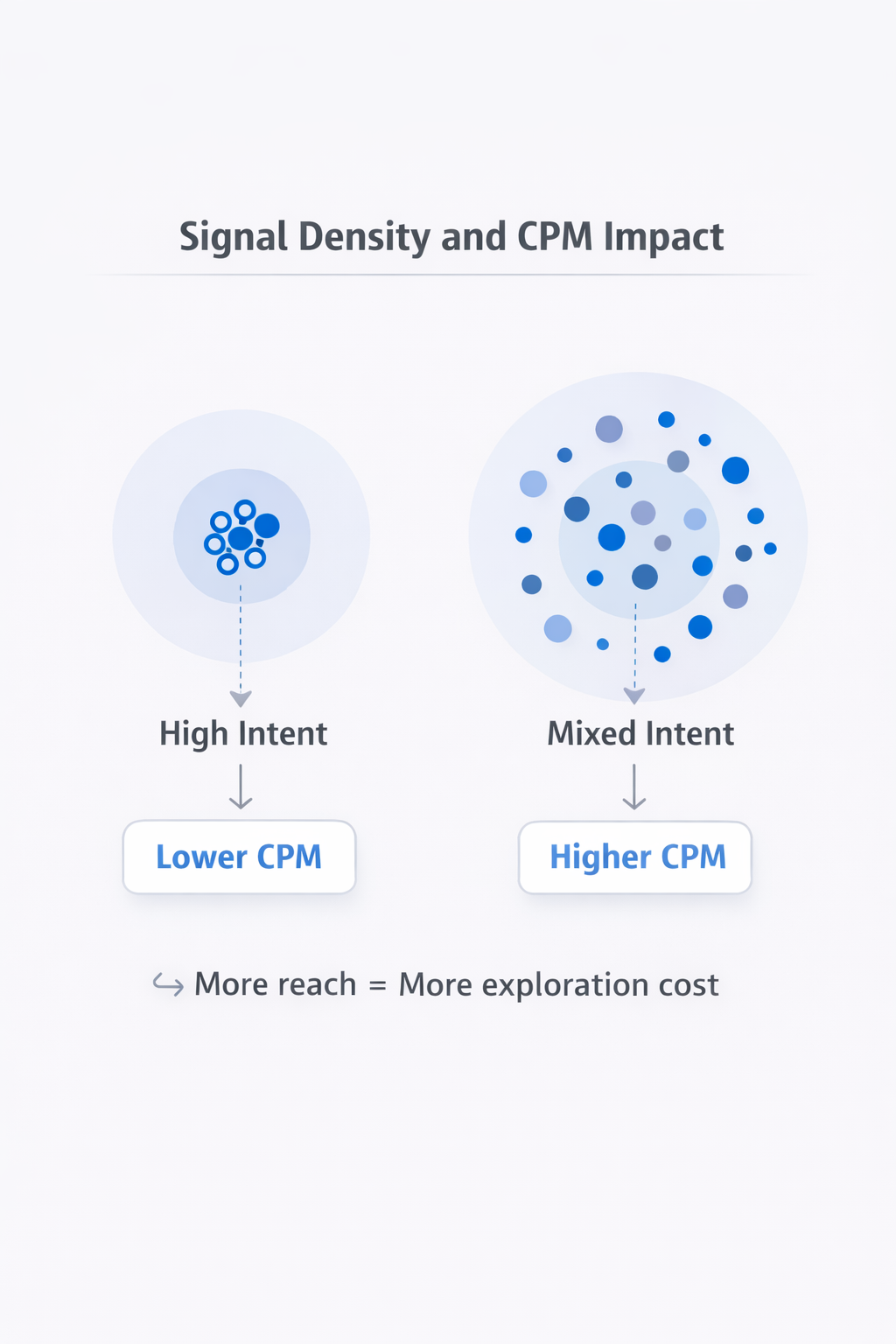
Meta works best with clear intent signals. When targeting gets broader, the system needs more exploration. Exploration costs money.
This often happens when:
-
You turn on audience expansion; for example, a fitness brand broadens from gym enthusiasts to general health interests, which weakens buying intent.
-
You switch from retargeting to broad targeting; a SaaS company replaces website visitors with open interest targeting, losing warm signals.
-
You stack too many interests; an ecommerce store combines five related interests, creating a mixed and unclear audience.
If you suspect targeting issues, review your setup using this guide to Facebook audience targeting best practices.
A diluted audience forces the algorithm to test more users. Testing increases CPM.
Creative Stopped Getting Attention
Engagement directly affects auction price. If people stop clicking or watching, Meta predicts weaker results. Weaker results increase your cost per impression.
Look for:
-
Rising frequency; a local service ad shows the same static image to a small audience four times in one week.
-
Falling CTR; an ecommerce carousel drops from 1.5 percent CTR to 0.8 percent in ten days.
-
Weak hooks; a video starts with a slow logo animation instead of a strong problem statement.
If this sounds familiar, study the early signs of ad fatigue and how to avoid it .
Creative fatigue is one of the fastest ways to raise CPM.
Competition Increased
Sometimes the issue is external. More advertisers enter the auction, and prices rise.
This often happens during:
-
Seasonal sales periods; many ecommerce brands double budgets during Black Friday.
-
Industry launches; multiple online courses open enrollment in the same week.
-
Local events; several real estate agents advertise heavily before a housing expo.
If your niche is crowded, explore practical tactics in this article on Facebook ads in competitive niches and what breaks first.
You cannot control competition. You can adjust how you compete.
You Reset the Learning Phase
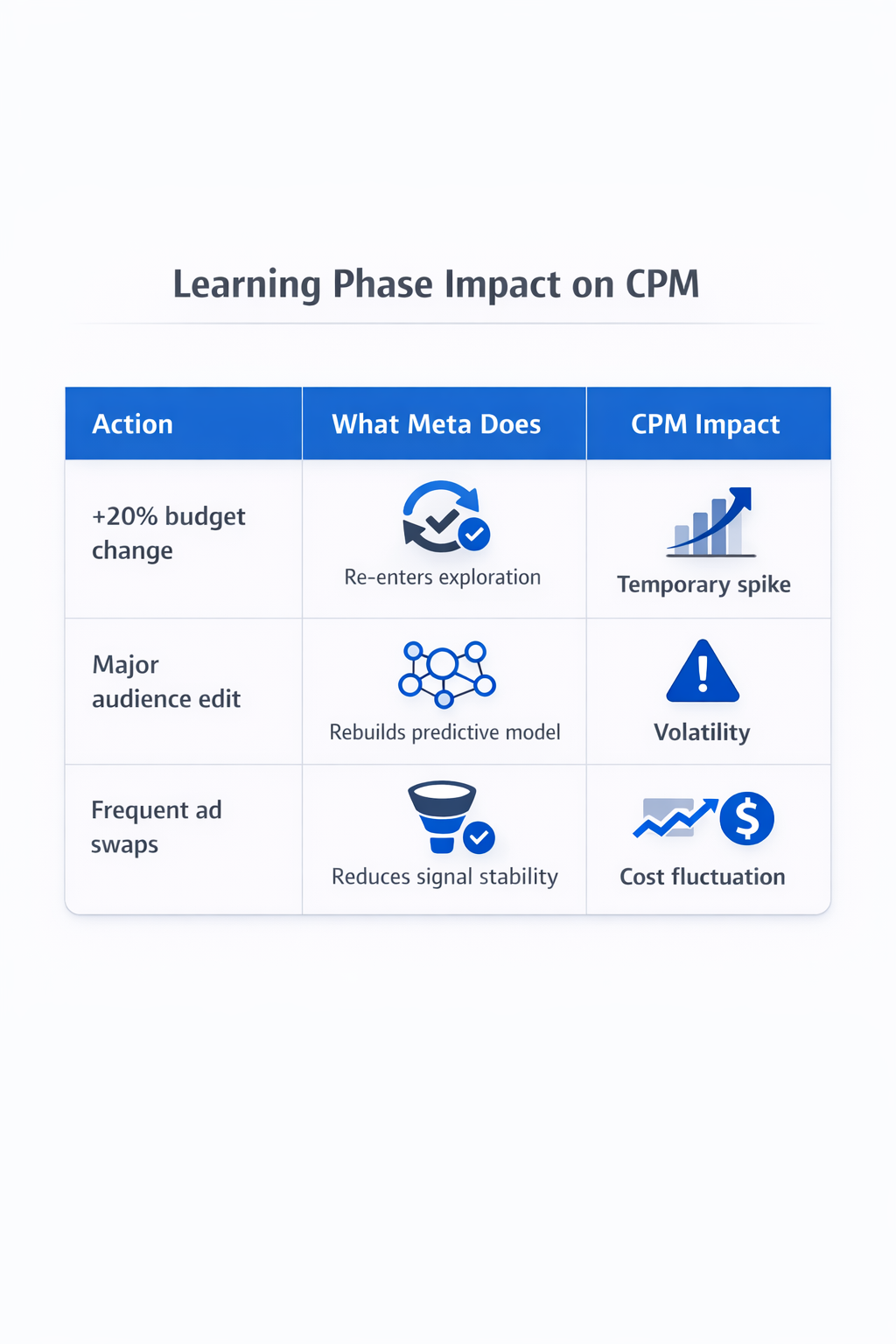
Large edits can destabilize delivery. When learning restarts, Meta explores again. Exploration increases CPM temporarily.
Common triggers include:
-
Budget changes above twenty percent; for example, raising daily spend from $50 to $100 overnight.
-
Major audience edits; replacing one interest set with a completely new targeting structure.
-
Frequent ad replacements; uploading three new creatives every two days inside one ad set.
Before making structural changes, review how the Facebook Ads learning phase works and how to use it to your advantage.
Constant changes create instability. Instability raises cost.
How to Lower CPM Fast
Step 1: Tighten Your Audience
Start with targeting. Ask whether your audience is still clear and high intent.
Actions you can take:
-
Turn off expansion and compare results for three days; watch CPM and CTR side by side.
-
Reintroduce warm audiences; for example, create a campaign only for users who visited your pricing page in the last fourteen days.
-
Simplify interest targeting; instead of five layered interests, test one strong core interest in a separate ad set.
Clear intent lowers uncertainty. Lower uncertainty reduces CPM.
Step 2: Refresh the Creative Properly
Changing small design elements rarely helps. You need a new angle.
Focus on:
-
A stronger opening; start a video with a bold statement such as “Still paying too much for leads?” instead of a brand intro.
-
Clearer problem statements; instead of “Improve your workflow,” say “Stop losing hours on manual reporting.”
-
Different formats; if static images dominate, test a short vertical video optimized for Reels.
Higher engagement improves your auction ranking. Better ranking lowers impression cost.
Step 3: Find Expensive Segments
Break down CPM by placement, age, and location. Spikes often come from one weak segment.
Check for:
-
Reels placements with low engagement; if CPM is 40 percent higher than feed, test creative made specifically for vertical viewing.
-
Older age groups with poor CTR; if users 55+ click half as often, separate them into their own ad set.
-
Specific regions with higher CPM; if one city costs twice as much, consider isolating it.
Separate expensive segments into their own ad sets. Control them instead of letting them inflate the whole campaign.
Step 4: Stop Over-Editing
If you changed many settings recently, pause. Let the system stabilize.
Keep budgets steady for several days. For example, avoid daily increases from $80 to $120 and back to $90. Avoid constant creative swaps unless performance clearly collapses.
Stable delivery usually lowers CPM after a short adjustment period.
When a High CPM Is Not a Real Problem
Sometimes CPM rises while revenue improves. If conversion rate or order value increases, higher CPM may be acceptable.
For example, if CPM rises from $12 to $16 but cost per purchase stays stable, the campaign may still be efficient. Always compare CPM with cost per acquisition and revenue per thousand impressions.
CPM is only one metric. Context defines whether it is a real issue.
Quick Diagnostic Checklist
If your CPM suddenly spikes, review this list:
-
Did you expand or change your audience recently?
-
Has CTR declined in the past seven days?
-
Did you make large budget edits?
-
Is frequency above three in a small audience?
-
Is there seasonal competition in your industry?
CPM spikes rarely happen without a reason. Focus on audience clarity, strong creative, and stable delivery. When those elements align, costs usually normalize fast.