Many advertisers eventually encounter a frustrating situation.
You review your campaign setup, and the targeting appears completely logical. Interests match the product category, demographics look reasonable, and the audience size seems large enough for delivery.
Yet the campaign still produces weak conversions or unstable costs.
In most cases, the issue is not that the targeting is incorrect. The real problem is that the audience definition fails to generate clear behavioral signals for Meta’s delivery system. Without those signals, the algorithm struggles to identify which users actually resemble buyers.
Understanding this gap requires looking at how Meta’s optimization process works in practice.
Meta Optimizes for Behavioral Patterns — Not Interests
Interest targeting mainly determines where the campaign starts delivering impressions. After that, Meta relies heavily on behavioral signals generated during the campaign.
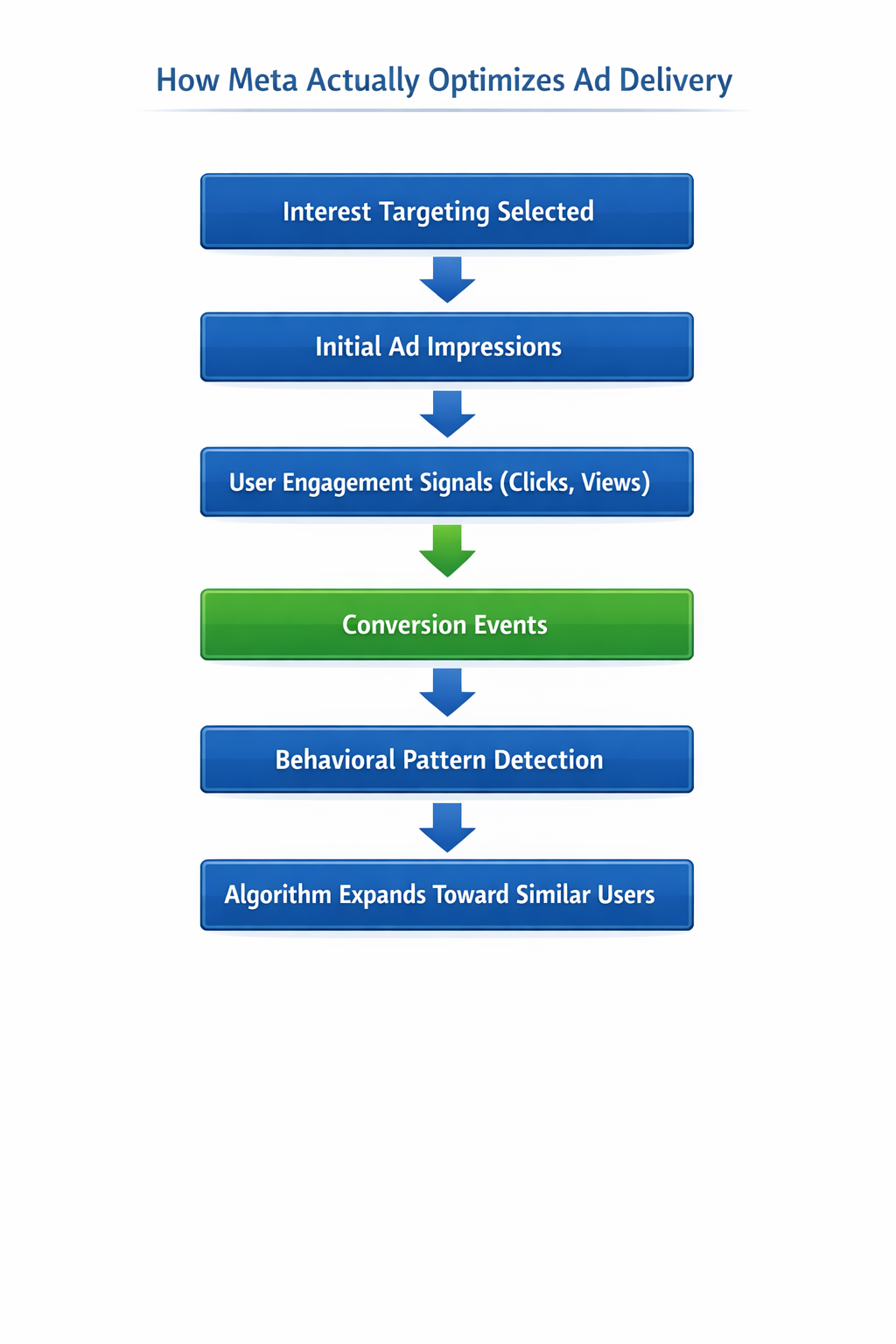
In practice, the optimization cycle usually unfolds in several stages.
-
The campaign begins delivering ads within the selected targeting pool.
Interests, demographics, or broad targeting determine which users are initially eligible to see the ads. -
Meta observes early engagement signals from those users.
The platform records interactions such as clicks, video views, and landing page visits. -
Conversion events appear among a subset of users.
Purchases, leads, or other optimization events indicate which profiles resemble potential buyers. -
The algorithm identifies behavioral similarities among converters.
It analyzes patterns such as device usage, browsing habits, engagement history, and previous ad interactions. -
Future delivery shifts toward users who resemble those converters.
Meta increasingly allocates impressions to profiles that share characteristics with early buyers.
The important detail is that optimization happens around conversion behavior, not around the interests chosen during campaign setup.
If early signals are scattered across unrelated audience segments, the algorithm cannot identify a stable pattern. Performance begins to fluctuate because the system continues testing new users.
If you want a deeper explanation of how Meta structures its audience layers, the article The Ultimate Guide to Facebook Audience Targeting provides a full breakdown of how different targeting types influence delivery.
Interest Targeting Often Captures Curiosity Rather Than Buying Intent
Interest audiences frequently contain people who have shown casual engagement with a topic rather than strong purchase intent.
For example, someone may receive the interest “Digital Marketing” after watching a few short videos or liking a post months earlier. That does not necessarily mean the person is actively researching tools.
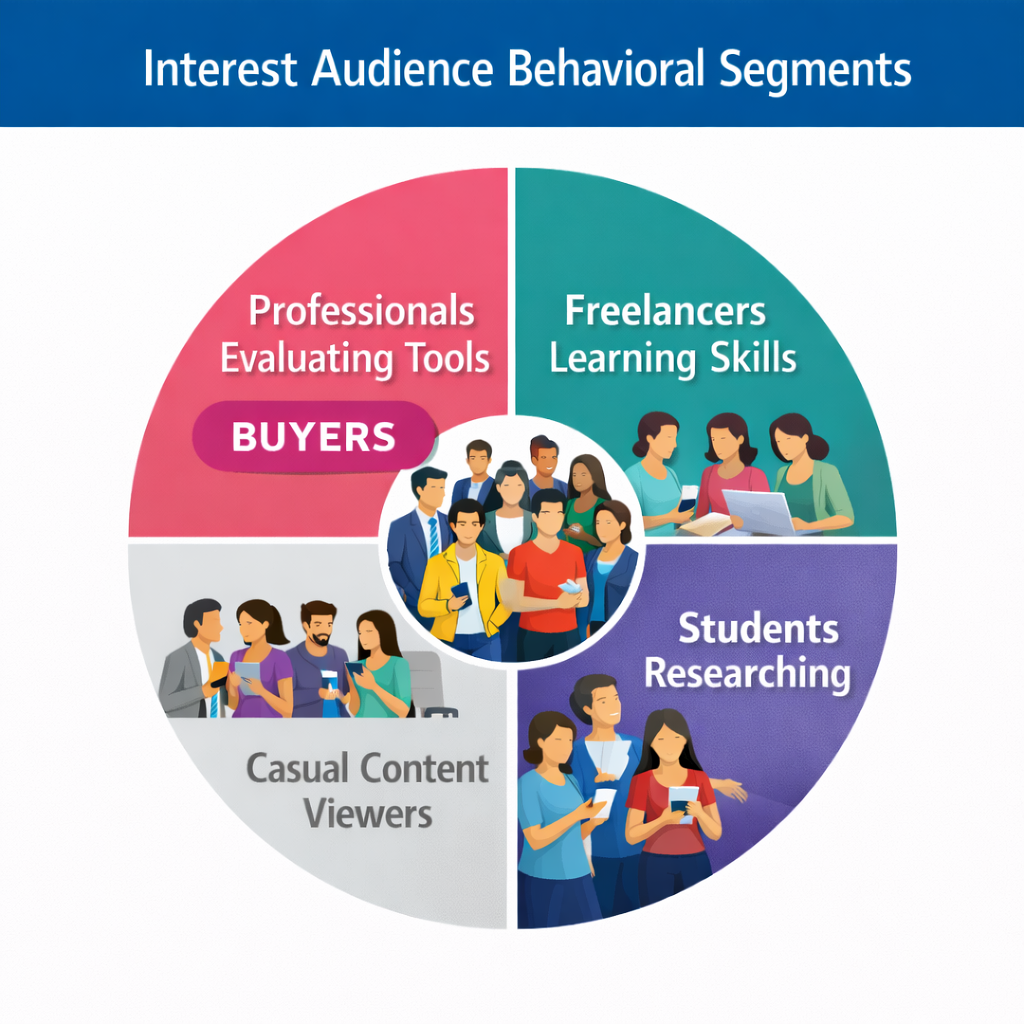
Inside a typical interest audience, you will often find several distinct behavioral groups:
• professionals evaluating tools or services related to the industry;
• freelancers consuming educational content about the topic;
• students learning about the field;
• casual users browsing entertainment content around the subject.
Each of these groups reacts differently to ads.
When impressions reach all of them simultaneously, early engagement signals come from unrelated behavioral clusters. Meta sees clicks from multiple segments but cannot immediately determine which users resemble buyers.
This slows optimization and leads to unstable cost metrics.
Broad Targeting Can Make Signal Quality Worse
Meta frequently recommends broad targeting because it allows the algorithm to explore more of the platform.
This approach can work well when campaigns generate high conversion volume. With enough purchase data, the system can quickly identify patterns and expand toward profitable segments.
However, campaigns with limited conversion data often experience the opposite effect.
Without reliable purchase signals, the algorithm starts prioritizing engagement behavior.
A common delivery pattern looks like this:
-
Early impressions reach users who frequently interact with ads.
-
These users click or watch videos at higher rates than average.
-
Meta identifies similar engagement-heavy profiles across the platform.
-
Delivery expands toward those users.
-
Traffic metrics improve while conversion rates remain weak.
From the advertiser’s perspective, the campaign generates activity but struggles to produce buyers.
This problem commonly appears in campaigns promoting:
• high-ticket products that generate fewer purchase events;
• B2B services with longer buying cycles;
• niche SaaS tools targeting specialized professionals;
• products that require research before a purchase decision.
In these cases, signal quality becomes far more important than audience size.
Communities Often Reveal Stronger Buyer Intent
One layer of targeting that many advertisers overlook is community participation.
In many industries, buying intent develops inside communities long before someone clicks an ad. These communities often take the form of:
• Facebook groups where professionals exchange tools and strategies;
• Instagram accounts followed by enthusiasts of a specific niche;
• creator communities centered around specialized skills or industries.
These environments concentrate people who already share:
• a common problem;
• interest in a specific solution category;
• exposure to related products.
This means behavioral similarity already exists before the campaign begins.
If you want to see how group environments concentrate high-intent audiences, the article Using Facebook Groups to Reach Ready-to-Buy Users explains how these communities often reveal stronger purchase signals.
Why Community Audiences Improve Optimization Signals
Community-based audiences often outperform interest audiences because they reduce behavioral noise.
Several improvements typically appear when campaigns start inside these clusters.
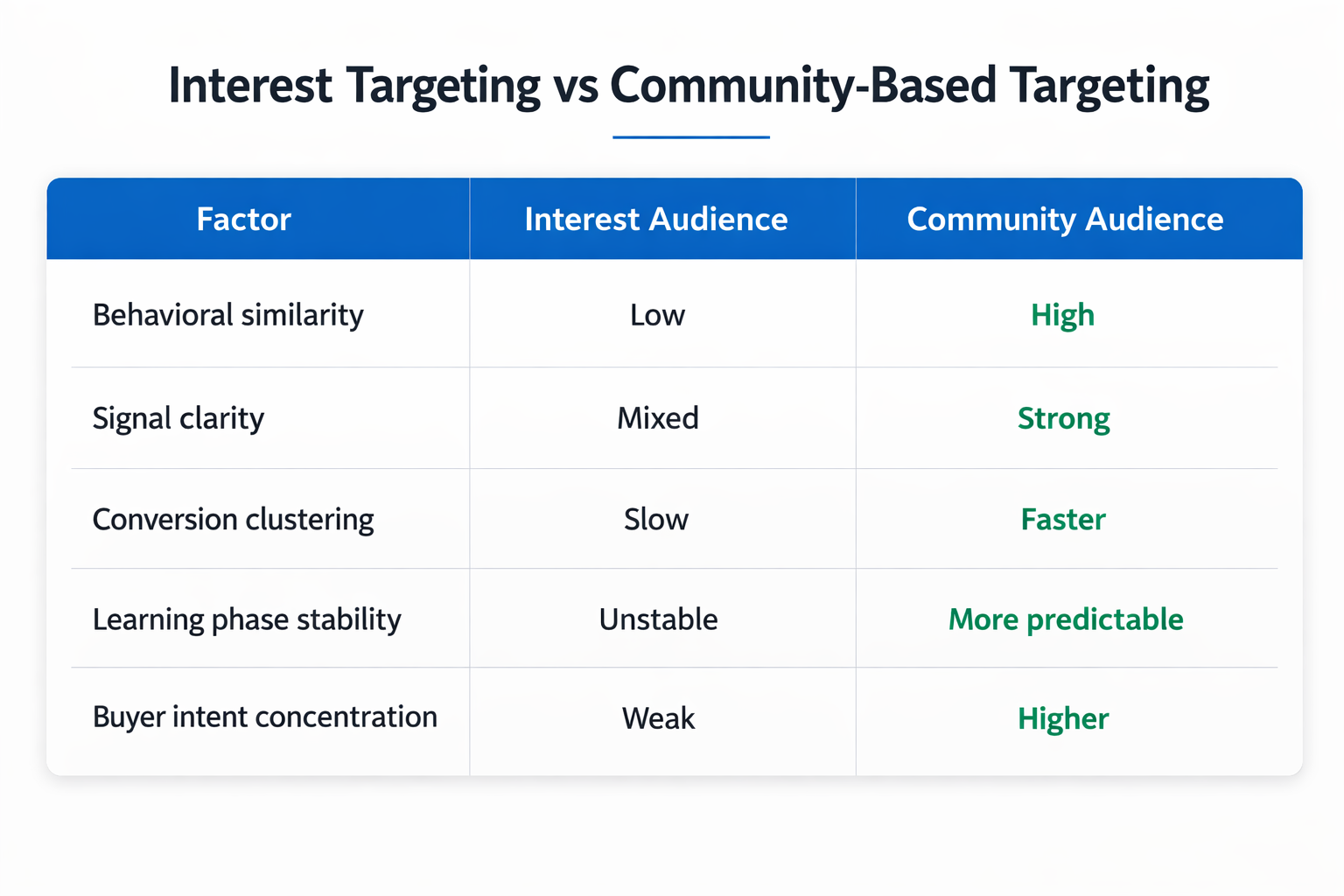
• More consistent engagement behavior.
Users participating in the same community often interact with ads in similar ways because they share the same interests and problems.
• Earlier conversion clustering.
When purchases occur inside a concentrated audience, Meta can identify patterns among buyers more quickly.
• Faster learning stabilization.
Because signals are less fragmented, the delivery system does not need to test as many unrelated audience segments.
These improvements usually translate into more predictable cost-per-acquisition and smoother campaign scaling.
Where LeadEnforce Fits Into This Strategy
One limitation of Meta’s built-in targeting tools is that advertisers cannot directly target many of these communities.
For example, Ads Manager does not normally allow advertisers to reach:
• followers of a specific Instagram account;
• members of a particular Facebook group.
These audiences often represent behaviorally concentrated clusters, where users already engage with similar content or discussions.
Instead of relying on broad interest categories, campaigns can begin inside environments where users already share stronger intent signals.
For example, the guide How to Build Instagram Ad Audiences From Account Followers explains how follower-based audiences can help advertisers reach users already interested in a specific niche.
Practical Use Cases for LeadEnforce
Community-based targeting becomes much easier to understand when viewed through real campaign scenarios.
Targeting Followers of Competitor Brands
Many potential customers already follow competing brands or creators discussing similar products.
With LeadEnforce, advertisers can build audiences composed of followers of those accounts.
For example, a marketing analytics SaaS tool could target followers of well-known marketing educators or competing platforms. These users already consume content related to the problem the product solves.
Because they are familiar with the category, early campaign signals often come from users closer to purchasing.
Reaching Niche Professional Communities
Certain industries organize themselves primarily through Facebook groups.
Examples include communities for:
• SEO professionals sharing algorithm insights and tools;
• ecommerce founders discussing growth strategies;
• real estate agents exchanging local market knowledge.
LeadEnforce allows advertisers to build audiences from members of these groups.
Instead of targeting a broad interest such as “digital marketing,” a campaign can reach professionals already participating in discussions about tools and workflows.
A detailed explanation of this strategy can be found in How to Build Your Target Audience From a Facebook Group.
Launching Products Inside Established Ecosystems
Some products exist within tightly connected ecosystems where users follow specific creators.
Examples include:
• Shopify ecommerce tools;
• photography editing software;
• specialized marketing analytics platforms;
• niche SaaS tools.
People interested in these products often follow influencers who regularly publish educational content about the ecosystem.
By targeting followers of those accounts, campaigns begin inside a community where users already understand the product category.
This increases the likelihood that early engagement signals come from qualified prospects rather than casual browsers.
How to Recognize When Targeting Is the Problem
Before adjusting targeting settings, it helps to examine delivery signals inside Ads Manager.
Certain patterns often indicate that the audience lacks strong buyer intent:
• click-through rates above 2 percent combined with conversion rates below 1 percent;
• large audience sizes but unstable CPA fluctuations;
• conversions appearing inconsistently across days;
• strong engagement metrics without corresponding purchase signals.
When several of these signals appear together, the campaign likely needs a more concentrated audience source, not simply different interest combinations.
A Better Way to Think About Targeting
Many advertisers approach targeting as a process of selecting the correct interests.
In reality, campaign performance depends far more on where the algorithm receives its early behavioral signals.
Interest audiences often contain fragmented behavioral clusters that make optimization difficult. Community-based audiences concentrate users who already share similar interests and intent.
When campaigns begin inside those environments, Meta receives clearer signals, identifies buyer patterns faster, and stabilizes delivery more quickly.
For advertisers whose campaigns look logically targeted but still perform poorly, improving signal quality — rather than endlessly adjusting interest combinations — is often the change that finally produces consistent results.