
Regular ad account audits are essential to uncover waste, fix blind spots, and scale profitable campaigns. But where do you start?
This guide walks you through the first things to check when auditing a Facebook or Instagram ad account. Whether you’re running the account yourself or reviewing someone else’s, these core elements set the foundation for better performance.
Why Ad Account Audits Matter
Without regular reviews, even smart advertisers lose money. Poor structure, outdated targeting, and misaligned creatives are common — and costly.
Audits help you:
-
Cut unnecessary spend and improve ROAS;
-
Find missed opportunities in targeting or creative;
-
Restore campaign stability after performance drops.
A good audit doesn’t need to be overwhelming. Start with the essentials — the parts that affect everything else.
1. Check the Account Structure First
Why Structure Affects Performance
Account structure influences data quality, learning phases, and budget distribution. Bad structure often leads to poor learning, internal competition, and inconsistent results.
Over time, even high-performing accounts can slow down due to inefficiencies caused by poor organization. Auditing structure first gives you leverage to fix deeper performance problems.
Poor structure also contributes to long-term chaos. Learn more in The Hidden Costs of a Messy Ad Account.
What to Look For
Consolidation vs. Fragmentation
Too many ad sets? That splits learning and stretches budget thin. Look for duplicate audiences or campaigns targeting the same group. Consolidating similar ad sets can lead to faster learning and stronger delivery.
Clear Campaign Objectives
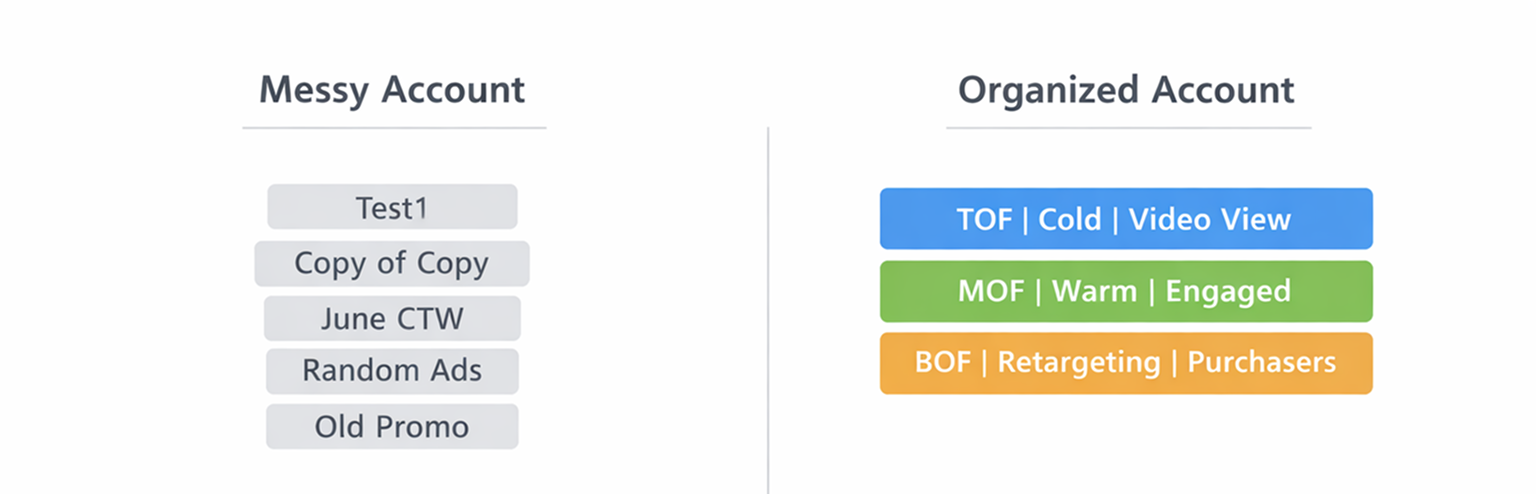
Are campaigns organized by funnel stage — awareness, consideration, and conversion? Avoid mixing goals in a single campaign. Meta’s algorithm performs better with clear signals. Each campaign should have one job — not three.
Naming Conventions
Can you quickly understand what each campaign or ad set is doing? Use consistent, descriptive naming to make audits faster and more useful. Names should include funnel stage, objective, and audience type.
If you manage multiple brands or clients, check out how to stay organized when managing multiple ad accounts.
2. Review Audience Targeting
Why Targeting Can Make or Break a Campaign
Even great creative fails if it reaches the wrong people. Targeting determines who sees your message and whether that audience has any intent to act.
Facebook and Instagram have shifted toward broad targeting, but strategy still matters. You need to balance automation with insight into your buyer’s journey.
To go deeper, read how to map the customer journey before launching ad campaigns.
What to Look For
Over-Segmentation
Are you using too many small audiences? Facebook’s algorithm works best with broader pools. Smaller segments slow learning and lead to higher CPMs.
Outdated Interest Stacks
Many interests lose accuracy over time. Retest assumptions. For example, “online shopping” may no longer signal purchase intent — test more behavior-based options. Try lookalikes based on high-quality events like purchases or high-value leads.
Lack of Exclusions
If you're not excluding recent buyers or overlapping ad sets, you’re likely paying for redundant impressions. Always exclude people who’ve already taken your core action.
Missing Retargeting Layers
Do you have layered retargeting — not just “visited site,” but intent-based layers like video viewers or cart abandoners?
Proper layering reduces waste and improves message matching across the funnel. To identify your highest-value segments, review the behavioral patterns that predict high-value customers.
3. Evaluate Ad Creative and Copy
Why Creative Drives Results in Modern Campaigns
On Facebook and Instagram, creative is a major performance driver. It’s what stops the scroll, communicates value, and earns the click.
If your ads aren’t converting, start by looking here. Great creative also signals relevance to Meta’s delivery algorithm, lowering costs over time.
What to Look For
Ad Fatigue
Are you showing the same ad for months? High frequency and declining CTRs suggest it's time to refresh.
Even strong creatives wear out — rotate every few weeks or run fatigue-resistant UGC.
Misaligned Messaging
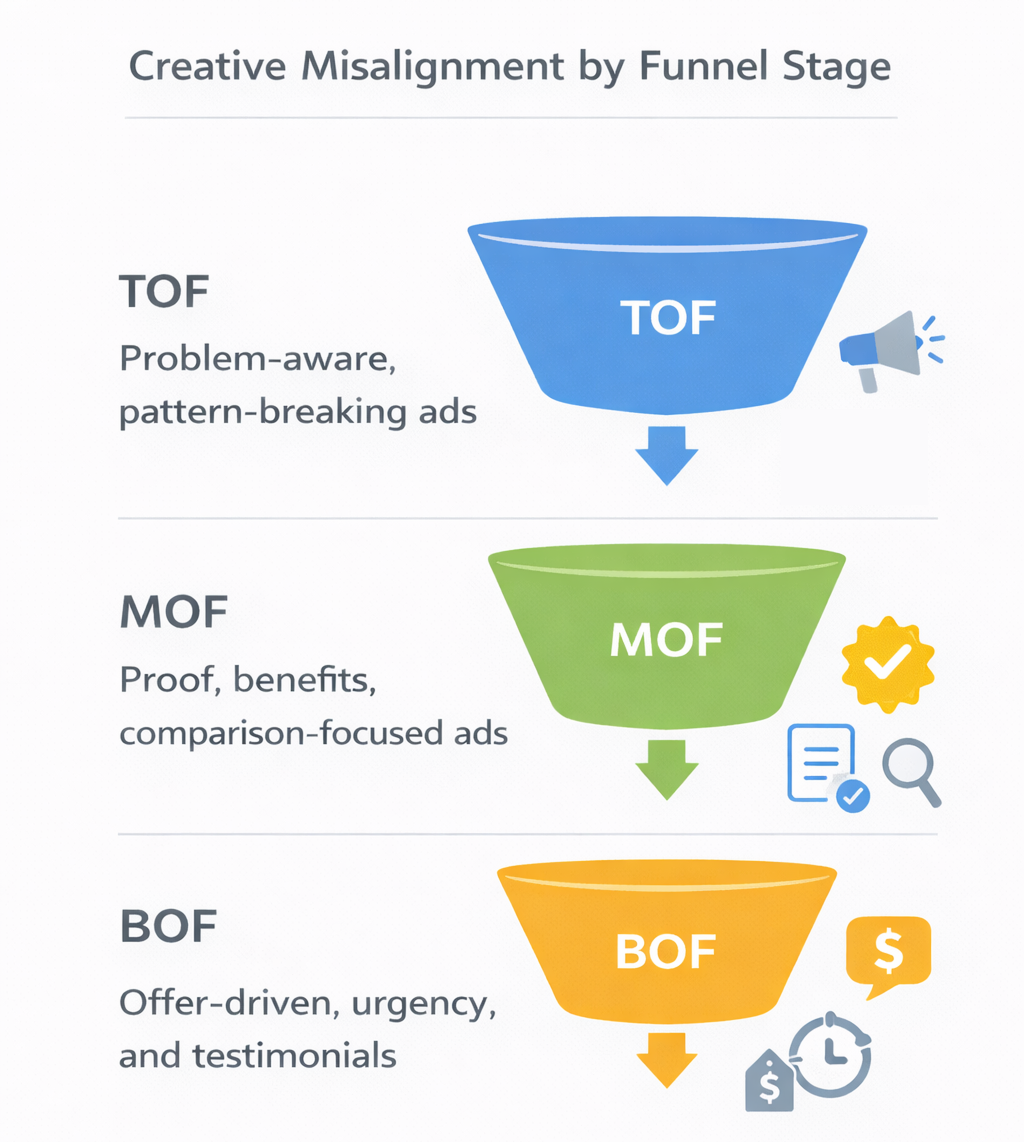
Does your creative match the audience's awareness level? For cold traffic, use problem-first messaging; for warm audiences, highlight proof and offers. Messaging mismatch is one of the top reasons ads get clicks but not conversions.
Format Variety
Are you testing different creative formats — image, video, carousel, UGC-style? Diverse formats reach users in different browsing modes and improve delivery. For example, short video hooks perform better in Reels and Stories placements.
4. Review Budget Allocation
Why Budgets Need to Match Campaign Goals
Even with the right setup, poor budget distribution limits results. You could be over-funding campaigns that don’t convert — or starving the ones that do.
A smart audit ensures your budget supports both acquisition and conversion. It also helps you identify opportunities to scale without increasing total spend.
What to Look For
Overspending on TOF
Top-of-funnel (TOF) gets the budget, but does it lead to conversion? Ensure enough is allocated to middle- and bottom-funnel campaigns for follow-through.
High-Cost Experiments
Are you testing new creatives with large budgets? Start small and scale what works. Use learning-phase-friendly budgets that don't waste spend.
No Daily Monitoring
Budget drift happens. Ad sets get stuck or overspend if no one checks regularly. Use rules or dashboards to flag issues early.
5. Inspect Key Metrics Beyond CPA
Why CPA Alone Is Not Enough
Cost per acquisition (CPA) is a common benchmark — but it's only part of the story. CPA tells you how much you're paying to acquire leads or customers, not whether they’re valuable.
If you focus only on CPA, you might optimize for cheap leads that never convert. A complete audit looks at quality, intent, and long-term impact.
Here’s what to check beyond CPA:
-
Lead-to-Customer Conversion Rate: Are your leads turning into actual buyers? If not, revisit your lead magnets or targeting.
-
Revenue per Lead or Purchase: Are certain campaigns driving high-value customers? Track lifetime value where possible.
-
Click Quality: Look at bounce rate, time on site, and actions taken after the click.
-
Consistency Across Audiences: Does one audience show strong ROI while others drag the average down?
For revenue-focused optimization, explore the buyer journey triggers that predict larger orders.
6. Assess Tracking and Attribution
Why You Need Trustworthy Data
If your tracking is broken, your optimization is blind. Meta relies on accurate events to deliver and report on your campaigns.
You should audit both technical setup and attribution logic regularly. Even small errors here can create misleading performance trends.
Accounts with broken tracking often get flagged or underdeliver. Read why Facebook ad accounts get disabled — and how to fix it to stay compliant.
What to Look For
Pixel Health
Is your Meta Pixel firing correctly on key actions — page views, leads, purchases?
Use the Meta Pixel Helper or Events Manager to check. Look for missing or duplicate events.
Event Prioritization
Is your Aggregated Event Measurement set up with the right order of importance? Post-iOS14, this affects delivery and reporting.
Prioritize purchase or lead events higher than content views or page visits.
UTM Hygiene
Are your UTMs tracking cleanly across campaigns? Poor UTM structure can make it impossible to tie ads to actual revenue.
Standardize your UTM structure and test it regularly.
Final Thoughts: Audit Before You Scale
Ad account audits are not just for when things go wrong. They’re a proactive tool for advertisers who want to grow smarter, not just spend more. By checking the fundamentals, you build a more stable, scalable system.
Start by reviewing structure, targeting, creative, budgets, metrics, and tracking. Fixing even one weak link can unlock stronger results across the entire funnel.
