Many marketers still approach offer testing by cloning funnels, rewriting pages, or launching entirely new campaigns. This method is slow, expensive, and introduces too many variables at once.
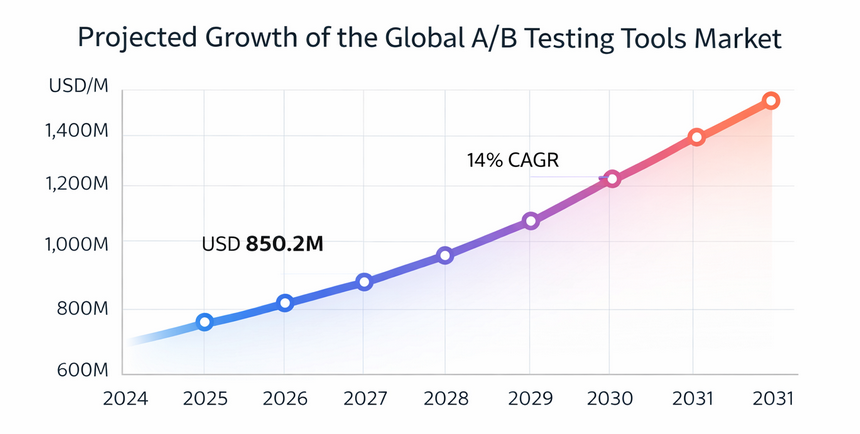
Projected growth of the global A/B testing tools market — reaching USD 850.2M in 2024 and growing at a 14% CAGR through 2031
According to industry benchmarks, 60–70% of funnel experiments fail to produce actionable insights because too many elements are changed simultaneously. When copy, audience, pricing, and creative are all modified at once, it becomes nearly impossible to isolate what actually drove the result.
The goal of effective testing is clarity, not complexity.
What You Should (and Shouldn’t) Change When Testing Offers
When testing offers, the most reliable results come from controlling everything except the offer itself.
Keep these elements stable:
-
Funnel structure and steps
-
Page layout and design
-
Traffic source and campaign objective
-
Tracking events and attribution setup
Change only:
-
Pricing or payment structure
-
Bonuses or add-ons
-
Core value proposition
-
Positioning angle (e.g., speed vs. depth, beginner vs. advanced)
This controlled approach can reduce test noise by up to 40%, making performance differences statistically meaningful much faster.
Use Audience Segmentation Instead of Funnel Duplication
Rather than duplicating funnels, segment traffic at the audience level.
Running the same funnel against different, tightly defined audiences allows you to test offers under consistent conditions. This approach delivers cleaner comparisons and reduces setup time significantly.
Data from large-scale ad accounts shows that segmented audience testing reaches confidence thresholds 28–35% faster than funnel-level A/B tests, primarily because fewer variables are introduced.
Test Offers with Entry-Point Variations
Another efficient method is testing offers through entry-point messaging while keeping downstream funnel steps unchanged.
Examples include:
-
Different ad angles leading to the same landing page
-
Alternate headlines that frame the same core solution differently
-
Distinct problem-aware vs. solution-aware messaging
If the offer resonates, you’ll see improvements in:
-
Click-through rate (CTR)
-
Cost per click (CPC)
-
First conversion event (lead or add-to-cart)
On average, winning offer angles increase CTR by 20–45% without any need to rebuild pages or automation.
Measure the Right Metrics for Offer Validation
Offer testing isn’t about vanity metrics. Focus on indicators that reflect real buying intent.
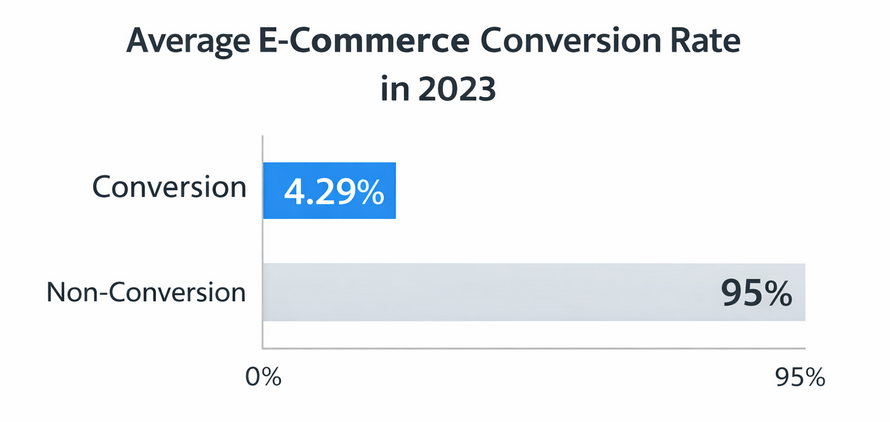
Average e-commerce conversion rate in 2023 was ~4.29%, highlighting the challenge of capturing buyer actions without optimization
Key metrics to track:
-
Conversion rate to the first monetized action
-
Cost per qualified lead
-
Average order value (AOV)
-
Funnel completion rate
In e-commerce and info-product funnels, a validated offer typically improves AOV by 10–25% before any major scaling occurs.
Avoid over-optimizing early engagement metrics if they don’t translate into downstream revenue.
Scale Only After You Validate
One of the most common mistakes is scaling traffic before the offer is proven.
A simple rule:
-
Validate the offer at low, controlled spend
-
Confirm consistent performance across at least two audience segments
-
Only then increase budget or expand reach
Marketers who follow this sequence report 30% lower cost per acquisition during scale phases compared to those who optimize funnel structure first.
Final Thoughts
Testing offers doesn’t require rebuilding funnels, redesigning pages, or starting from scratch. By isolating variables, segmenting audiences, and focusing on the offer itself, you can get reliable insights faster and with far less risk.
The most successful marketers don’t test more — they test smarter.
Recommended Articles
If you found this helpful, you may also want to read: