Modern B2B marketing operates in an environment defined by data abundance and attention scarcity. According to industry benchmarks, more than 70% of the buyer’s journey is completed before direct contact with sales, and over 60% of marketers report that improving audience quality is their primary performance lever. In this context, broad targeting is inefficient and expensive.
Audience layering is the structured combination of multiple data dimensions to create narrowly defined, high-intent segments. Rather than targeting "marketing managers in SaaS," advanced layering might focus on "VP-level marketing leaders in Series B SaaS companies (50–200 employees) using HubSpot and actively researching ABM solutions within the past 30 days." The difference in performance between these two segments can be dramatic.
This article breaks down advanced audience layering methodologies, practical frameworks, and measurable optimization strategies.
1. The Core Dimensions of Audience Layering
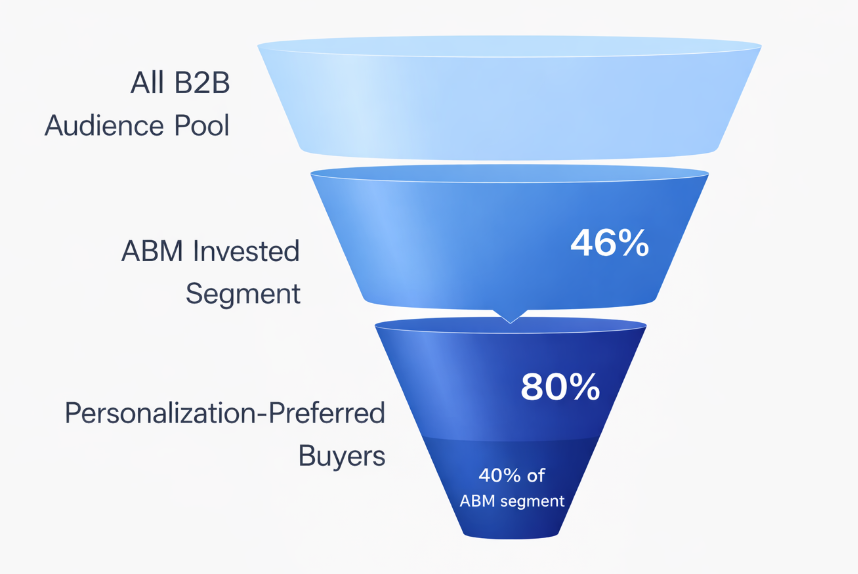
Funnel showing the relationship between total B2B audience, the segment investing in ABM, and the majority who prefer personalized experiences
Advanced layering is built on five primary data categories:
1.1 Firmographic Filters
Firmographics define the structural profile of a company:
-
Industry classification (NAICS/SIC)
-
Employee count
-
Annual revenue
-
Funding stage
-
Geographic location
Refining these parameters alone can reduce wasted impressions by 30–50% in B2B campaigns.
1.2 Role and Seniority Segmentation
Layering by job function and seniority ensures message alignment. For example:
-
C-level executives respond to strategic ROI messaging.
-
Directors prioritize operational efficiency.
-
Managers focus on tactical implementation.
Campaign data consistently shows 20–35% higher engagement when messaging aligns with seniority-specific pain points.
1.3 Technographic Data
Technographics identify technology stacks and software usage. This enables:
-
Competitive displacement campaigns
-
Integration-driven positioning
-
Maturity-based targeting
For example, targeting companies using legacy CRM systems while excluding modern, enterprise-grade solutions increases message relevance.
1.4 Behavioral and Engagement Signals
Behavioral layering includes:
-
Website visits
-
Content downloads
-
Webinar attendance
-
Platform engagement
Retargeting layered audiences can improve conversion rates by 2–3x compared to cold segments.
1.5 Intent Data
Intent signals capture active research behavior across digital channels. Organizations leveraging intent data report up to 40% higher opportunity conversion rates compared to those relying solely on static filters.
2. Progressive Layering Framework
Advanced segmentation should follow a structured build sequence rather than stacking filters randomly.
Step 1: Define the Ideal Customer Profile (ICP)
Clarify revenue contribution, retention rates, deal velocity, and expansion potential of existing customers. Use this to anchor your base layer.
Step 2: Apply Exclusion Layers
Remove:
-
Existing customers
-
Irrelevant industries
-
Companies below revenue thresholds
-
Non-decision-making roles
Exclusion discipline often improves budget efficiency by 15–25%.
Step 3: Add Intent and Behavioral Amplifiers
Once the core segment is defined, layer in high-intent behaviors. This elevates a "qualified" audience into a "ready-to-engage" audience.
Step 4: Micro-Segment by Messaging Variant
Create sub-layers tailored to:
-
Industry-specific use cases
-
Tech stack compatibility
-
Company growth stage
This structured approach prevents over-segmentation while maintaining precision.
3. Avoiding Over-Layering and Audience Fragmentation
While precision is critical, over-layering reduces reach and harms campaign stability.
Indicators of over-layering:
-
Audience size below platform delivery thresholds
-
High CPM with low frequency
-
Data sparsity leading to unstable optimization
Best practice suggests maintaining audience pools large enough to generate at least 50 conversions per optimization cycle to sustain algorithmic learning.
4. Performance Impact of Advanced Layering
Well-executed audience layering influences core metrics:
-
25–45% reduction in cost per qualified lead
-
30%+ increase in meeting booking rates
-
Shorter sales cycles due to improved fit
-
Higher average contract value through ICP alignment
When layered audiences are aligned with tailored messaging and sequential retargeting, full-funnel efficiency improves measurably.
5. Strategic Layer Combinations That Drive Results
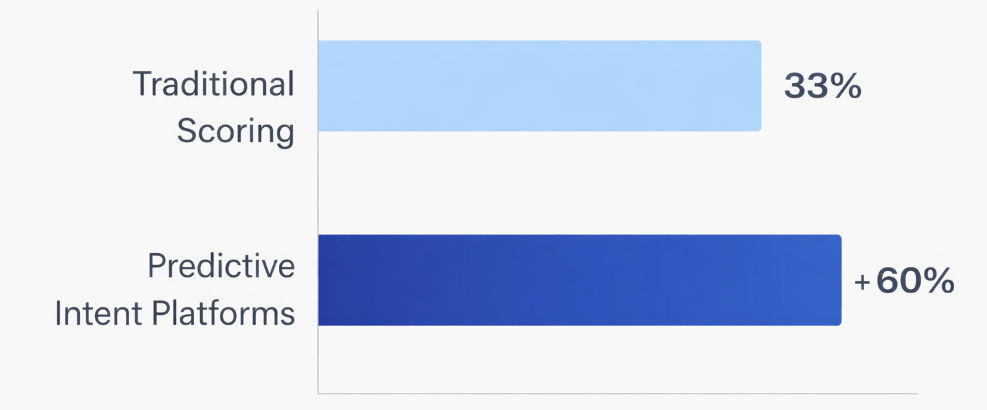
Predictive intent scoring improves the accuracy of identifying conversion-ready accounts by up to 60% compared to traditional methods
Below are high-performing examples of advanced combinations:
Combination A: Growth-Stage Acceleration
-
Series A–C companies
-
50–300 employees
-
VP+ marketing roles
-
Using mid-tier CRM systems
-
Researching demand generation topics in the last 30 days
Combination B: Competitive Displacement
-
Using competitor platform
-
Director-level operations roles
-
Annual revenue $10M–$100M
-
Recent content engagement with migration-related materials
Combination C: Expansion Revenue Focus
-
Existing engaged accounts
-
Multi-department interaction
-
Active webinar participation
-
High content consumption frequency
These structured combinations outperform generic targeting because they align qualification with timing.
6. Measurement and Iteration
Advanced layering is not static. Continuous optimization requires:
-
Segment-level conversion rate tracking
-
Cost-per-opportunity analysis
-
Closed-won attribution by audience layer
-
Engagement heat mapping
High-performing teams conduct quarterly ICP recalibration based on revenue data rather than campaign metrics alone.
Conclusion
Advanced audience layering transforms targeting from demographic filtering into revenue engineering. By combining firmographic precision, seniority alignment, technographic context, behavioral engagement, and real-time intent, marketing teams create segments that mirror real buying committees.
The most effective strategy is not maximum complexity, but structured precision. Build layered audiences methodically, measure impact rigorously, and refine based on revenue outcomes rather than vanity metrics.
Continue Reading
Precision targeting is a competitive advantage. Layer intelligently, and performance follows.