
In highly specialized B2B markets, scale without precision leads to waste. When total addressable markets are narrow and deal values are high, geo-targeting becomes more than a filtering mechanism — it becomes a strategic growth lever. Advanced geo-targeting enables organizations to align sales territories, compliance constraints, localized demand signals, and industry clusters to drive measurable pipeline impact.
According to industry research, over 70% of B2B buyers expect personalized experiences, and campaigns using geographic segmentation can improve response rates by up to 20–30% compared to non-segmented outreach. For niche B2B segments, the performance gap is often even greater.
Why Geo-Targeting Is Critical in Niche B2B Markets
Niche B2B segments are characterized by:
-
Limited total addressable accounts (TAM)
-
Concentrated industry clusters
-
Regulatory or compliance boundaries
-
Localized supply chains
-
Regional budget cycles
For example, advanced manufacturing suppliers may be concentrated in specific industrial corridors, while fintech startups cluster in major financial hubs. Targeting beyond these concentrations reduces efficiency and inflates customer acquisition cost (CAC).
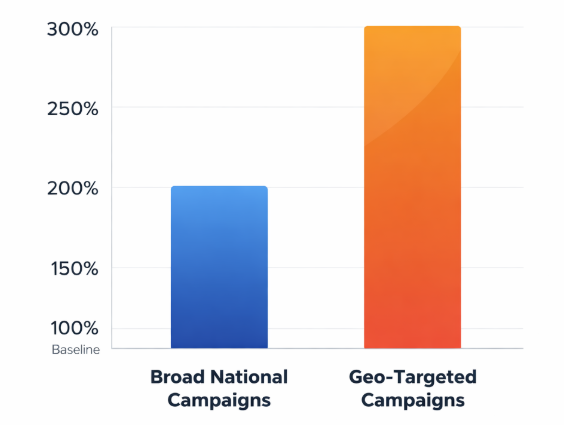
ROI uplift from geo-targeted marketing versus broad national campaigns
Organizations that apply refined geographic segmentation report:
-
15–25% lower CAC
-
10–20% higher meeting-to-opportunity rates
-
Improved sales cycle predictability in defined territories
Layers of Advanced Geo-Targeting
Effective geo-targeting for niche B2B markets operates on multiple layers:
1. Macro-Geographic Segmentation
This includes country, state, or metropolitan-level targeting. At this layer, marketers align campaigns with:
-
Economic activity by region
-
Industry density
-
Regulatory environments
-
Language and localization needs
For instance, targeting enterprise cybersecurity firms in major U.S. tech corridors delivers higher relevance than nationwide outreach.
2. Micro-Geographic Targeting
Micro-targeting narrows focus to:
-
Industrial parks
-
Technology campuses
-
Business districts
-
Specific postal codes
This level is particularly effective in manufacturing, logistics, biotech, and energy sectors where facilities are geographically clustered.
3. Geo-Behavioral Overlay
Advanced segmentation integrates geographic data with behavioral signals such as:
-
Hiring activity
-
Technology adoption
-
Expansion into new offices
-
Regional funding events
Combining these signals can increase lead qualification accuracy by up to 35% compared to geography alone.
Data Infrastructure Requirements
Advanced geo-targeting depends on structured, accurate, and frequently updated data. Core components include:
-
Verified company location data (HQ and branch-level)
-
Regional firmographic enrichment
-
Territory alignment with CRM systems
-
Dynamic suppression of out-of-scope geographies
-
Real-time account segmentation updates
Without clean data governance, geographic segmentation can produce false positives and territory conflicts between marketing and sales.
Aligning Geo-Targeting with Sales Territories
One of the most overlooked aspects of geo-targeting is operational alignment. Marketing campaigns must reflect:
-
Sales rep territory assignments
-
Regional quotas
-
Local partner ecosystems
-
Time zone-based engagement windows
When geo-targeted campaigns mirror sales structure, organizations see up to 18% improvement in opportunity acceptance rates. Misalignment, by contrast, often results in lead rejection or delayed follow-up.
Use Cases by Industry
Advanced Manufacturing
Target by industrial clusters, port proximity, or supply chain hubs. Micro-geographic precision reduces irrelevant outreach and improves facility-level targeting.
Healthcare Technology
Segment by state-level regulatory environments and hospital system density. Local compliance differences directly impact messaging strategy.
Financial Services Infrastructure
Focus on metropolitan financial centers and regions with high fintech concentration. Regional investment activity can serve as a strong overlay signal.
Energy and Utilities
Target by energy basins, renewable project zones, or regulated service territories. Geographic segmentation significantly impacts procurement cycles.
Measuring Performance
To evaluate advanced geo-targeting performance, track:
-
Meeting rate by region
-
Opportunity creation rate by territory
-
Pipeline velocity by geographic segment
-
Revenue per targeted region
-
CAC by micro-market
High-performing teams conduct quarterly geographic performance audits to refine targeting boundaries.
Common Mistakes
-
Overly broad regional segmentation
-
Ignoring branch locations and focusing only on headquarters
-
Failing to update geographic data regularly
-
Not aligning campaigns with territory ownership
-
Overlooking regional economic shifts
Avoiding these pitfalls preserves targeting accuracy and prevents wasted spend.
Strategic Implementation Framework
-
Define high-density geographic clusters within TAM.
-
Overlay firmographic and behavioral filters.
-
Map territories to CRM and outreach systems.
-
Launch segmented campaigns with localized messaging.
-
Measure performance by region and iterate quarterly.
Organizations that follow a structured geo-targeting framework consistently outperform broad-based outbound strategies in niche B2B environments.
Conclusion
In niche B2B segments, geographic precision is not optional — it is foundational to revenue efficiency. Advanced geo-targeting enables better territory alignment, stronger personalization, reduced acquisition costs, and higher conversion rates.
As competition intensifies and markets become more specialized, the organizations that treat geography as a strategic data layer — rather than a basic filter — will achieve sustainable growth advantages.