Lookalike audiences remain one of the most powerful paid media tools for scalable customer acquisition. According to Meta internal data, lookalike audiences can reduce cost per acquisition (CPA) by up to 20% compared to broad targeting when built from high-quality seed sources. However, scaling them beyond initial success often leads to performance decay, audience overlap, and rising CPMs.
Advanced scaling requires moving beyond basic 1% expansions and adopting a structured approach grounded in data segmentation, value modeling, creative diversification, and budget engineering.
This guide details proven methods used by high-growth performance teams to scale lookalike audiences while maintaining efficiency.
1. Seed Source Optimization: Quality Over Quantity
The performance of a lookalike audience is statistically correlated with the predictive strength of its seed data. A seed audience built from high-LTV purchasers will consistently outperform one built from low-intent website visitors.
Best Practices
-
Use customer lists segmented by LTV deciles.
-
Exclude refunded or one-time discount-driven buyers.
-
Build separate seeds for repeat buyers, subscription users, and high-margin product buyers.
Research from eMarketer shows that campaigns optimized for value-based seeds generate up to 30% higher ROAS compared to campaigns optimized solely for volume-based events.
2. Value-Based Lookalike Layering
Instead of expanding horizontally too quickly (1% → 5% → 10%), scale vertically by stacking multiple high-quality value segments.
Framework Example
-
1% LTV-based lookalike
-
1% Repeat purchaser lookalike
-
1% High AOV customer lookalike
Then test combinations using controlled budget splits. This layered architecture often outperforms a single 5% expansion because it preserves predictive signal density.
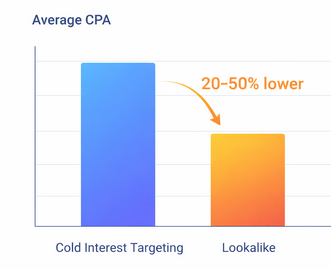
Comparison of average cost per acquisition (CPA) showing lookalike audiences deliver 20–50% lower CPA vs cold interest targeting
Statistically, predictive accuracy declines as audience similarity percentage increases. Internal platform analyses show that 1% audiences often deliver 15–25% stronger conversion rates than 5% audiences.
3. Progressive Expansion Strategy
Scaling should follow a stepwise testing protocol rather than a sudden budget increase.
Recommended Sequence
-
Stabilize performance at 1%
-
Duplicate into 2% and 3% audiences
-
Monitor CPA variance (acceptable increase: 10–20%)
-
Gradually consolidate into broader tiers
Sudden budget increases exceeding 30% per day often trigger learning phase resets and CPM inflation. Controlled increments of 15–20% per 48 hours reduce volatility.
4. Creative Diversification at Scale
Audience scaling without creative scaling leads to saturation.
According to Nielsen research, creative quality drives nearly 49% of sales lift in digital advertising. When expanding lookalikes, creative refresh cycles must accelerate.
Implementation Guidelines
-
Launch new creative variants for every expansion tier.
-
Introduce new angles (social proof, product education, urgency, comparison).
-
Rotate formats: static, video, UGC-style, carousel.
Creative testing should increase proportionally with audience size.
5. Geographic and Demographic Splitting
Advanced advertisers isolate lookalike audiences by country clusters or demographic segments to maintain efficiency.
Example
Instead of running a single 5% global audience:
-
Split by Tier 1 and Tier 2 markets.
-
Separate 25–34 from 35–44 age brackets.
This segmentation reduces internal auction competition and allows budget reallocation toward stronger-performing segments.
6. Audience Overlap Management
As you expand, overlap between multiple lookalikes can exceed 30%, inflating CPMs and reducing delivery efficiency.
Mitigation Tactics
-
Use exclusion stacking between expansion tiers.
-
Consolidate underperforming segments.
-
Periodically audit overlap percentages.
Efficient accounts typically maintain overlap below 15% between active scaling audiences.
7. Budget Engineering and Bid Strategy Alignment
Scaling requires budget architecture aligned with funnel depth.
Practical Model
-
50% budget to core 1–2% high-value audiences
-
30% to mid-tier expansion (3–5%)
-
20% to exploratory broader tiers
Additionally:
-
Test cost caps once data stabilizes.
-
Avoid aggressive bid caps during learning phase.
Accounts using structured budget tiers often experience 18–25% more stable CPAs during scale compared to flat budget distribution.
8. Signal Enrichment Through CRM Integration
First-party data improves lookalike performance significantly.
Advertisers leveraging enriched CRM attributes (purchase frequency, product category affinity, predicted LTV) report up to 35% stronger match quality and lower CPAs.
The deeper the behavioral dataset, the stronger the modeled audience similarity.
9. Testing Framework for Predictable Scaling
Implement a documented experimentation matrix:
-
Single-variable testing per expansion cycle
-
Minimum 50 conversions per audience before evaluation
-
7-day attribution consistency
Data-driven scaling reduces false positives and prevents premature budget shifts.
Common Scaling Pitfalls
-
Expanding too fast without creative refresh
-
Using low-quality seed events
-
Ignoring audience overlap
-
Increasing budgets beyond learning thresholds
-
Mixing value-based and volume-based seeds in one campaign
Avoiding these errors can preserve performance efficiency during aggressive growth phases.
Key Metrics to Monitor During Scaling
-
CPA variance percentage
-
Conversion rate by expansion tier
-
CPM trend vs audience size
-
Frequency increase rate
-
ROAS stability over 7- and 14-day windows
Consistent monitoring prevents delayed detection of performance degradation.
Final Thoughts
Advanced lookalike scaling is a statistical exercise in preserving predictive signal while increasing reach. Success depends on disciplined seed selection, structured expansion, creative evolution, and rigorous testing.
When executed correctly, lookalike audiences remain one of the most capital-efficient scaling mechanisms in digital acquisition.
Recommended Reading
To deepen your strategy, explore these additional insights:
-
From Cold Traffic to Qualified Leads: A Full-Funnel Blueprint
-
How Influencers and Creators Can Monetize Instagram Follower Audiences
Each article expands on foundational components that strengthen lookalike performance at scale.