Modern B2B sales environments generate an unprecedented volume of leads across multiple digital touchpoints. Yet, according to industry research, up to 79% of marketing leads never convert into sales, often due to inadequate qualification processes. At the same time, sales representatives spend nearly one-third of their time on non-revenue-generating activities, including manual lead review and scoring.
Automating lead qualification with behavioral signals addresses both inefficiencies. By leveraging real-time engagement data and intent-driven indicators, organizations can prioritize prospects who demonstrate genuine buying readiness while reducing operational overhead.
The Limitations of Traditional Lead Qualification
Traditional lead qualification relies heavily on static attributes such as:
-
Firmographics (industry, company size, revenue)
-
Demographics (job title, seniority)
-
Form submissions
-
Basic engagement metrics (email opens, clicks)
While useful, these signals do not fully capture buying intent. A prospect may match an ideal customer profile yet have no active purchasing timeline. Conversely, a smaller organization exhibiting high-intent behavior may be overlooked due to rigid scoring thresholds.
This misalignment creates three core challenges:
-
Delayed response to high-intent prospects
-
Overloaded sales teams chasing low-probability leads
-
Inconsistent qualification standards across teams
What Are Behavioral Signals?
Behavioral signals are dynamic indicators that reflect how prospects interact with digital assets and sales channels. Unlike static profile data, behavioral signals provide temporal and contextual insight into buying readiness.
Common behavioral signals include:
-
Frequency and recency of website visits
-
Engagement with pricing or solution-specific pages
-
Repeated interaction with case studies or product documentation
-
Webinar attendance and replay activity
-
Multi-channel engagement patterns within short timeframes
Research shows that companies using behavioral data for lead scoring see up to a 30% increase in conversion rates and 20% improvement in sales productivity.
Building an Automated Behavioral Qualification Framework
To operationalize behavioral signals effectively, organizations need a structured framework that combines data aggregation, scoring logic, and automated routing.
1. Centralized Data Collection
All behavioral interactions must be unified across:
-
Website analytics
-
Email engagement platforms
-
CRM systems
-
Advertising platforms
Fragmented data leads to incomplete scoring and missed opportunities.
2. Weighted Behavioral Scoring
Not all behaviors indicate equal intent. For example:
-
Visiting a homepage may indicate awareness.
-
Downloading a technical whitepaper suggests evaluation.
-
Viewing pricing multiple times within 48 hours signals strong purchase consideration.
Assign weighted scores to behaviors based on historical conversion data. Machine learning models can further refine scoring by analyzing past closed-won opportunities.
3. Real-Time Threshold Triggers
Automation should trigger actions when specific score thresholds are reached. These may include:
-
Immediate sales notification
-
Automated meeting scheduling invitations
-
Account-based marketing activation
-
Dynamic content personalization
Organizations that respond to leads within five minutes are up to 21 times more likely to qualify them compared to those responding after 30 minutes.
4. Continuous Optimization
Behavioral qualification systems require ongoing refinement. Monitor:
-
Conversion rates by behavioral segment
-
Sales cycle duration
-
Lead-to-opportunity ratios
-
Revenue per qualified lead
Regular recalibration ensures the scoring model reflects evolving buyer behavior.
Benefits of Automating Lead Qualification
Increased Sales Efficiency
By automatically prioritizing high-intent prospects, sales teams spend more time engaging decision-makers and less time researching unqualified leads.
Improved Marketing-Sales Alignment
Clear behavioral thresholds create objective qualification criteria, reducing friction between departments and improving pipeline predictability.
Shorter Sales Cycles
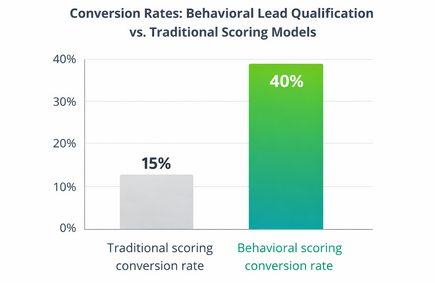
Conversion Rates: Behavioral Lead Qualification vs. Traditional Scoring Models
When outreach aligns with active buying signals, conversations begin at later decision stages, accelerating deal progression.
Higher Revenue Predictability
Behavioral-driven qualification improves forecast accuracy by linking engagement depth to opportunity probability.
Practical Implementation Considerations
Before implementing behavioral automation, organizations should address:
-
Data accuracy and enrichment quality
-
Compliance with privacy regulations
-
Clear definitions of marketing-qualified and sales-qualified thresholds
-
CRM integration and workflow automation readiness
A phased rollout often yields better results than full-scale deployment, allowing teams to validate scoring assumptions before scaling.
Future Outlook: Predictive and AI-Driven Qualification
The next evolution of behavioral automation integrates predictive analytics and AI models that identify buying committees, detect intent signals across external platforms, and recommend personalized outreach strategies.
Gartner projects that by 2027, 70% of B2B organizations will rely on AI-guided selling solutions to enhance lead prioritization and account targeting.
Organizations that adopt behavioral automation early gain structural advantages in pipeline velocity, cost efficiency, and competitive responsiveness.
Conclusion
Automating lead qualification with behavioral signals transforms a reactive, manual process into a proactive, data-driven system. By combining weighted engagement scoring, real-time triggers, and continuous optimization, companies can significantly improve conversion rates, reduce operational waste, and accelerate revenue growth.
As buyer journeys become increasingly digital and complex, behavioral intelligence is no longer optional—it is foundational to modern revenue operations.