Modern organizations generate vast amounts of customer data across multiple channels—websites, social media, email campaigns, CRM systems, and more. However, raw data alone is not valuable unless it can be transformed into actionable insights. Artificial intelligence (AI) plays a critical role in this transformation by automating analysis, uncovering hidden patterns, and providing predictive capabilities.
According to recent industry reports, over 80% of companies using AI for marketing report measurable improvements in customer engagement, while businesses leveraging advanced analytics are 2.6 times more likely to outperform competitors in profitability.
What Are AI Tools for Audience Insights?
AI tools for audience insights are platforms and technologies that use machine learning, natural language processing, and data modeling to analyze customer behavior, preferences, and intent. These tools process structured and unstructured data to deliver insights that would be difficult or impossible to obtain manually.
Key capabilities include:
-
Behavioral segmentation based on user actions
-
Predictive analytics for future customer behavior
-
Sentiment analysis across communication channels
-
Personalization recommendations
-
Real-time data processing and visualization
Key Benefits of Using AI for Audience Analysis
1. Deeper Customer Understanding
AI enables organizations to move beyond basic demographics and gain a multidimensional view of their audience. By analyzing browsing behavior, purchase history, and engagement patterns, businesses can identify micro-segments and tailor their messaging accordingly.
2. Real-Time Insights
Traditional analytics often rely on historical data. AI tools, however, can process streaming data in real time, allowing businesses to react instantly to changing customer behavior. This is particularly valuable in fast-moving industries such as e-commerce and digital advertising.
3. Predictive Capabilities
Predictive analytics powered by AI helps organizations anticipate customer needs and behaviors. Studies show that predictive models can improve marketing ROI by up to 20% and reduce customer churn by 15–25%.
4. Improved Personalization
Personalization is a key driver of engagement. AI tools analyze individual preferences and deliver tailored experiences at scale. Research indicates that 71% of consumers expect personalized interactions, and 76% become frustrated when this expectation is not met.
5. Automation and Efficiency
AI reduces the need for manual data analysis, freeing up teams to focus on strategy and execution. Automation also minimizes human error and ensures consistency in data processing.
Types of AI Tools for Audience Insights
Customer Data Platforms (CDPs)
CDPs aggregate customer data from multiple sources into a unified profile. AI enhances CDPs by enabling intelligent segmentation and predictive scoring.
Social Listening Tools
These tools analyze conversations across social media platforms to identify trends, sentiment, and emerging topics. AI-driven sentiment analysis can achieve accuracy rates of over 85%, providing reliable insights into public perception.
Predictive Analytics Platforms
Predictive tools use historical data and machine learning algorithms to forecast future behavior. This includes purchase likelihood, churn risk, and lifetime value predictions.
Recommendation Engines
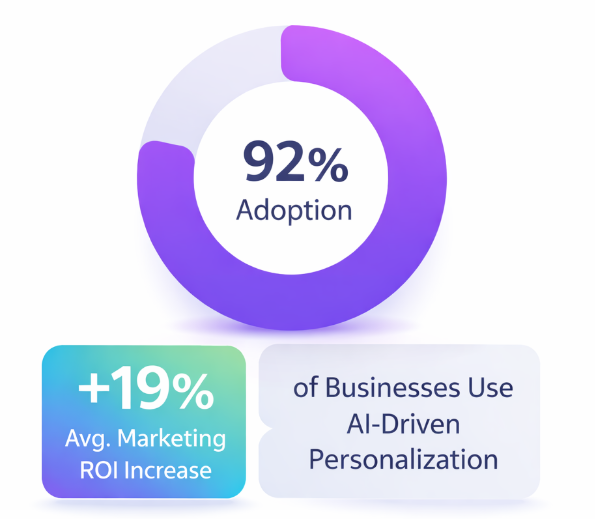
AI-powered personalization is widely adopted and consistently delivers measurable ROI improvements
Recommendation systems use AI to suggest products, content, or services based on user behavior. These engines can drive up to 35% of total revenue in e-commerce environments.
Natural Language Processing (NLP) Tools
NLP tools analyze text data from emails, reviews, and customer support interactions. They help identify key themes, sentiment, and intent, enabling more informed decision-making.
How to Choose the Right AI Tool
Selecting the right AI solution depends on several factors:
-
Business objectives: Define what insights you need and how they will be used.
-
Data availability: Ensure you have access to high-quality, relevant data.
-
Integration capabilities: Choose tools that integrate seamlessly with your existing systems.
-
Scalability: Opt for solutions that can grow with your business.
-
Ease of use: Consider user-friendly platforms that do not require extensive technical expertise.
Best Practices for Implementation
To maximize the value of AI tools for audience insights, organizations should follow these best practices:
-
Start with clear goals and measurable KPIs
-
Ensure data quality and consistency
-
Combine AI insights with human expertise
-
Continuously monitor and optimize models
-
Maintain transparency and ethical data usage
Challenges and Considerations
While AI offers significant advantages, there are also challenges to consider:
-
Data privacy and compliance requirements
-
Potential biases in algorithms
-
Integration complexity with legacy systems
-
Need for skilled personnel to manage AI tools
Addressing these challenges proactively is essential for successful implementation.
Future Trends
The role of AI in audience insights is expected to grow rapidly. Key trends include:
-
Increased use of real-time personalization
-
Greater adoption of generative AI for content insights
-
Enhanced cross-channel data integration
-
More advanced predictive modeling techniques
By 2027, it is estimated that over 75% of organizations will rely on AI-driven analytics as a core component of their decision-making processes.
Conclusion
AI tools are transforming how organizations understand and engage with their audiences. By leveraging advanced analytics, predictive modeling, and automation, businesses can gain deeper insights, improve personalization, and drive better outcomes.
As the technology continues to evolve, adopting AI-powered audience analysis will become not just an advantage, but a necessity for staying competitive in a data-driven world.