
Customer Relationship Management (CRM) systems are the backbone of modern marketing operations. However, even the most sophisticated CRM loses its effectiveness when its data structure is misaligned with advertising and audience platforms. Field inconsistency, poor formatting, and incomplete mapping can significantly reduce audience match rates and campaign performance.
Aligning CRM fields is not a purely technical exercise—it is a strategic step that directly impacts targeting accuracy, personalization, and return on ad spend.
Why CRM Field Alignment Matters
Accurate audience matching depends on how well your CRM data integrates with external platforms. When fields are inconsistent or poorly structured, even high-quality data becomes unusable.
Consider the following industry benchmarks:
-
Properly normalized CRM data can increase audience match rates by up to 30–45%.
-
Campaigns using well-structured first-party data see up to 20% higher conversion rates.
-
Inconsistent formatting (e.g., phone numbers, country codes) accounts for up to 25% of match failures.
These numbers highlight a critical point: data quality is not just about completeness—it’s about usability.
Common CRM Field Misalignment Issues
1. Inconsistent Data Formats
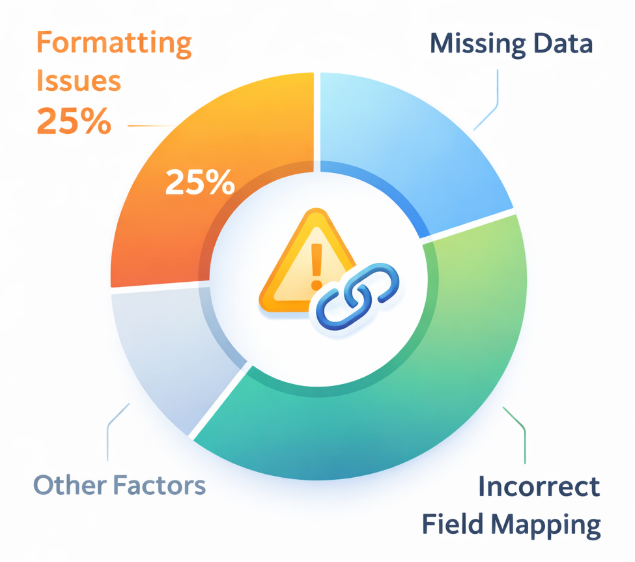
Inconsistent data formatting alone can account for up to 25% of audience match failures
Phone numbers, emails, and names often appear in multiple formats within the same database. For example:
-
Phone numbers with and without country codes
-
Emails with uppercase vs lowercase characters
-
Names stored as full name vs separate first and last name fields
These inconsistencies reduce the ability of platforms to correctly identify users.
2. Missing or Fragmented Fields
Incomplete records are one of the primary reasons for low match rates. Missing key identifiers such as email, phone number, or location data severely limit audience usability.
Fragmentation—where the same user exists across multiple records—further complicates matching and leads to inefficient targeting.
3. Incorrect Field Mapping
When CRM fields are not properly mapped to platform-specific identifiers, data may be uploaded but not effectively used. For example, mapping a "full name" field where separate "first name" and "last name" fields are expected can reduce matching accuracy.
4. Lack of Standardization Across Systems
Organizations often use multiple tools (CRM, CDP, marketing automation platforms), each with its own schema. Without a unified standard, data alignment becomes inconsistent and error-prone.
Key CRM Fields That Drive Matching Performance
To maximize audience matching, focus on the following core identifiers:
-
Email address (primary identifier in most platforms)
-
Phone number (with standardized international format)
-
First name and last name (stored separately)
-
Country, city, and ZIP/postal code
-
External IDs or customer IDs
Enhancing these fields with consistent formatting and validation significantly improves match rates.
Best Practices for Aligning CRM Fields
1. Standardize Data Formats
Ensure that all key fields follow a consistent format across your database:
-
Use lowercase for all email addresses
-
Store phone numbers in E.164 international format
-
Separate first and last names into distinct fields
Implement validation rules at the point of data entry to maintain consistency over time.
2. Enrich and Complete Missing Data
Data enrichment processes can fill gaps in your CRM records. This may include:
-
Appending missing contact details
-
Validating existing entries
-
Removing duplicate records
Even a modest increase in data completeness can significantly improve audience match rates.
3. Align Field Mapping with Platform Requirements
Each advertising platform has specific requirements for data ingestion. Ensure that your CRM fields are correctly mapped to these requirements:
-
Match field names and structures precisely
-
Use platform-supported identifiers
-
Avoid combining multiple data points into a single field
Proper mapping ensures that your data is not only uploaded but also effectively utilized.
4. Implement a Unified Data Schema
Establish a centralized schema that defines how data should be structured across all systems. This includes:
-
Standard naming conventions
-
Field definitions and formats
-
Data validation rules
A unified schema reduces inconsistencies and simplifies integration with external platforms.
5. Regularly Audit and Clean Data
Data alignment is not a one-time task. Regular audits help identify and resolve issues such as:
-
Formatting inconsistencies
-
Duplicate records
-
Outdated or invalid data
Organizations that perform routine data hygiene see significantly better long-term performance.
Measuring the Impact of CRM Alignment
To evaluate the effectiveness of your efforts, track the following metrics:
-
Audience match rate
-
Data completeness percentage
-
Duplicate record rate
-
Campaign conversion rates
Improvement in these metrics indicates successful alignment and better utilization of first-party data.
Conclusion
CRM field alignment is a foundational element of modern audience strategy. Without it, even the most advanced campaigns struggle to reach their full potential.
By standardizing formats, improving data completeness, and ensuring accurate field mapping, organizations can unlock higher match rates, better targeting precision, and improved campaign performance.
Recommended Reading
To further enhance your data and audience strategy, consider exploring the following articles: