Audience creation has long been one of the most resource-intensive components of digital marketing. Traditionally, marketers relied on static rules, manual segmentation, and limited datasets to define their target groups. While effective to some extent, these approaches struggle to keep pace with rapidly changing user behavior and the increasing volume of data.
Machine learning introduces a fundamentally different paradigm. Instead of manually defining audiences, marketers can now rely on algorithms that continuously analyze data, identify patterns, and automatically build high-performing segments.
Why Traditional Audience Creation Falls Short
Manual audience creation is constrained by several limitations:
-
Static logic: Rule-based segments do not adapt to real-time changes in user behavior.
-
Limited scalability: As datasets grow, managing segments becomes increasingly complex.
-
Human bias: Marketers may overlook valuable patterns hidden in large datasets.
According to recent industry data, companies that rely heavily on manual segmentation report up to 30% lower campaign efficiency compared to those using data-driven automation. Additionally, over 60% of marketers say they struggle to maintain accurate audience definitions across multiple channels.
How Machine Learning Transforms Audience Creation
Machine learning automates audience creation by analyzing vast amounts of behavioral, transactional, and contextual data. Instead of predefined rules, algorithms identify clusters, predict intent, and dynamically update segments.
Key capabilities include:
1. Predictive Segmentation
Machine learning models can predict which users are most likely to convert, churn, or engage. These predictive audiences are built based on historical patterns and continuously refined as new data becomes available.
Studies show that predictive segmentation can increase conversion rates by 20–50%, depending on the industry and data quality.
2. Lookalike Modeling
Lookalike audiences are created by identifying users who share characteristics with high-value customers. Machine learning enhances this process by analyzing hundreds or thousands of variables simultaneously.
Compared to traditional lookalike approaches, advanced models can improve targeting precision by up to 35%.
3. Real-Time Adaptation
Unlike static segments, machine learning-driven audiences evolve in real time. As users interact with ads, websites, or apps, their profiles are updated, and their audience membership changes accordingly.
This dynamic approach helps maintain relevance and improves campaign performance over time.
4. Multi-Source Data Integration
Machine learning systems can combine data from multiple sources, including CRM systems, website analytics, and advertising platforms. This unified view enables more accurate audience creation and reduces fragmentation.
Organizations that integrate multiple data sources report a 15–25% increase in marketing ROI.
Key Benefits of Automated Audience Creation
Improved Accuracy
Algorithms process far more data than humans can, uncovering hidden correlations and micro-segments that would otherwise go unnoticed.
Increased Efficiency
Automation reduces the time required to build and manage audiences. Marketing teams can shift their focus from manual tasks to strategy and optimization.
Scalability
Machine learning systems can handle millions of users and continuously generate new segments without additional manual effort.
Better Personalization
More precise audiences enable more relevant messaging, which leads to higher engagement and conversion rates.
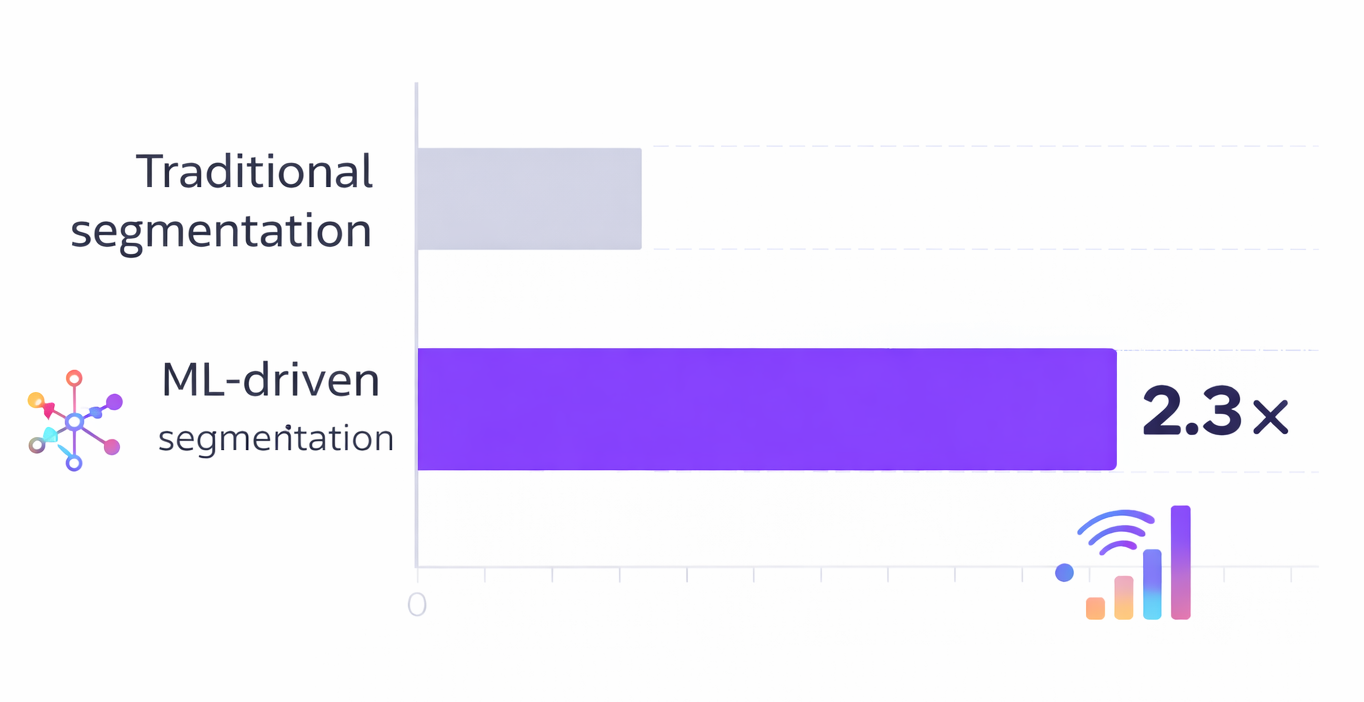
Machine learning-driven segmentation significantly outperforms traditional methods in engagement metrics
According to industry benchmarks, personalized campaigns can deliver up to 6x higher transaction rates compared to non-personalized approaches.
Implementation Challenges
Despite its advantages, adopting machine learning for audience creation comes with challenges:
-
Data quality issues: Inaccurate or incomplete data can reduce model performance.
-
Integration complexity: Combining multiple data sources requires robust infrastructure.
-
Skill gaps: Teams may lack expertise in data science and machine learning.
To overcome these challenges, organizations should invest in clean data pipelines, scalable architectures, and cross-functional collaboration between marketing and data teams.
Best Practices for Getting Started
-
Start with clear objectives: Define what outcomes you want to achieve, such as higher conversions or reduced churn.
-
Ensure data readiness: Clean, structured, and unified data is critical for effective machine learning models.
-
Test and iterate: Continuously evaluate model performance and refine your approach.
-
Combine automation with strategy: Machine learning should augment, not replace, human decision-making.
Future Outlook
As machine learning continues to evolve, audience creation will become even more autonomous and precise. Advances in real-time processing, privacy-preserving technologies, and AI-driven insights will further enhance the effectiveness of automated segmentation.
By 2027, it is expected that over 80% of digital marketing campaigns will rely on machine learning-driven audience strategies, reflecting a major shift toward automation and data-centric decision-making.
Suggested Reading
Conclusion
Automating audience creation with machine learning represents a significant step forward for modern marketing. By replacing static, manual processes with dynamic, data-driven systems, organizations can achieve greater accuracy, efficiency, and scalability.
As competition intensifies and data volumes continue to grow, adopting machine learning is no longer optional—it is becoming a fundamental requirement for effective audience strategy.