Customer journeys are fragmented. According to multiple industry benchmarks, B2B buyers consume 3–7 pieces of content before engaging with a sales representative, and more than 70% of the buyer’s journey is completed before direct contact with a vendor. Meanwhile:
-
LinkedIn generates up to 2x higher conversion rates for B2B compared to other major social platforms.
-
Facebook remains one of the largest paid media ecosystems, with over 3 billion monthly active users and highly advanced behavioral targeting.
-
Retargeted users are up to 70% more likely to convert compared to first-time visitors.
Using these platforms in isolation limits performance. Used together, they create a layered acquisition system that captures demand, nurtures awareness, and accelerates decision-making.
Platform Roles in the Funnel
A cross-platform strategy works best when each channel plays a defined role.
LinkedIn: Precision Targeting and High-Intent Capture
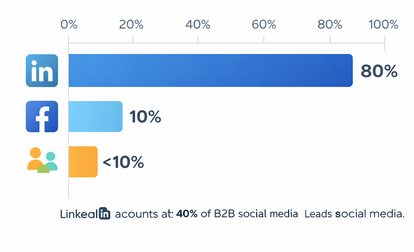
LinkedIn accounts for around 80% of B2B leads generated via social media
LinkedIn excels in firmographic targeting: job titles, industries, company size, seniority, and skills. This makes it ideal for:
-
Account-based marketing (ABM)
-
Decision-maker targeting
-
Lead magnet distribution (whitepapers, webinars, case studies)
-
Direct response campaigns for high-value services
Cost per lead is typically higher on LinkedIn, but lead qualification rates are often stronger due to professional targeting filters.
Facebook: Scale, Behavioral Data, and Retargeting
Facebook’s strength lies in behavioral targeting, lookalike modeling, and cost-efficient reach. It is highly effective for:
-
Top-of-funnel awareness campaigns
-
Retargeting LinkedIn visitors and website traffic
-
Scaling campaigns via lookalike audiences
-
Video engagement and content amplification
When LinkedIn captures initial high-intent prospects, Facebook can nurture and re-engage them at lower costs.
Strategic Architecture: How to Combine Both Platforms
1. Unified Audience Mapping
Start by defining three core audience layers:
-
Cold audiences (lookalikes, interest-based segments)
-
Warm audiences (engaged users, video viewers, website visitors)
-
Hot audiences (form starters, pricing page visitors, repeat visitors)
LinkedIn can efficiently identify decision-makers in cold segments. Facebook can expand reach using lookalike modeling based on qualified LinkedIn leads.
2. Sequential Messaging Framework
Avoid duplicating messages across platforms. Instead, implement progressive sequencing:
Stage 1 (LinkedIn):
-
Industry-specific pain point content
-
Authority-building assets
-
Professional credibility positioning
Stage 2 (Facebook retargeting):
-
Social proof
-
Case studies
-
Testimonials
-
Objection-handling creative
Stage 3 (Conversion push on both platforms):
-
Strong CTA
-
Limited-time offers
-
Direct demo or consultation booking
Sequential messaging can improve conversion rates by reinforcing familiarity and reducing perceived risk.
3. Cross-Platform Retargeting Loops
Install tracking infrastructure on all landing pages. Build retargeting pools such as:
-
LinkedIn ad clickers retargeted on Facebook
-
Facebook video viewers retargeted on LinkedIn
-
Website visitors segmented by content category
Multi-touch retargeting typically lowers blended cost per acquisition compared to single-platform campaigns.
Data Alignment and Attribution
One of the main operational challenges is attribution clarity. To maintain accuracy:
-
Use consistent UTM structures
-
Separate campaign naming conventions by funnel stage
-
Track assisted conversions, not just last-click results
-
Measure pipeline contribution, not only cost per lead
In B2B environments, a lead generated on Facebook may convert after multiple LinkedIn interactions. Attribution models must reflect this multi-channel reality.
Budget Allocation Model
A common starting allocation for B2B campaigns:
-
40% LinkedIn (high-intent acquisition)
-
40% Facebook (retargeting + scale)
-
20% testing and creative optimization
As performance data matures, budgets should shift toward channels producing the strongest pipeline velocity rather than the lowest surface-level CPL.
Creative Differentiation by Platform
LinkedIn creative should emphasize:
-
Industry insights
-
Professional tone
-
Data-backed value propositions
Facebook creative should emphasize:
-
Visual storytelling
-
Short-form video
-
Emotional triggers
-
Simplified messaging
Maintaining platform-native creative significantly improves engagement rates.
Common Mistakes to Avoid
-
Running identical ads on both platforms
-
Ignoring retargeting segmentation
-
Optimizing only for cost per lead instead of revenue impact
-
Overlooking creative fatigue cycles
-
Failing to sync CRM feedback into campaign optimization
Performance Benchmarks to Monitor
Key performance indicators in a cross-platform model include:
-
Cost per marketing-qualified lead (MQL)
-
Lead-to-opportunity conversion rate
-
Customer acquisition cost (CAC)
-
Return on ad spend (ROAS)
-
Pipeline contribution per channel
Cross-platform synergy should reduce blended CAC over time while increasing lead quality consistency.
Final Thoughts
Facebook and LinkedIn are not competitors in B2B lead generation—they are complementary systems. LinkedIn drives precision and authority; Facebook provides scale and reinforcement. When integrated through structured sequencing, retargeting loops, and unified attribution, they form a resilient acquisition engine capable of sustaining long-term pipeline growth.