
A growing number of organizations rely on behavioral signals to improve acquisition performance, personalization, and campaign optimization. At the same time, privacy expectations and regulatory frameworks are reshaping how user data can be collected and used.
Introduction
Digital marketing systems depend on signals: events, identifiers, behavioral patterns, and engagement data that help algorithms optimize targeting and performance. However, regulations such as GDPR and evolving privacy standards have made user consent a central requirement in data collection practices.
The challenge for marketing and data teams is to maintain the quality of optimization signals while respecting explicit user consent preferences. When not addressed properly, this balance can lead either to compliance risks or to significant losses in data visibility and campaign efficiency.
The Role of Optimization Signals
Optimization signals are the foundation of modern marketing automation and campaign management. Platforms use these signals to:
-
Train targeting algorithms
-
Attribute conversions
-
Optimize bidding strategies
-
Personalize content and offers
Research by Deloitte indicates that data-driven marketing strategies can improve marketing ROI by up to 20–30% compared to traditional campaign approaches. Meanwhile, companies that actively leverage behavioral analytics are 2.6 times more likely to outperform competitors in revenue growth.
These results depend heavily on reliable signal collection. When signal loss occurs—due to consent restrictions, browser limitations, or technical implementation gaps—optimization models degrade quickly.
The Expanding Role of Consent
User consent has evolved from a legal checkbox into a critical operational component of digital marketing infrastructure.
According to industry studies, between 40% and 70% of website visitors decline optional tracking cookies when presented with consent banners. In regions with strong privacy regulations, this number can be even higher.
This has several implications:
-
Reduced availability of third‑party tracking data
-
Incomplete conversion attribution
-
Fragmented customer journey visibility
-
Lower confidence in performance metrics
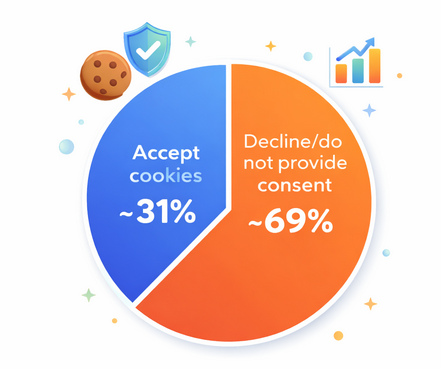
Average cookie consent acceptance rate is roughly 31%, meaning most websites lose a large portion of potential tracking signals when users decline or ignore tracking permissions
Organizations that rely exclusively on traditional client-side tracking often experience substantial signal gaps as a result.
Key Sources of Signal Loss
Several technical and behavioral factors contribute to signal loss in modern marketing environments.
Browser Privacy Controls
Modern browsers increasingly block or restrict tracking mechanisms. Safari and Firefox already limit many third‑party cookies by default, while Chrome is progressively introducing privacy sandbox technologies.
Consent Denials
If users deny consent, many tracking scripts are prevented from firing. This means critical events such as page views, form submissions, or product interactions may never reach analytics or advertising platforms.
Client-Side Tracking Limitations
Traditional browser-based tracking relies on JavaScript events that can be blocked by ad blockers, network restrictions, or script execution failures.
Studies estimate that ad blockers alone can prevent between 15% and 30% of tracking events from being collected on average websites.
Strategies for Maintaining Signal Quality
Organizations can address these challenges through a combination of architectural and operational improvements.
1. Strengthening First-Party Data Infrastructure
First-party data collection is becoming the primary foundation for reliable optimization signals. Server-controlled data pipelines reduce reliance on fragile browser-side scripts and allow better management of consent states.
2. Consent-Aware Data Flows
Instead of treating consent as a blocking mechanism, advanced systems integrate consent logic directly into data pipelines. This ensures that compliant signals continue to flow while respecting user preferences.
3. Improving Event Redundancy
Critical events should be captured through multiple mechanisms where possible. Redundant signal collection reduces the probability that optimization systems lose important conversion data.
4. Enhancing Identity Resolution
When identifiers become fragmented, identity resolution techniques can help reconnect events across sessions and devices while remaining compliant with consent frameworks.
Building a Privacy-Resilient Measurement Strategy
A privacy-resilient measurement framework focuses on durability rather than volume of data. Instead of collecting every possible signal, organizations prioritize the signals that directly affect decision-making.
Key components include:
-
Prioritized conversion events
-
Reliable server-level data delivery
-
Accurate consent state propagation
-
Structured event taxonomies
Companies that adopt these approaches often recover a significant portion of lost signals without violating privacy constraints.
Operational Alignment Between Teams
Balancing consent and optimization is not purely a technical task. It requires coordination between several functions:
-
Marketing teams defining optimization goals
-
Data teams designing tracking infrastructure
-
Legal teams interpreting regulatory requirements
-
Product teams implementing user interfaces for consent
Organizations that align these stakeholders early in the design process typically avoid costly tracking redesigns later.
The Future of Optimization Signals
The ecosystem is shifting toward privacy-first measurement models. Instead of unrestricted tracking, platforms are adopting aggregated reporting, modeled conversions, and secure data-sharing environments.
While these approaches change how performance is measured, they do not eliminate the importance of high-quality signals. In fact, the accuracy of modeling systems depends heavily on the integrity of the signals that remain available.
Companies that invest in resilient signal architecture today will be significantly better prepared for the next generation of marketing measurement frameworks.
Conclusion
Balancing user consent with optimization signals is one of the defining challenges of modern digital marketing. Organizations must simultaneously protect user privacy, comply with evolving regulations, and maintain the data quality required for effective campaign optimization.
The solution is not to choose between privacy and performance, but to redesign data infrastructure so that both objectives can coexist. By focusing on resilient signal pipelines, consent-aware architectures, and strong first-party data strategies, companies can continue to optimize marketing performance while respecting user choice.