
Marketing teams are entering an era where consent-based data defines the limits of targeting, measurement, and optimization. As regulations tighten and third‑party identifiers disappear, campaign performance increasingly depends on how effectively marketers work with partial datasets.
The Growing Challenge of Limited Consent Data
Privacy regulations and platform policy changes have significantly reduced the amount of user data available for digital marketing. Regulations such as GDPR and similar frameworks worldwide have shifted the responsibility of data collection toward explicit user consent.
According to industry estimates, between 40% and 60% of website visitors decline tracking cookies when given the option. In some regions, acceptance rates are even lower. At the same time, browser restrictions on third‑party cookies continue to reduce trackable traffic.
The impact is measurable. Marketing analytics platforms report that up to 30%–50% of conversions may become unobservable when relying only on consent‑based tracking. This creates gaps in attribution models, audience segmentation, and campaign optimization.
Despite these limitations, campaigns can still perform effectively when marketers adopt strategies designed for incomplete data environments.
Prioritize High‑Quality First‑Party Data
When third‑party tracking weakens, first‑party data becomes the most reliable foundation for campaign performance.
First‑party data includes information collected directly through owned channels such as websites, CRM systems, email subscriptions, and product usage. Because it comes from direct relationships with users, it remains compliant and highly accurate.
Organizations that prioritize first‑party data strategies consistently outperform competitors. Research shows that companies using advanced first‑party data strategies generate up to 2.9x more revenue from marketing activities compared with those relying primarily on third‑party data.
To strengthen first‑party data assets, marketers should:
-
Improve value exchange for visitors (content, tools, resources)
-
Encourage account creation or newsletter subscriptions
-
Consolidate customer data across CRM, marketing automation, and analytics platforms
-
Use progressive profiling to gradually enrich user data
Even when consent rates are limited, first‑party data provides the most stable signals for optimization.
Use Modeled and Aggregated Measurement
When individual‑level tracking declines, statistical modeling becomes essential for performance measurement.
Modern analytics approaches use aggregated signals and predictive modeling to estimate campaign outcomes that cannot be directly observed. This approach is already widely adopted by major advertising platforms.
Modeled attribution techniques analyze observable behavior patterns and apply probabilistic models to estimate missing conversions. For example, platforms often combine consented user behavior, contextual signals, and historical performance data to approximate overall campaign impact.
Studies from major ad platforms indicate that modeled conversions can recover between 60% and 90% of previously untracked conversions in privacy‑restricted environments.
While modeled measurement is not perfectly precise, it significantly reduces the visibility gap caused by limited consent data.
Focus on Contextual and Intent‑Based Targeting
As behavioral targeting becomes less reliable, contextual targeting is returning as a powerful strategy.
Contextual targeting focuses on the environment in which ads appear rather than on individual user profiles. Advances in natural language processing now allow platforms to understand page topics, sentiment, and intent with far greater accuracy than in earlier contextual systems.
Recent industry data shows that contextual campaigns can achieve engagement rates comparable to behavioral targeting when aligned with relevant content categories.
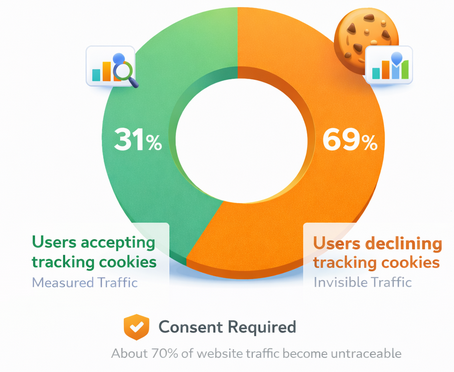
Share of website visitors who accept vs decline tracking cookies, illustrating how consent requirements significantly reduce observable marketing data.
Marketers can strengthen contextual performance by:
-
Aligning ad creatives with page topics and audience intent
-
Segmenting campaigns by content category
-
Testing multiple contextual environments
-
Optimizing creatives for different content contexts
In many cases, contextual strategies produce strong results without relying on personal identifiers.
Strengthen Conversion Optimization
Limited consent data makes every observable conversion more valuable. As a result, improving conversion efficiency becomes a key lever for campaign performance.
Even small improvements in conversion rate can compensate for reduced data visibility.
Typical conversion rate optimization tactics include:
-
Testing landing page layouts and messaging
-
Improving page load speed
-
Simplifying forms and checkout flows
-
Using clearer calls‑to‑action
Research indicates that systematic conversion rate optimization programs can increase conversion rates by 20%–30% over time.
With fewer trackable signals available, maximizing the performance of existing traffic becomes even more important.
Build Stronger Campaign Experimentation
Testing frameworks help marketers adapt faster when data signals become less complete.
Structured experimentation allows teams to evaluate performance changes even when attribution models contain uncertainty. By running controlled tests across creatives, targeting strategies, and landing pages, marketers can identify improvements using comparative analysis.
Key experimentation methods include:
-
A/B testing creative variations
-
Geo‑based experiments
-
Incrementality testing
-
Holdout group analysis
These approaches focus on measuring relative performance differences rather than relying entirely on individual user tracking.
Rethink Attribution Models
Traditional last‑click attribution becomes less reliable as trackable journeys become fragmented.
To maintain meaningful insights, marketers should adopt more flexible attribution approaches that combine multiple data sources.
Modern attribution strategies may include:
-
Data‑driven attribution models
-
Media mix modeling
-
Incrementality testing
-
Blended attribution frameworks
Media mix modeling in particular is gaining renewed interest. Large organizations increasingly use statistical models that analyze historical spend and performance data to estimate the contribution of different channels.
These models operate on aggregated data and remain effective even when user‑level tracking is limited.
Conclusion
Limited consent data is quickly becoming the standard operating environment for digital marketing. Rather than relying on traditional tracking methods, successful campaigns now depend on resilient strategies built around first‑party data, contextual targeting, modeled measurement, and rigorous experimentation.
Organizations that adapt early can maintain strong campaign performance while staying aligned with evolving privacy expectations.