Marketing leaders increasingly face a difficult question: where should the next marketing dollar go? With fragmented customer journeys, privacy restrictions, and multiple advertising platforms competing for budgets, relying on a single measurement approach often produces incomplete insights.
Marketing mix modeling (MMM) provides a macro‑level understanding of how different channels contribute to overall business outcomes. Platform data, on the other hand, offers granular performance metrics at the campaign and audience level. When these two data sources are blended, organizations gain a more comprehensive framework for optimizing marketing spend.
Why MMM Alone Is No Longer Enough
MMM has experienced a resurgence as third‑party cookies disappear and privacy regulations tighten. It analyzes historical performance across channels and quantifies the contribution of marketing activities to revenue or conversions.
However, traditional MMM models operate at a relatively high level of aggregation. They are typically updated quarterly or monthly and cannot always capture rapid campaign changes.
This limitation becomes critical in environments where:
-
Campaigns change weekly or even daily
-
Multiple creative variations run simultaneously
-
Audience targeting evolves quickly
According to industry research, organizations using MMM alone may miss up to 20–30% of optimization opportunities that exist within campaign-level data.
The Strength of Platform-Level Data
Advertising platforms provide immediate performance signals such as impressions, clicks, engagement rates, and conversion data. These insights enable tactical adjustments and allow marketers to iterate quickly.
Platform analytics offer several advantages:
-
Near real-time reporting
-
Detailed audience segmentation
-
Creative-level performance tracking
-
Bid and budget optimization signals
For example, Meta reports that advertisers using platform optimization tools can improve campaign efficiency by up to 32% through continuous learning algorithms.
Yet platform data also has limitations. Each platform measures performance within its own ecosystem, often attributing conversions using different methodologies. This can lead to inflated or overlapping attribution results.
Why Blending MMM and Platform Data Works
Combining MMM and platform data bridges the gap between strategic insights and tactical execution.
MMM provides a macro perspective on channel effectiveness across the entire marketing ecosystem. Platform data adds operational intelligence that explains how campaigns perform within each channel.
Together, they allow marketers to:
-
Validate platform attribution against independent modeling
-
Detect diminishing returns across channels
-
Optimize budgets across both channels and campaigns
-
Align short‑term performance metrics with long‑term revenue impact
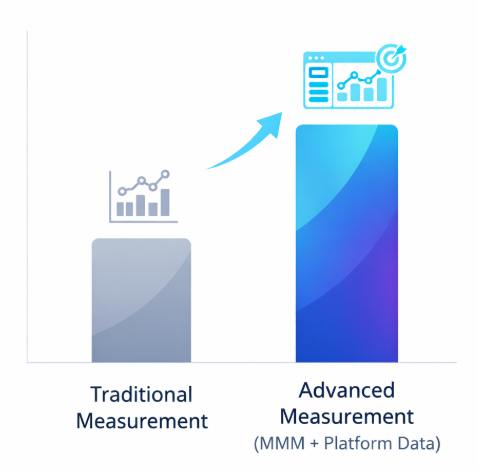
Improved Marketing Efficiency with Advanced Measurement
Research from Nielsen indicates that organizations integrating multiple measurement frameworks achieve up to 15% higher marketing ROI compared with those relying on a single approach.
A Practical Framework for Integration
Blending MMM and platform data requires a structured workflow. The goal is not to replace one system with another but to allow them to inform each other.
1. Use MMM for Strategic Budget Distribution
Start with MMM insights to determine the optimal allocation of budget across major channels such as search, social, display, and offline media. MMM identifies which channels drive incremental impact and where diminishing returns begin.
This macro allocation acts as the strategic foundation for campaign planning.
2. Apply Platform Data for Tactical Optimization
Once budgets are distributed across channels, platform-level data helps refine campaign execution. Marketers can test audiences, creatives, and bidding strategies while staying within the channel-level allocation determined by MMM.
This creates a two-layer optimization structure: strategic allocation at the channel level and tactical optimization within platforms.
3. Feed Platform Insights Back into MMM
Over time, campaign-level insights should inform the next iteration of the MMM model. Performance signals such as creative fatigue, audience saturation, and new targeting segments provide valuable inputs for future modeling cycles.
This feedback loop helps improve model accuracy and ensures that strategic insights reflect evolving market conditions.
The Impact on Budget Allocation
Organizations that successfully integrate MMM and platform data often see measurable improvements in marketing efficiency.
Several outcomes commonly emerge:
-
Reduced overspending on saturated channels
-
Faster reallocation of budgets toward high-performing segments
-
Better forecasting of incremental revenue impact
A recent global survey of senior marketing executives found that 64% of companies using combined measurement approaches reported significantly improved budget planning accuracy.
Common Implementation Challenges
While the benefits are clear, blending MMM and platform data requires overcoming several operational barriers.
Data consistency is one of the biggest challenges. Platform metrics must be normalized so they can be compared within a unified modeling framework.
Another challenge involves organizational alignment. MMM is often managed by analytics or strategy teams, while platform optimization sits within performance marketing teams. Without clear collaboration, the insights from each system remain siloed.
Finally, data latency can slow the integration process. MMM cycles are typically slower than platform reporting, requiring careful coordination between long-term modeling and short-term campaign optimization.
Building a Measurement Ecosystem
Rather than choosing between measurement approaches, leading organizations build a measurement ecosystem where each method plays a distinct role.
In this ecosystem:
-
MMM provides strategic guidance
-
Platform analytics enables tactical adjustments
-
Continuous feedback improves both systems
This layered approach allows marketing teams to navigate uncertainty while maintaining confidence in budget decisions.
Conclusion
Modern marketing measurement cannot rely on a single data source. As digital ecosystems become more complex and privacy constraints limit traditional tracking methods, marketers must combine multiple perspectives to understand true performance.
Blending marketing mix modeling with platform-level data creates a powerful framework for smarter budget allocation. By aligning macro-level insights with campaign-level intelligence, organizations can maximize marketing effectiveness while adapting quickly to changing market dynamics.
Recommended Reading