
Marketing teams frequently rely on attribution reports when deciding where to allocate advertising budgets. However, attribution alone does not always reveal whether a campaign truly caused a conversion or merely received credit for one that would have happened anyway.
Incrementality analysis addresses this gap by measuring the real impact of marketing activities. By identifying which campaigns generate additional conversions rather than simply capturing existing demand, organizations can distribute their budgets more strategically.
Why Incrementality Matters for Budget Allocation
Attribution models assign credit for conversions across marketing channels, but they rarely distinguish between causal impact and coincidence. Incrementality focuses on the difference between outcomes with and without a marketing intervention.
Research across digital advertising campaigns suggests that a significant portion of attributed conversions are not incremental. Several studies indicate that as much as 40–60% of conversions credited to retargeting campaigns may have occurred even without the ads.
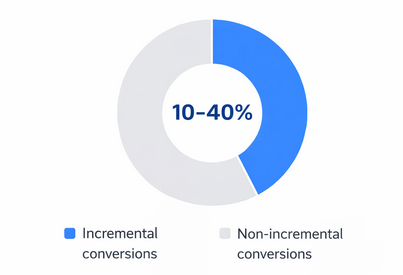
A large share of conversions credited to retargeting campaigns may not be truly incremental, highlighting the importance of measuring causal marketing impact
When budgets are allocated solely based on attribution metrics, this effect can lead to overspending on channels that appear effective but generate limited additional value.
Incrementality insights help marketers answer critical questions:
-
Which campaigns actually generate new demand?
-
Which audiences would convert without advertising exposure?
-
Where should budgets be increased, reduced, or reallocated?
Key Statistics Demonstrating the Impact of Incrementality
Incrementality measurement has become increasingly important as advertising ecosystems evolve and privacy regulations limit traditional tracking methods.
Several industry findings highlight the scale of the issue:
-
Studies of retargeting campaigns show that only about 40% of attributed conversions are truly incremental, meaning the remaining conversions would likely have occurred without the campaign.
-
Controlled experiments have demonstrated that incrementality testing can reduce wasted ad spend by up to 30% by identifying campaigns with limited causal impact.
-
Organizations that regularly run incrementality tests report 10–20% improvements in marketing efficiency after reallocating budgets toward higher‑impact channels.
These statistics illustrate why incrementality is increasingly used as a strategic input for budget planning.
How Incrementality Insights Guide Budget Decisions
1. Identifying Over‑Attributed Channels
Channels that receive strong attribution credit are not always the most effective drivers of growth. Retargeting and branded search campaigns often capture users who are already close to conversion.
Incrementality analysis can reveal whether these campaigns actually generate additional purchases or simply intercept customers who were already planning to buy.
If testing shows that a large share of conversions would have happened without advertising exposure, marketers can safely reduce spending in those areas without harming overall revenue.
2. Prioritizing High‑Impact Campaigns
When incrementality tests highlight campaigns that genuinely increase conversions, those campaigns become strong candidates for additional investment.
Examples include:
-
Prospecting campaigns targeting new audiences
-
Upper‑funnel display or video campaigns
-
Discovery campaigns designed to expand reach
These channels may appear less efficient under traditional attribution models but can deliver substantial incremental lift when measured experimentally.
3. Balancing Short‑Term and Long‑Term Impact
Incrementality insights help organizations maintain a healthier balance between lower‑funnel conversion capture and upper‑funnel demand generation.
Without incrementality measurement, budgets often drift heavily toward retargeting and brand search because those channels produce immediate conversions.
By measuring causal impact, marketers can allocate more resources toward campaigns that build future demand rather than simply harvesting existing interest.
4. Optimizing Audience Segmentation
Incrementality analysis frequently reveals that certain audience segments respond strongly to advertising while others convert regardless of exposure.
Budget allocation can therefore be refined by focusing advertising on segments where campaigns generate the largest incremental lift.
For example, new visitors or lightly engaged users may show significantly higher incremental response than highly engaged returning customers.
Practical Framework for Incrementality‑Driven Budget Allocation
Organizations adopting incrementality insights often follow a structured process.
-
Run controlled experiments using holdout groups to measure the causal impact of specific campaigns.
-
Calculate incremental lift by comparing conversion rates between exposed and non‑exposed audiences.
-
Estimate incremental cost per conversion to determine the true efficiency of each campaign.
-
Reallocate budgets toward campaigns that produce the highest incremental return.
-
Repeat testing regularly as campaign performance and audience behavior evolve.
This approach transforms budget allocation from assumption‑based planning into a continuous optimization process grounded in empirical evidence.
Challenges and Considerations
While incrementality provides powerful insights, implementing it effectively requires careful experimentation design.
Key considerations include:
-
Ensuring sufficiently large sample sizes
-
Avoiding audience contamination between test and control groups
-
Running experiments long enough to capture meaningful outcomes
Organizations that institutionalize incrementality testing often integrate experimentation into their ongoing marketing workflows rather than treating it as a one‑time project.
Conclusion
Budget allocation decisions become significantly more effective when based on incrementality insights rather than attribution metrics alone. By identifying which campaigns truly generate additional conversions, marketers can reduce wasted spending, prioritize high‑impact channels, and improve overall marketing efficiency.
As digital advertising continues to evolve, incrementality measurement is becoming an essential component of modern marketing strategy.