
As privacy regulations expand and third‑party cookies disappear, marketers increasingly rely on aggregated measurement techniques. Marketing Mix Modeling (MMM) has re-emerged as a reliable approach for evaluating marketing performance without depending on user-level tracking.
Unlike attribution models that track individual customer journeys, MMM analyzes historical performance data to estimate the impact of different marketing activities on sales or other business outcomes.
For mid-sized brands, a lightweight MMM framework provides valuable insights without the complexity or cost of enterprise-level modeling systems.
Why MMM Is Becoming Essential
Recent industry research highlights the growing importance of marketing mix modeling:
-
72% of marketers say privacy changes have significantly reduced the reliability of traditional attribution methods.
-
Companies using MMM alongside other measurement approaches improve marketing ROI visibility by up to 35%.
-
Organizations that regularly optimize marketing spend based on econometric models report 20–30% improvements in media efficiency.
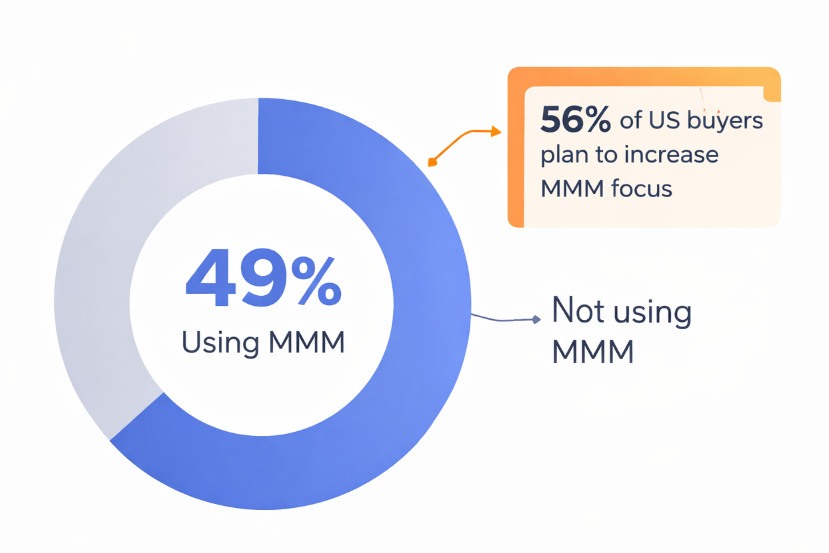
Adoption and growing interest in Marketing Mix Modeling among marketing teams
These shifts make MMM particularly valuable for brands that rely on multiple acquisition channels such as paid search, social media, display, and offline marketing.
Core Components of a Simple MMM Framework
A practical MMM implementation does not require a large data science team. A mid-sized brand can build a basic framework using four key components.
1. Data Collection
Start by gathering consistent historical data across three categories:
-
Sales or conversions (daily or weekly)
-
Marketing spend by channel
-
External factors such as seasonality, promotions, or holidays
Weekly data is often sufficient for mid-sized companies and provides a balance between accuracy and model stability.
2. Data Preparation
Data should be normalized and aligned across time periods. Common preparation steps include:
-
Aggregating marketing spend by channel
-
Creating seasonality indicators
-
Adjusting for outliers or unusual events
At least 18–24 months of historical data typically produces more stable MMM results.
3. Model Construction
The simplest MMM model is a multiple regression model where sales are predicted based on marketing activity and external variables.
Typical variables include:
-
Paid search spend
-
Paid social spend
-
Display advertising
-
Email campaigns
-
Promotions
-
Seasonality
The model estimates the contribution of each channel while controlling for external factors.
4. Insights and Optimization
Once the model is calibrated, marketers can evaluate:
-
Marginal return on each channel
-
Diminishing returns in media spending
-
Optimal budget allocation across channels
Many brands use these insights to simulate different budget scenarios and forecast expected revenue outcomes.
Practical Implementation Steps
To build a working MMM system, teams can follow a structured approach:
-
Define the primary business metric (revenue, leads, or conversions).
-
Consolidate marketing spend data from all channels.
-
Align datasets into a weekly time series.
-
Build a regression model using statistical software.
-
Validate the model using historical holdout periods.
-
Generate scenario simulations for budget allocation.
Even a basic MMM implementation can reveal patterns that are difficult to detect with channel-level dashboards alone.
Common Challenges
While MMM is powerful, teams should be aware of several limitations:
Data quality issues. Inconsistent spend tracking can distort model outputs.
Lag effects. Some channels generate delayed responses that require adstock or lag variables.
External influences. Market trends, competitor activity, and macroeconomic shifts may affect results.
Despite these challenges, MMM remains one of the most reliable ways to measure marketing effectiveness at an aggregated level.
When Mid-Sized Brands Should Adopt MMM
MMM becomes particularly useful when companies:
-
Spend across multiple marketing channels
-
Have at least two years of performance data
-
Need strategic guidance for budget allocation
-
Want measurement methods that respect privacy restrictions
For brands scaling their marketing operations, MMM provides a long-term decision-making framework rather than a short-term attribution tool.
Conclusion
Marketing Mix Modeling is no longer limited to large enterprises with extensive analytics teams. With structured data, basic statistical tools, and consistent measurement practices, mid-sized brands can implement a simplified MMM framework that delivers actionable insights.
By understanding how each marketing channel contributes to overall performance, organizations can allocate budgets more effectively, improve marketing efficiency, and make more confident strategic decisions.
Suggested Reading