Media Mix Modeling is widely used to estimate how different marketing channels contribute to overall business outcomes. According to industry research, companies that adopt marketing mix modeling improve budget allocation efficiency by up to 15–30%. However, applying MMM to paid social campaigns requires careful data preparation and modeling decisions.
Paid social advertising is dynamic: algorithms optimize delivery, audiences shift rapidly, and performance signals change frequently. When MMM approaches designed for traditional media are applied directly to paid social datasets, significant analytical errors can occur.
Below are the most frequent Media Mix Modeling errors encountered in paid social analysis.
1. Ignoring Platform Optimization Dynamics
Paid social platforms continuously optimize ad delivery using machine learning. Campaign performance can change dramatically as algorithms learn which users are most likely to convert.
Traditional MMM assumes relatively stable media exposure patterns. However, paid social campaigns often experience performance changes within days due to:
-
automated bid adjustments
-
creative fatigue
-
audience expansion
-
algorithmic learning phases
When these dynamics are not accounted for, the model may attribute performance shifts to external factors instead of platform optimization.
2. Using Aggregated Data That Is Too Coarse
Many MMM implementations rely on weekly or monthly data aggregation. While this works reasonably well for TV or radio campaigns, it can obscure important signals in paid social advertising.
Research indicates that digital campaign performance can fluctuate by more than 40% within a single week due to audience saturation and optimization cycles. Aggregating data at a high level may hide these patterns.
More granular datasets—such as daily spend, impressions, and conversions—help capture the true relationship between investment and performance.
3. Overlooking Adstock and Carryover Effects
Adstock represents the delayed effect of advertising exposure. While paid social is often considered immediate-response media, studies show that social advertising can generate delayed conversions for several days or even weeks.
Ignoring carryover effects may cause the model to underestimate the real impact of paid social campaigns. In some industries, delayed attribution accounts for 20–35% of total conversions.
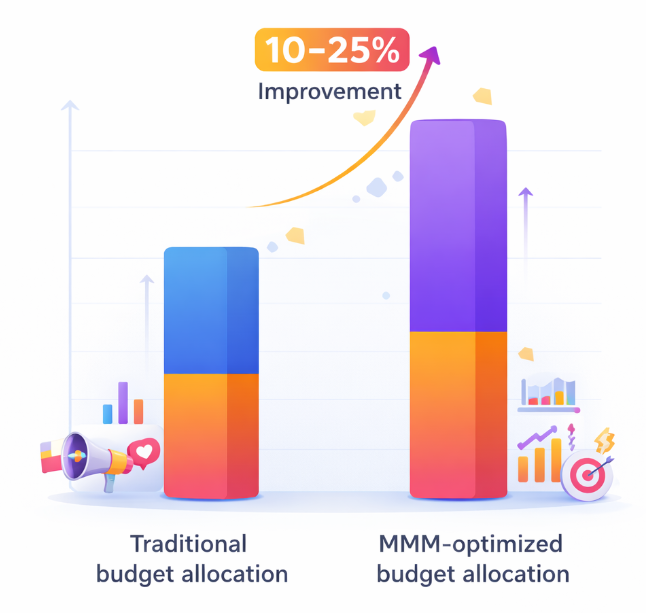
Companies implementing Media Mix Modeling frequently improve marketing ROI by 10–25% through more efficient budget allocation
Properly calibrated adstock parameters help capture these delayed effects and provide a more accurate representation of channel contribution.
4. Failing to Separate Prospecting and Retargeting Campaigns
Paid social strategies frequently include both prospecting campaigns (targeting new audiences) and retargeting campaigns (engaging users who already interacted with the brand).
When both campaign types are grouped together in MMM datasets, the model may misinterpret their performance characteristics.
Prospecting campaigns typically drive long‑term growth and brand awareness, while retargeting campaigns tend to generate higher immediate conversion rates. Combining them can distort the estimated ROI for paid social.
Separating these campaign categories allows the model to better capture their unique roles within the marketing mix.
5. Not Controlling for External Demand Factors
Paid social performance often correlates with broader market demand trends. Seasonality, promotions, product launches, and macroeconomic factors can all influence campaign results.
Without controlling for these external drivers, MMM may incorrectly attribute natural demand increases to paid social advertising.
For example, during peak seasonal demand periods, conversion rates may increase significantly across all channels. Without seasonal controls, the model may overestimate the effectiveness of paid social spend.
6. Using Insufficient Historical Data
Reliable Media Mix Modeling typically requires substantial historical data. Many organizations attempt to build MMM models using only a few months of campaign data.
Industry benchmarks suggest that effective MMM implementations usually require at least 18–24 months of historical marketing data to generate statistically reliable insights.
Shorter timeframes reduce the model's ability to detect true patterns and distinguish between noise and meaningful relationships.
7. Ignoring Creative and Format Differences
Paid social performance varies significantly depending on creative format, messaging, and placement. Video ads, carousel ads, and static images often deliver different engagement and conversion patterns.
If all paid social investments are treated as a single variable in the model, these differences disappear. As a result, the model may overlook valuable optimization opportunities.
Breaking down spend by major format categories—such as video versus static creative—can improve the interpretability of MMM results.
Best Practices for Accurate Paid Social MMM
To avoid these errors and produce more reliable results, analysts should consider the following practices:
-
Use daily or near‑daily campaign data where possible.
-
Separate campaign types such as prospecting and retargeting.
-
Incorporate adstock and lag effects into the modeling framework.
-
Include seasonality, promotions, and macroeconomic indicators.
-
Maintain at least 18–24 months of historical marketing data.
Applying these practices can significantly improve the reliability of Media Mix Modeling insights for paid social campaigns.
Conclusion
Media Mix Modeling remains one of the most valuable tools for understanding marketing effectiveness across channels. However, applying MMM to paid social advertising requires careful consideration of platform dynamics, data granularity, and campaign structure.
By avoiding common modeling mistakes—such as ignoring optimization cycles, aggregating data too broadly, or failing to separate campaign types—analysts can produce more accurate insights and make better budget allocation decisions.
As paid social advertising continues to evolve, robust analytical frameworks will become increasingly important for marketers seeking to understand the real drivers of performance.
Further Reading
If you are interested in improving your marketing analytics strategy, consider exploring the following topics: