Modern customer journeys are no longer linear. According to research by Gartner, B2B buyers spend only 17% of their time meeting with potential suppliers, while the rest is spent on independent research. At the same time, Google reports that users interact with an average of 20+ touchpoints before converting in complex funnels.
Traditional retargeting strategies—based on simple audience buckets—fail to reflect this complexity. As a result, marketers experience lower conversion rates, wasted ad spend, and audience fatigue.
This is where retargeting trees come into play.
A retargeting tree is a structured framework that organizes audiences and messaging based on behavioral pathways rather than isolated actions. It allows marketers to respond dynamically to user intent at every stage of the funnel.
What Is a Retargeting Tree?
A retargeting tree is a branching logic model where each node represents a specific audience segment defined by user behavior, and each branch represents a transition based on new actions or inactions.
Instead of targeting "all website visitors" or "cart abandoners," a retargeting tree enables segmentation such as:
-
Visited pricing page but did not start a trial
-
Watched 75% of a product demo video but did not click CTA
-
Downloaded a whitepaper but did not return within 7 days
Each of these nodes leads to tailored messaging and next-step actions.
Why Retargeting Trees Matter in Complex Funnels
1. They Reflect Real Buyer Behavior
According to McKinsey, today’s customer journeys are circular rather than linear, with buyers revisiting stages multiple times. Retargeting trees accommodate this by allowing users to move between branches dynamically.
2. They Increase Conversion Rates
A study by WordStream shows that personalized ads can increase conversion rates by up to 202%. Retargeting trees enable this level of personalization at scale.
3. They Reduce Ad Waste
HubSpot reports that 26% of marketing budgets are wasted on ineffective targeting. By structuring audiences precisely, retargeting trees minimize overlap and redundancy.
Core Components of a Retargeting Tree
Behavioral Triggers
Triggers define how users enter and move within the tree. Examples include:
-
Page visits
-
Time on site
-
Scroll depth
-
Video engagement
-
CRM events
Audience Nodes
Nodes are segments grouped by shared behaviors. Each node should be:
-
Mutually exclusive where possible
-
Actionable
-
Aligned with a specific intent level
Transition Logic
This defines how users move between nodes. For example:
-
If user visits pricing page → move to high-intent node
-
If user is inactive for 7 days → move to re-engagement node
Messaging Layers
Each node should have tailored messaging that aligns with user intent. According to Salesforce, 66% of customers expect companies to understand their needs.
How to Build a Retargeting Tree
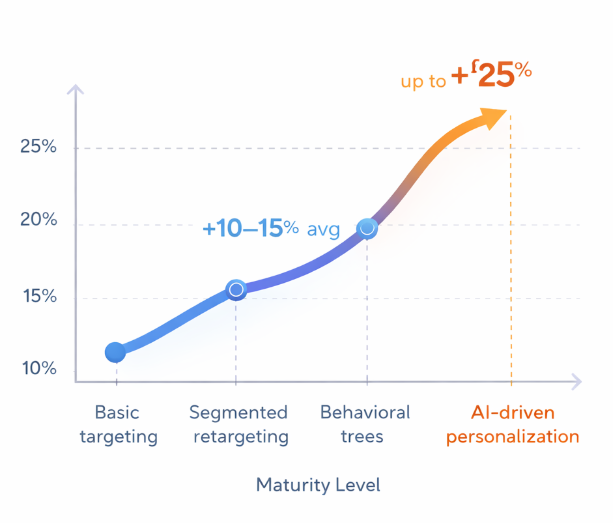
Conversion rate improvement increases with more advanced personalization and retargeting strategies
Step 1: Map the Funnel in Detail
Break down your funnel into granular stages, such as:
-
Awareness (content consumption)
-
Consideration (product exploration)
-
Intent (pricing, demos)
-
Decision (conversion actions)
Include micro-conversions, not just macro ones.
Step 2: Identify Key Behavioral Signals
Focus on high-signal actions that indicate intent. For example:
-
Repeated visits to product pages
-
Engagement with comparison content
-
Returning users within short intervals
According to Forrester, behavior-based segmentation can improve engagement rates by up to 50%.
Step 3: Design Branching Logic
Create conditional paths based on user behavior. For instance:
-
If user downloads a guide → show case studies
-
If user views pricing twice → show testimonials or offer
Avoid overly complex trees initially; start with 3–5 core branches and expand.
Step 4: Define Audience Durations
Timing is critical. Research shows that retargeting ads are most effective within the first 7 days after interaction.
Set clear durations for each node, such as:
-
1–3 days: high urgency messaging
-
4–7 days: value reinforcement
-
8–30 days: re-engagement
Step 5: Align Creative With Intent
Each node requires different messaging:
-
Early stage: educational content
-
Mid stage: differentiation
-
Late stage: urgency and incentives
Dynamic creative optimization can improve CTR by up to 50%, according to eMarketer.
Common Mistakes to Avoid
Overlapping Audiences
Failing to exclude users from previous nodes leads to message conflicts and wasted spend.
Overcomplication
Too many branches can make management difficult and reduce clarity. Start simple and iterate.
Ignoring Negative Signals
Users who disengage or bounce repeatedly should be moved to suppression or low-frequency nodes.
Static Messaging
If messaging does not evolve with user behavior, performance declines. Continuous testing is essential.
Measuring Performance
Key metrics for retargeting trees include:
-
Conversion rate by node
-
Cost per acquisition (CPA)
-
Time to conversion
-
Frequency vs. performance
According to Nielsen, campaigns that integrate sequential messaging outperform single-message campaigns by 30%.
Use cohort analysis to understand how users move through the tree and identify bottlenecks.
Advanced Strategies
Predictive Branching
Leverage machine learning to predict next-best actions based on historical data.
Cross-Channel Trees
Integrate retargeting across platforms (display, social, email) to maintain consistent messaging.
Intent Scoring
Assign scores to behaviors and dynamically move users between nodes based on cumulative intent.
Conclusion
Retargeting trees transform fragmented audience targeting into a structured, behavior-driven system. In complex funnels, this approach enables precise messaging, reduces waste, and significantly improves conversion performance.
As customer journeys continue to evolve, marketers who adopt retargeting trees will be better positioned to adapt, personalize, and scale their campaigns effectively.
Recommended Reading