Customer data is one of the most valuable assets a business owns. However, its impact is limited when it remains siloed within a CRM system. Integrating CRM data with advertising platforms enables more precise targeting, better attribution, and improved return on ad spend (ROAS).
According to industry research, companies that effectively leverage first-party data can achieve up to a 2.9x increase in revenue and a 1.5x improvement in cost efficiency. As third-party cookies phase out, the importance of CRM-driven advertising continues to grow.
Why CRM–Ad Platform Integration Matters
Connecting CRM data to ad platforms allows marketers to:
-
Build highly targeted audience segments based on real customer behavior
-
Improve conversion rates through personalized messaging
-
Optimize campaigns using offline and lifecycle data
-
Reduce wasted ad spend by excluding irrelevant audiences
A study by Salesforce found that 78% of high-performing marketing teams actively use customer data to drive campaign decisions, compared to just 37% of underperforming teams.
Key Data Types to Integrate
Not all CRM data should be pushed into ad platforms. Focus on high-impact data categories:
1. Customer Lifecycle Stages
Segment users based on where they are in the funnel: leads, marketing-qualified leads (MQLs), sales-qualified leads (SQLs), customers, and churned users.
2. Transactional Data
Purchase history, order value, and frequency help identify high-value segments and enable lookalike modeling.
3. Engagement Data
Email opens, website visits, and product interactions can be used to retarget or nurture users.
4. Offline Conversion Data
Uploading offline conversions improves attribution accuracy and allows platforms to optimize for real business outcomes.
Common Integration Methods
Native Integrations
Many ad platforms provide built-in CRM connectors. These are easy to set up but often limited in flexibility and data granularity.
API-Based Integration
Using APIs allows for real-time or near-real-time data syncing. This approach provides maximum control but requires technical resources.
Middleware and Data Platforms
Customer data platforms (CDPs) and integration tools act as intermediaries, enabling scalable and flexible data pipelines.
Best Practices for Effective Integration
Ensure Data Quality and Hygiene
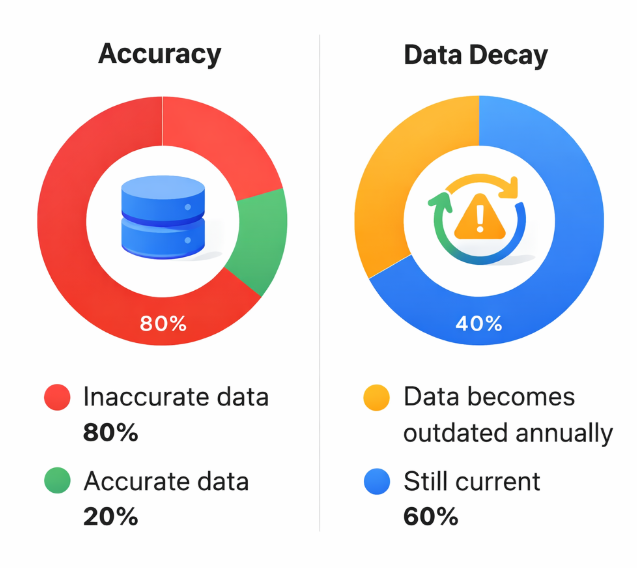
CRM data quality challenges: inaccuracies and rapid data decay affecting advertising performance
Poor data quality leads to ineffective targeting. Deduplicate records, standardize fields, and validate inputs regularly.
Prioritize Privacy and Compliance
Ensure compliance with regulations such as GDPR and CCPA. Use hashed identifiers and obtain proper user consent before activating data.
Use Incremental Syncing
Instead of full data uploads, implement incremental updates to reduce load and maintain freshness.
Align Marketing and Sales Teams
Successful integration requires collaboration between marketing and sales to define meaningful segments and KPIs.
Test and Iterate
Continuously test audience segments, messaging, and bidding strategies. Data-driven experimentation is key to optimization.
Measuring Success
To evaluate the effectiveness of CRM–ad platform integration, track the following metrics:
-
Conversion rate uplift
-
Cost per acquisition (CPA)
-
Return on ad spend (ROAS)
-
Customer lifetime value (CLV)
Organizations that integrate CRM data into their advertising strategies report up to a 30% increase in campaign efficiency and a 20% reduction in acquisition costs.
Common Challenges and How to Overcome Them
Data Silos
Break down silos by centralizing data or using integration layers.
Delayed Data Syncing
Implement real-time or frequent batch updates to maintain relevance.
Inconsistent Identifiers
Use unified identifiers such as email or customer IDs across systems.
Limited Technical Resources
Leverage no-code or low-code tools to simplify integration.
Conclusion
Connecting CRM data with advertising platforms is no longer optional—it is essential for competitive, data-driven marketing. By focusing on high-quality data, choosing the right integration method, and continuously optimizing campaigns, businesses can significantly improve performance and efficiency.
Further Reading