Modern websites rely on accurate event tracking to measure marketing performance, understand user behavior, and optimize conversion funnels. However, growing privacy requirements and poorly optimized consent banners often result in a significant loss of trackable events.
Why Event Loss Happens
Event tracking gaps are increasingly common due to privacy regulations and browser restrictions. When visitors do not provide consent, analytics platforms cannot record interactions such as page views, button clicks, purchases, or form submissions.
According to industry studies, between 20% and 40% of website traffic becomes untracked because visitors decline consent or abandon the banner without interacting with it. This creates blind spots in attribution models and marketing performance analysis.
Additionally, research from multiple analytics platforms shows that:
-
Up to 35% of users ignore consent banners entirely when the interface is confusing or intrusive.
-
Poorly designed banners can reduce consent rates by 15–25%.
-
Websites with optimized consent experiences can increase measurable analytics events by 10–30%.
These losses directly affect marketing teams that rely on data-driven decisions.
The Relationship Between Consent UX and Data Quality
Consent banners are not only legal tools; they are also user experience components that influence whether visitors allow tracking. A poorly implemented banner interrupts browsing, while a well-designed one integrates smoothly into the page.
Small design and behavioral changes can significantly affect consent rates and therefore the volume of recoverable analytics events.
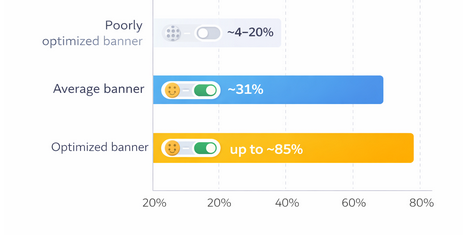
Average cookie consent acceptance rates vary dramatically depending on banner design, ranging from under 10% to more than 80%
Improved consent UX typically leads to:
-
Higher acceptance rates
-
Lower bounce rates after page load
-
More complete behavioral datasets
When consent rates increase, analytics systems regain visibility into user journeys that would otherwise remain hidden.
Practical Strategies to Improve Consent Rates
1. Simplify the Banner Interface
Complex consent interfaces discourage interaction. Many banners present several layers of settings before users can proceed, which increases friction.
Effective banners follow three key principles:
-
Clear language explaining why tracking is used
-
Simple choices such as "Accept" or "Customize"
-
Minimal steps to proceed
Studies show that simplifying consent interfaces can increase acceptance rates by 8–12%.
2. Improve Banner Placement and Timing
Placement strongly affects user behavior. Banners that immediately block the entire page often lead to quick dismissals or exits.
Better-performing implementations typically:
-
Use non-intrusive bottom or corner banners
-
Allow users to continue reading content
-
Delay banner appearance by a few seconds
Testing different placements frequently produces measurable improvements in consent rates.
3. Use Visual Hierarchy Carefully
Design details such as button color, spacing, and typography influence how users interact with the banner.
Effective design patterns include:
-
Clearly visible primary consent action
-
Balanced button contrast
-
Concise supporting text
Even small UI adjustments can increase consent interaction rates by 5–10%.
4. Run A/B Tests on Consent Variations
Consent banners should be optimized the same way landing pages are optimized.
Testing variables such as wording, layout, and placement can uncover patterns that significantly improve consent acceptance.
Organizations that actively experiment with banner variations often recover 10–20% more measurable events compared to static implementations.
Measuring Event Recovery
Improving consent banners should always be accompanied by measurement. Teams need to understand how changes affect both consent rates and the volume of recovered events.
Key metrics to monitor include:
-
Consent acceptance rate
-
Number of recoverable events
-
Changes in attribution accuracy
-
Conversion tracking completeness
Tracking these metrics allows teams to determine whether UX improvements translate into better analytics visibility.
Compliance and Transparency
While optimizing consent banners, organizations must maintain transparency and compliance with privacy regulations such as GDPR and similar frameworks.
Best practices include:
-
Clear explanation of tracking purposes
-
Accessible preference management
-
Easy consent withdrawal options
Maintaining user trust is essential. Optimization should never come at the expense of transparency.
The Strategic Importance of Event Recovery
When event tracking gaps accumulate, marketing teams lose insight into campaign performance and user behavior. This leads to inaccurate attribution, inefficient budget allocation, and slower growth.
Improving consent banner design is one of the most practical ways to restore lost data signals without violating privacy requirements. Even modest improvements in consent rates can restore thousands of previously missing events each month on high‑traffic websites.
Recommended Reading
To further improve tracking accuracy and data reliability, explore these additional articles: