
As third-party cookies deprecate and browser-side tracking faces increasing restrictions, server-side tracking has moved from an experimental enhancement to a mission-critical infrastructure component. High-volume advertisers—processing millions of events per day—must treat Conversion API implementation as a scalable data engineering initiative rather than a simple integration.
Recent industry data indicates:
-
Up to 20–35% of browser-based conversion events can be lost due to tracking restrictions and signal degradation.
-
Server-side tracking can improve event match quality by 10–20% when properly configured.
-
Advertisers operating hybrid tracking (Pixel + Conversion API) frequently see measurable CPA reductions when event deduplication and identity parameters are optimized.
Scaling Conversion API effectively requires architectural planning, rigorous validation, and continuous optimization.
1. Architect for Event Volume and Redundancy
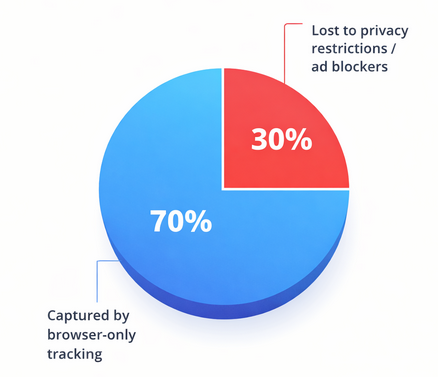
Estimated share of browser-based conversion signals lost to privacy restrictions and tracking blocks
High-volume advertisers must assume peak load variability. Campaign launches, seasonal spikes, and flash promotions can multiply event throughput within minutes.
Key Infrastructure Considerations
Queue-based event processing
Implement asynchronous processing layers (e.g., message queues) to prevent API throttling during traffic surges.
Retry logic and failure handling
Design exponential backoff and logging systems to reprocess failed events without duplication.
Batching vs. real-time streaming
For high-frequency events, batching can reduce overhead while maintaining latency thresholds acceptable for optimization algorithms.
A resilient pipeline ensures event integrity under scale rather than degrading performance during peak traffic.
2. Maximize Event Match Quality (EMQ)
Scaling volume without optimizing match quality is counterproductive. Platforms prioritize deterministic identifiers.
Critical Identity Parameters
-
Email (hashed)
-
Phone number (hashed)
-
External ID
-
IP address
-
User agent
-
Click identifiers (e.g., fbc, fbclid equivalents)
High-volume advertisers should implement:
-
Systematic hashing normalization
-
Field validation before dispatch
-
Identity enrichment at CRM or CDP level
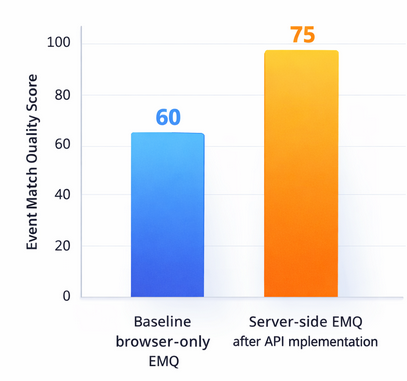
Server-side event sending substantially increases event match quality compared with browser-only tracking
Improving EMQ from "Average" to "Great" can significantly enhance algorithmic optimization. At scale, even a 5% lift in match rate can materially influence CPA and ROAS.
3. Implement Rigorous Deduplication Logic
Hybrid tracking (browser + server) is best practice, but without deterministic deduplication, double counting occurs.
Deduplication Framework
-
Unique event_id generation at the client
-
Event_id persistence through backend processing
-
Synchronized timestamp alignment
High-volume advertisers should maintain centralized event_id governance rather than generating IDs in fragmented systems. Deduplication failures at scale distort reporting and misguide budget allocation.
4. Monitor Data Freshness and Latency
Optimization systems rely on timely event ingestion. Delayed server-side events reduce algorithmic learning efficiency.
Enterprise benchmarks indicate:
-
Sub-5-minute delivery is optimal for performance stability
-
Delays exceeding 30 minutes can reduce learning responsiveness
Implement:
-
Real-time monitoring dashboards
-
Latency alerts
-
Event ingestion SLA tracking
Scaling without observability introduces hidden inefficiencies that compound over time.
5. Enforce Data Governance and Schema Discipline
At high event volumes, minor inconsistencies multiply into systemic data corruption.
Best Practices
-
Standardized event naming conventions
-
Strict schema version control
-
Automated payload validation
-
Change management documentation
When marketing, engineering, and analytics teams operate with inconsistent schemas, attribution becomes unreliable.
6. Optimize for Signal Prioritization
Not all events carry equal optimization value.
High-volume advertisers should:
-
Prioritize high-intent events
-
Align event hierarchy with revenue impact
-
Minimize low-value noise events
Signal prioritization ensures algorithmic systems learn from revenue-driving actions rather than superficial micro-conversions.
7. Integrate CRM and Offline Conversions
Server-side tracking enables full-funnel measurement, including offline events.
Advertisers integrating CRM-based revenue signals report:
-
Improved downstream ROAS visibility
-
More accurate lifetime value optimization
-
Stronger audience modeling
Passing qualified lead stages, pipeline progression, and revenue confirmations enhances bidding intelligence beyond surface-level conversions.
8. Continuous Validation and A/B Testing
Conversion API scaling is not a one-time deployment.
Establish ongoing validation cycles:
-
Compare Pixel-only vs. Hybrid tracking
-
Analyze match quality trends
-
Monitor CPA volatility post-deployment
Enterprise advertisers treating server-side tracking as an iterative optimization layer outperform static implementations.
Common Scaling Pitfalls
-
Treating Conversion API as a plug-and-play solution
-
Ignoring identity normalization
-
Failing to monitor event discrepancies
-
Overlooking offline revenue feedback loops
Each of these issues magnifies at scale.
Operational Checklist for High-Volume Advertisers
-
Infrastructure load-tested for peak events
-
Centralized event_id governance
-
Identity enrichment pipeline operational
-
Real-time monitoring dashboards active
-
Schema version control enforced
-
Offline conversion loop integrated
-
Quarterly tracking audit scheduled
Conclusion
Scaling Conversion API for high-volume advertising is fundamentally an engineering and data strategy initiative. Properly executed, it restores lost signals, enhances attribution fidelity, and strengthens algorithmic optimization in privacy-constrained environments.
Advertisers who approach server-side tracking as scalable infrastructure—rather than a tactical add-on—create durable competitive advantage.