In digital advertising, creative performance determines success faster than targeting, bidding, or placement. Yet teams often face the same dilemma: should they keep improving what already works, or scrap everything and start fresh?
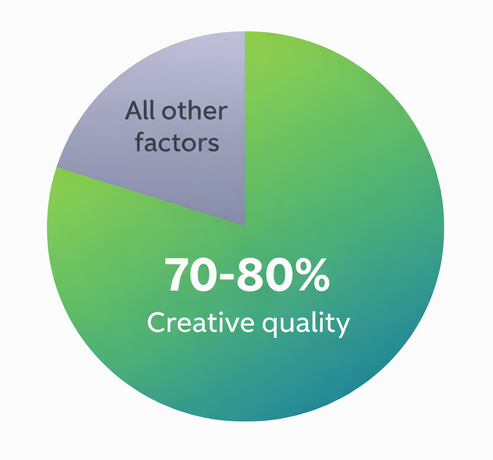
Creative quality accounts for 70–80% of overall ad performance, underscoring why iterative improvement should be prioritized in campaign strategies
The answer is not binary. Creative iteration and creative reinvention serve different purposes, and knowing when to apply each can dramatically impact cost efficiency, learning speed, and long-term growth.
What Creative Iteration Really Means
Creative iteration focuses on controlled, incremental changes to existing assets. The core idea remains intact while individual variables are tested and refined.
Typical iteration elements include:
-
Headline variations
-
Hook timing in video ads
-
Visual framing or color contrast
-
CTA wording
-
Primary text length or structure
Iteration works because it preserves proven signals while isolating what actually drives performance.
Why Iteration Performs So Well
According to Meta campaign benchmarks, advertisers who continuously test creative variations within the same concept see up to 20–30% lower cost per conversion compared to campaigns that launch entirely new creatives without historical context.
Iteration also compounds learning. Each variation adds signal, allowing algorithms to optimize faster and with less budget volatility.
When Reinvention Becomes Necessary
Creative reinvention means introducing a completely new concept: a new message, angle, or narrative structure.

Engagement increases by up to 38% when creatives are refreshed every 4–6 weeks, highlighting the impact of timely creative updates on audience interest
Reinvention is most effective when:
-
Frequency rises above 2.5 and performance declines
-
The audience has saturated and engagement drops
-
Market conditions or user intent shifts
-
A new product, feature, or positioning is introduced
In these cases, iteration can no longer overcome fatigue because the core idea itself has lost relevance.
The Cost of Reinventing Too Often
While reinvention feels innovative, it is expensive. Industry data shows that brand-new creative concepts can take 40–60% more spend to reach stable performance compared to iterated variants built on proven structures.
Frequent reinvention also resets learning, delaying optimization and increasing volatility in results.
Iteration vs Reinvention: A Performance Comparison
High-performing advertisers typically follow a 70/30 rule:
-
70% of creative efforts go toward iteration of top-performing concepts
-
30% toward testing entirely new ideas
This balance maintains efficiency while preventing stagnation. Accounts that follow this approach consistently outperform those that rely heavily on constant reinvention, with higher ROAS stability over time.
A Practical Decision Framework
Before choosing iteration or reinvention, ask:
-
Is the creative still generating engagement but declining in conversion rate?
→ Iterate -
Has engagement collapsed across all variants?
→ Reinvent -
Is performance stable but growth has plateaued?
→ Iterate and test one new concept in parallel
This framework prevents emotional decision-making and keeps creative strategy grounded in data.
Common Mistakes to Avoid
-
Killing creatives too early without enough spend
-
Reinventing based on intuition instead of performance signals
-
Testing too many variables at once
-
Ignoring audience overlap and creative fatigue
Creative success is rarely about brilliance—it is about discipline.
Conclusion
Creative iteration scales efficiency. Creative reinvention restores relevance. The most effective advertisers do not choose one over the other—they build a system that uses both intentionally.
When iteration is treated as a structured process and reinvention as a strategic reset, creative performance becomes predictable, scalable, and far less dependent on guesswork.