When teams move beyond founder-led advertising, paid media performance often becomes inconsistent. Campaigns multiply, channels expand, and decision-making fragments. A documented playbook creates alignment by defining how budgets are allocated, how audiences are built, and how success is measured.
According to industry benchmarks, companies with documented marketing processes are 33% more likely to report consistent year-over-year growth. For paid media teams, structure is often the difference between profitable scale and rising acquisition costs.
Playbook 1: Budget Allocation by Funnel Stage
Growing teams frequently overspend on acquisition while underinvesting in mid- and bottom-funnel performance.
A resilient paid media budget typically follows this distribution:
-
50–60% on acquisition (prospecting and audience expansion)
-
25–30% on retargeting and consideration
-
10–20% on conversion-focused campaigns
It focuses on repeatable systems, clear ownership, and audience precision rather than ad-hoc experimentation.
Teams that rebalance budgets toward retargeting often see 2–3x higher conversion rates compared to cold traffic, while maintaining lower cost per acquisition.
Playbook 2: Audience Precision Before Creative Volume
As teams grow, the instinct is to increase creative output. While testing creatives is essential, audience quality has a stronger impact on efficiency at scale.
Performance data across paid social platforms shows:
-
High-intent audiences convert 60–70% better than broad or interest-only targeting
-
Smaller, refined audiences typically deliver 20–35% lower acquisition costs
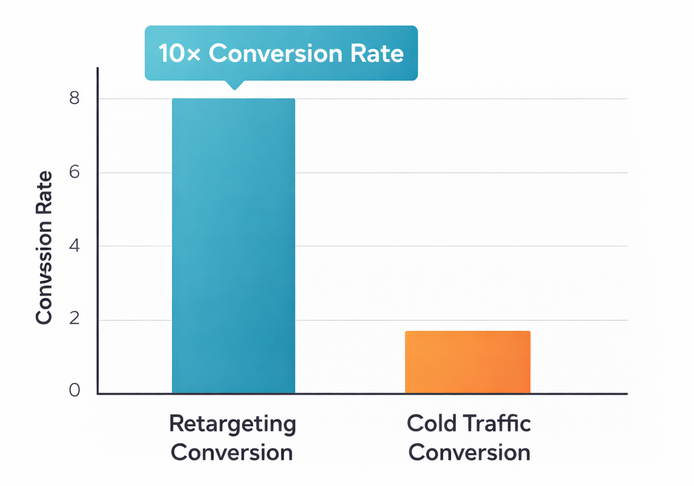
Comparison of conversion rates between retargeting audiences and cold traffic, highlighting the efficiency of audience refinement
Scaling teams should prioritize audience strategy reviews on a monthly cadence, ensuring segmentation evolves alongside product-market fit.
Playbook 3: Testing Frameworks That Scale
Unstructured testing leads to noise rather than insight. Growing teams benefit from standardized testing frameworks:
-
Test one variable at a time (audience, creative, or offer)
-
Maintain a minimum 7-day learning period before evaluation
-
Document outcomes in a shared testing log
Teams that follow structured testing frameworks reduce wasted spend by up to 25% while accelerating learning velocity.
Playbook 4: Clear Ownership and Reporting
Paid media performance declines when accountability is unclear. Scaling teams should define:
-
A single owner per channel
-
Weekly performance reviews focused on leading indicators
-
Monthly deep dives tied to revenue impact
Organizations with clear ownership models are 40% more likely to hit quarterly growth targets, according to marketing operations surveys.
Playbook 5: Incremental Scaling Over Budget Spikes
Sudden budget increases often disrupt platform learning phases. Sustainable growth comes from incremental scaling:
-
Increase budgets in 10–20% increments
-
Scale winning audiences before expanding new ones
-
Protect top-performing campaigns from frequent edits
Brands that scale incrementally report 15–25% more stable ROAS compared to teams that rely on aggressive budget jumps.
Recommended Reading
To deepen your paid media strategy, consider these related articles:
Final Thoughts
Paid media success for growing teams is less about hacks and more about systems. Playbooks create clarity, reduce friction, and allow teams to scale with confidence. By focusing on audience precision, structured testing, and disciplined scaling, marketing teams can turn paid media into a predictable growth engine rather than a volatile cost center.