Poor audience segmentation rarely causes campaigns to collapse overnight. Instead, it slowly erodes performance — increasing costs, diluting relevance, and masking real demand. Many teams interpret these symptoms as creative fatigue or platform saturation, when the real issue is simpler: ads are shown to the wrong people.
The cost of weak segmentation isn’t just wasted ad spend. It affects data quality, optimization speed, and long-term growth decisions.
The Direct Financial Cost
When audiences are too broad or poorly defined, platforms compensate by testing aggressively. That experimentation is expensive.
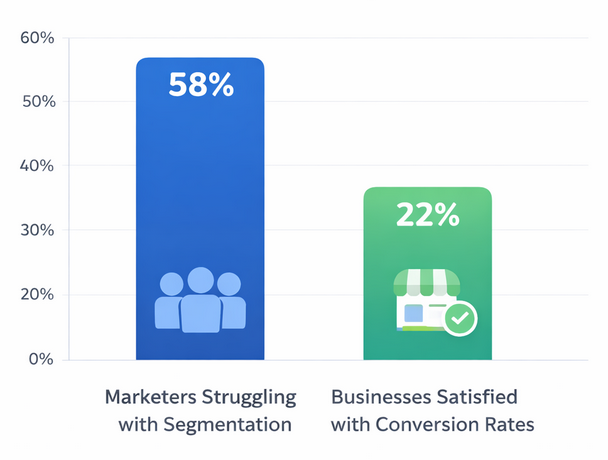
Percentage of marketers struggling with audience segmentation compared to businesses satisfied with conversion performance
Industry benchmarks consistently show that:
-
Broad, non-segmented audiences can cost 30–60% more per conversion than well-defined lookalike or data-enriched audiences.
-
Campaigns targeting refined segments often reach statistical significance 2× faster, reducing learning-phase spend.
This means that even if a campaign eventually becomes profitable, it may require thousands in unnecessary spend to get there.
The Hidden Cost: Data Pollution
Poor segmentation doesn’t just waste money — it corrupts performance data.
When ads reach users with low intent:
-
Click-through rates decline, lowering algorithmic confidence
-
Conversion signals become noisy
-
Optimization models learn from irrelevant behavior
According to multiple ad platform studies, up to 40% of optimization signals in broad campaigns come from users who never had real purchase intent. This skews future targeting and makes scaling riskier.
Slower Learning, Slower Growth
Modern ad platforms rely on feedback loops. The tighter the audience, the faster the loop.
Well-segmented campaigns typically:
-
Exit learning phases 35–50% faster
-
Require fewer creative variants to stabilize
-
Scale with smaller budget jumps and less volatility
Poor segmentation, by contrast, forces teams to “buy data” at scale — paying to discover what should have been known upfront.
Opportunity Cost: Missed Demand
Perhaps the most expensive consequence is invisible: missed high-intent users.
When high-value segments are blended with low-quality traffic:
-
Budget is evenly distributed instead of prioritized
-
High-intent users see ads less frequently
-
Conversion windows are missed
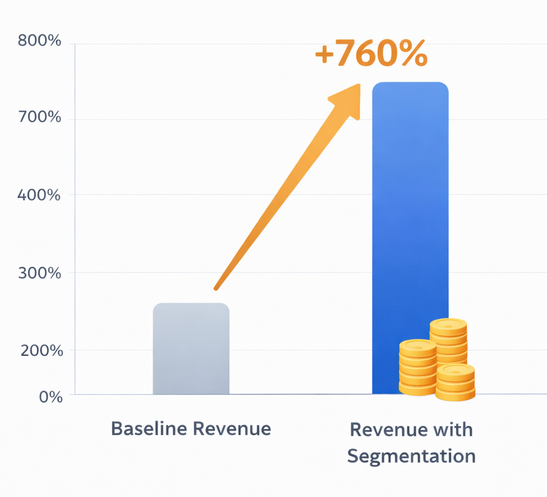
Revenue increase potential when campaigns use refined audience segmentation
Studies on audience refinement show that top 20% intent-based segments can generate over 50% of total conversions when isolated and scaled correctly.
Why This Problem Persists
Poor segmentation isn’t usually caused by lack of data, but by underutilization of it.
Common reasons include:
-
Reliance on surface-level interests
-
Limited use of competitor, community, or behavioral signals
-
Overconfidence in broad targeting defaults
Without external data enrichment, segmentation remains shallow — even with large budgets.
Conclusion
The real cost of poor audience segmentation isn’t visible in a single report. It shows up over time as rising acquisition costs, slower learning, unstable scaling, and flawed strategic decisions.
Better segmentation doesn’t just improve performance — it protects data integrity and accelerates growth. In a landscape where attention is expensive, precision is no longer optional.