Enterprise sales cycles are long, complex, and involve multiple stakeholders. Traditional prospecting methods—cold outreach, static lists, and generic messaging—are no longer sufficient. Today’s top-performing sales teams rely on data-driven prospecting to prioritize the right accounts, engage decision-makers with precision, and increase conversion rates.
Data-driven prospecting uses a combination of firmographic, behavioral, and intent data to guide outreach efforts. By analyzing these signals, sales teams can focus on prospects that are most likely to convert.
Why Data-Driven Prospecting Matters
The shift toward data-driven prospecting is supported by compelling statistics:
-
Organizations using data-driven sales strategies are 23% more likely to outperform competitors in revenue growth.
-
Companies that leverage intent data see up to a 78% increase in conversion rates.
-
91% of sales teams report that data-driven insights improve lead prioritization.
-
Personalized outreach based on data can increase response rates by over 2x.
These numbers highlight a clear trend: better data leads to better decisions—and better results.
Core Components of Data-Driven Prospecting
1. Ideal Customer Profile (ICP) Definition
A strong ICP is the foundation of any successful prospecting strategy. It includes:
-
Industry and company size
-
Revenue range
-
Geographic location
-
Technology stack
-
Buying triggers
By clearly defining the ICP, sales teams can narrow their focus to accounts that closely match their best customers.
2. Firmographic and Technographic Data
Firmographic data provides basic company information, while technographic data reveals the tools and technologies a company uses. Together, they help identify:
-
Compatibility with your solution
-
Potential integration opportunities
-
Competitive positioning
3. Buyer Intent Signals
Intent data captures online behaviors that indicate a company is actively researching solutions. These signals may include:
-
Content consumption patterns
-
Search activity
-
Engagement with relevant topics
Companies using intent data can identify prospects earlier in the buying journey and engage them before competitors.
4. Behavioral Data and Engagement Tracking
Tracking how prospects interact with your content—such as email opens, website visits, and ad engagement—provides valuable insights into their level of interest.
Sales teams can use this data to:
-
Prioritize warm leads
-
Tailor follow-up messages
-
Time outreach more effectively
Building a Data-Driven Prospecting Workflow
Step 1: Data Collection and Integration
Aggregate data from multiple sources, including CRM systems, marketing platforms, and third-party providers. Ensure that all data is centralized and regularly updated.
Step 2: Data Enrichment
Enhance existing records with additional attributes such as job roles, company growth metrics, and technology usage. Enriched data enables more precise segmentation.
Step 3: Lead Scoring and Prioritization
Use scoring models to rank prospects based on fit and intent. High-scoring leads should be prioritized for immediate outreach.
Step 4: Segmentation and Personalization
Segment prospects based on shared characteristics and tailor messaging accordingly. Personalized outreach significantly improves engagement.
Step 5: Continuous Optimization
Analyze performance metrics such as response rates, conversion rates, and pipeline velocity. Use these insights to refine targeting and messaging strategies.
Common Challenges and How to Overcome Them
Data Quality Issues
Incomplete or outdated data can lead to poor targeting. Regular data cleansing and validation are essential.
Over-Reliance on Volume
Focusing on quantity over quality can dilute results. Data-driven prospecting emphasizes precision over mass outreach.
Misalignment Between Sales and Marketing
Ensure both teams share the same data definitions, goals, and metrics to create a unified approach.
Measuring Success in Data-Driven Prospecting
Key metrics to track include:
-
Conversion rate from prospect to opportunity
-
Pipeline velocity
-
Average deal size
-
Response and engagement rates
-
Cost per qualified lead
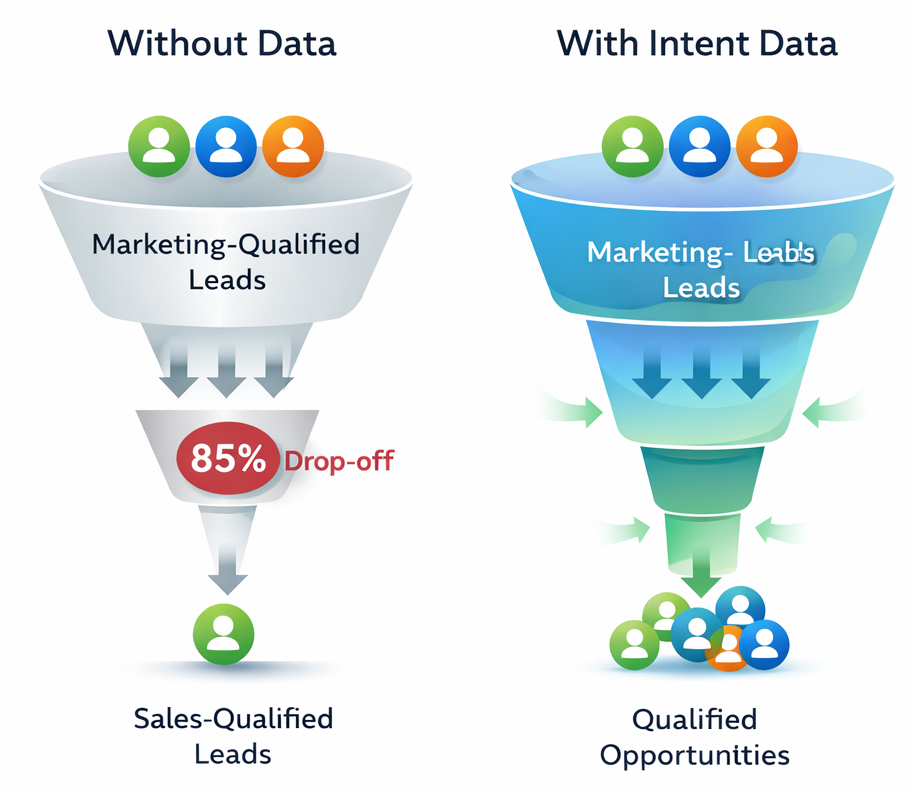
Using intent data significantly reduces funnel drop-off and improves lead qualification efficiency
Organizations that consistently monitor these metrics can identify areas for improvement and scale successful strategies.
Future Trends in Enterprise Prospecting
Data-driven prospecting continues to evolve with advancements in AI and predictive analytics. Emerging trends include:
-
Predictive lead scoring models
-
Real-time intent signal tracking
-
Automated personalization at scale
-
Integration of sales and marketing data ecosystems
These innovations will further enhance the ability of sales teams to identify and engage high-value prospects.
Conclusion
Data-driven prospecting is no longer optional in enterprise sales—it is a necessity. By leveraging accurate data, refining targeting strategies, and continuously optimizing workflows, sales teams can significantly improve efficiency and outcomes.
Organizations that invest in data-driven approaches will be better positioned to navigate complex sales cycles, build stronger relationships, and drive sustainable revenue growth.