Customer Relationship Management (CRM) systems are only as powerful as the data they contain. Incomplete, outdated, or inconsistent data leads to missed opportunities, poor targeting, and inefficient sales cycles. Data enrichment pipelines solve this problem by systematically enhancing CRM records with accurate, up-to-date, and actionable information.
Organizations that implement structured data enrichment workflows consistently outperform competitors in lead conversion, personalization, and customer retention.
What Are Data Enrichment Pipelines?
A data enrichment pipeline is a structured process that enhances raw CRM data by appending, validating, and standardizing information from internal and external sources.
These pipelines typically operate in real-time or batch processing modes and are designed to:
-
Fill missing data fields (e.g., job title, company size, industry)
-
Validate and correct inaccurate entries
-
Append behavioral, firmographic, and technographic insights
-
Normalize data for consistency across systems
Why Data Enrichment Matters for CRM Performance
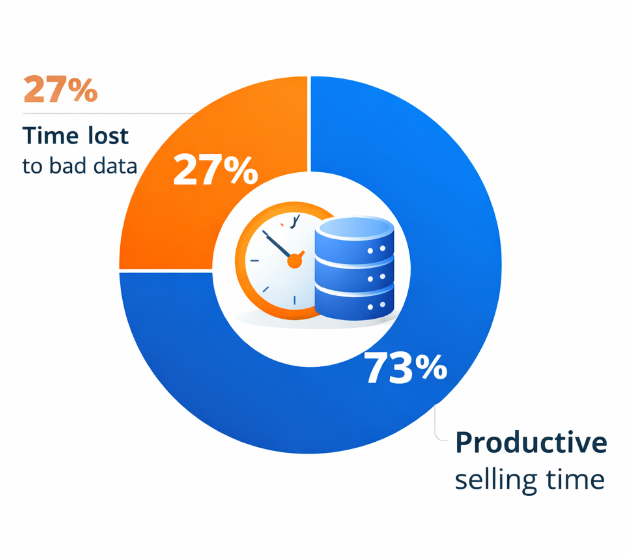
Poor CRM data quality significantly reduces sales productivity, consuming over a quarter of working time
Poor data quality is a widespread issue. According to industry research:
-
Up to 30% of CRM data becomes outdated every year
-
Sales teams waste approximately 27% of their time dealing with bad data
-
Organizations lose 15–25% of revenue due to poor data quality
By contrast, companies that prioritize data quality and enrichment report:
-
20–40% higher lead conversion rates
-
Up to 50% improvement in campaign performance
-
30% reduction in customer acquisition costs
These gains highlight the direct connection between enriched data and revenue growth.
Key Components of a Data Enrichment Pipeline
1. Data Collection Layer
This layer gathers raw data from multiple sources, including:
-
CRM inputs (forms, imports, integrations)
-
Marketing platforms
-
Third-party data providers
2. Data Cleaning and Validation
Before enrichment, data must be standardized and validated:
-
Remove duplicates
-
Correct formatting errors
-
Verify email addresses and phone numbers
3. Enrichment Engine
This is the core of the pipeline, where additional attributes are appended:
-
Firmographic data (industry, company size, revenue)
-
Demographic data (job role, seniority)
-
Technographic data (software stack, tools used)
-
Intent data (purchase signals, engagement patterns)
4. Data Normalization
To ensure consistency across systems:
-
Standardize job titles and company names
-
Align taxonomy across marketing and sales platforms
5. Synchronization and Activation
Enriched data is then synced back into the CRM and activated across:
-
Marketing automation tools
-
Sales engagement platforms
-
Advertising systems
Types of Data Enrichment
Firmographic Enrichment
Enhances company-level data such as:
-
Industry classification
-
Employee count
-
Annual revenue
Demographic Enrichment
Adds individual-level attributes:
-
Job title
-
Department
-
Seniority level
Behavioral Enrichment
Tracks user actions and engagement:
-
Website visits
-
Content downloads
-
Email interactions
Technographic Enrichment
Provides insight into tools and technologies used by a company.
Real-Time vs Batch Enrichment
Real-Time Enrichment
-
Updates data instantly during user interactions
-
Ideal for lead capture and routing
-
Improves response time and personalization
Batch Enrichment
-
Processes large datasets at scheduled intervals
-
Suitable for database maintenance and large-scale updates
A hybrid approach is often the most effective strategy.
Best Practices for Building Enrichment Pipelines
Prioritize Critical Data Fields
Focus on enriching fields that directly impact revenue:
-
Contact accuracy
-
Job role and decision-making authority
-
Company size and industry
Automate Wherever Possible
Manual data handling introduces errors and inefficiencies. Automation ensures consistency and scalability.
Maintain Data Governance Standards
Define clear rules for:
-
Data formatting
-
Field usage
-
Update frequency
Monitor Data Quality Metrics
Track key indicators such as:
-
Completeness rate
-
Accuracy rate
-
Duplicate rate
Ensure Compliance
Adhere to data privacy regulations such as GDPR and CCPA when handling and enriching personal data.
Common Challenges
Data Decay
Contact and company data naturally degrade over time, requiring continuous enrichment.
Integration Complexity
Connecting multiple data sources and systems can be technically challenging.
Cost Management
Balancing enrichment depth with budget constraints is essential.
Data Overload
Excessive data can reduce usability. Focus on actionable insights rather than volume.
Use Cases
Lead Scoring Optimization
Enriched data improves scoring accuracy by incorporating firmographic and behavioral signals.
Account-Based Marketing (ABM)
Detailed company insights enable precise targeting and personalization.
Sales Prospecting
Sales teams gain access to high-quality, actionable data for outreach.
Customer Segmentation
Improved segmentation leads to more relevant campaigns and higher engagement.
Measuring Success
To evaluate the effectiveness of a data enrichment pipeline, track:
-
Lead-to-opportunity conversion rate
-
Campaign ROI
-
Data completeness and accuracy
-
Sales cycle length
Continuous optimization based on these metrics ensures long-term performance gains.
Conclusion
Data enrichment pipelines are no longer optional for organizations that rely on CRM systems. They are a foundational component of modern revenue operations, enabling better targeting, faster sales cycles, and improved customer experiences.
By implementing a structured, automated, and scalable enrichment strategy, businesses can unlock the full potential of their CRM data and drive measurable growth.
Suggested Articles for Further Reading