Most marketers spend hours optimizing creatives, bids, and placements, yet overlook the quality of the data feeding their campaigns. Data hygiene refers to the accuracy, freshness, structure, and relevance of the datasets used for targeting, optimization, and measurement. When inputs are messy, even the most sophisticated ad platforms optimize in the wrong direction.
Industry research consistently shows that data quality directly affects revenue outcomes. According to multiple marketing analytics studies, organizations estimate that poor-quality data costs between 10–25% of annual revenue, largely through wasted ad spend and missed conversions. In paid media, those losses show up as higher cost per acquisition (CPA), weaker learning phases, and unstable performance.
Clean data doesn’t just support better reporting — it actively improves delivery, targeting precision, and algorithmic learning.
What "dirty data" looks like in advertising
Dirty data isn’t always obvious. Campaigns may still spend and generate conversions, but performance plateaus or degrades over time. Common symptoms include:
-
Outdated audience segments that no longer reflect user intent
-
Duplicate or overlapping inputs that confuse delivery algorithms
-
Incomplete attributes (missing locations, devices, or behavioral signals)
-
Noisy signals from low-quality traffic sources
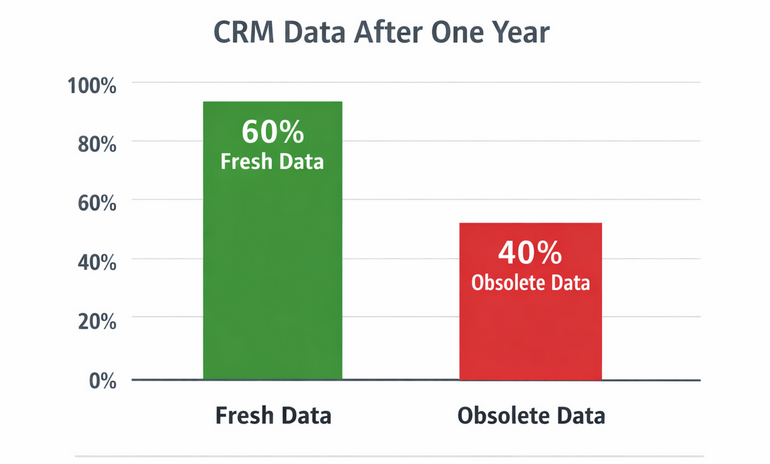
Annual rate of CRM data becoming obsolete – nearly 40% of marketing contacts may be outdated after one year
A widely cited benchmark in digital marketing shows that up to 30% of CRM and audience data becomes outdated every year. In fast-moving markets, that decay rate can be even higher.
When platforms train on stale or inaccurate signals, they optimize toward users who look good on paper but don’t convert in reality.
The compounding cost of bad inputs
Ad platforms rely on machine learning models that reward consistency and clarity. Bad data does not fail once — it compounds over time.
Consider these performance impacts observed across large-scale paid media accounts:
-
Campaigns using well-maintained audience data see 15–35% lower CPA compared to accounts with unmanaged datasets
-
Clean, segmented inputs help platforms exit learning phases 20–40% faster, stabilizing results sooner
-
Removing low-quality or duplicate audience sources can increase conversion rates by up to 25% without increasing spend
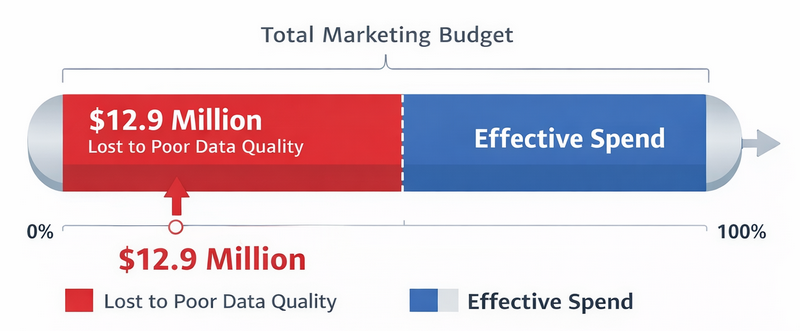
Average annual cost incurred by organizations due to poor data quality — $12.9 million
These gains come not from changing ads, but from improving what the system learns from.
Core principles of data hygiene for marketers
1. Relevance over volume
More data is not better if it’s unfocused. Large, unfiltered datasets often dilute high-intent signals. Prioritize relevance: recent activity, meaningful engagement, and clear behavioral indicators.
2. Freshness is non-negotiable
Audience data should reflect current behavior, not historical assumptions. Regular refresh cycles ensure targeting aligns with how users act today, not months ago.
3. Consistency across sources
When datasets conflict — for example, different naming conventions or mismatched attributes — optimization suffers. Standardization allows platforms to interpret signals correctly.
4. Intent signals matter more than demographics
Behavioral and engagement-based data consistently outperforms broad demographic targeting. Clean intent data gives algorithms something actionable to learn from.
Measuring the impact of clean data
Improving data hygiene should show up in measurable outcomes. Key indicators include:
-
Reduced CPA and cost per click (CPC)
-
Faster stabilization after campaign launches
-
Higher conversion rates within the same budget
-
More predictable scaling performance
According to performance marketing benchmarks, advertisers who regularly audit and clean their data inputs are 2x more likely to report consistent month-over-month results compared to those who do not.
Operational habits that keep data clean
Data hygiene is not a one-time fix. It’s an operational discipline. High-performing teams tend to:
-
Schedule routine data audits (monthly or quarterly)
-
Remove or refresh underperforming segments
-
Validate new data sources before scaling spend
-
Document audience logic to avoid silent overlap and decay
Over time, these habits reduce wasted spend and make performance more predictable.
Conclusion: Better ads start before the ad account
Ad performance doesn’t begin with creative or bidding — it begins with inputs. Clean data gives algorithms clarity, accelerates learning, and protects budgets from silent inefficiencies.
In an environment where paid media costs continue to rise, data hygiene is no longer optional. It’s one of the few levers marketers fully control — and one of the most overlooked sources of competitive advantage.
Recommended reading
To deepen your understanding of data-driven targeting and performance optimization, explore these related articles: