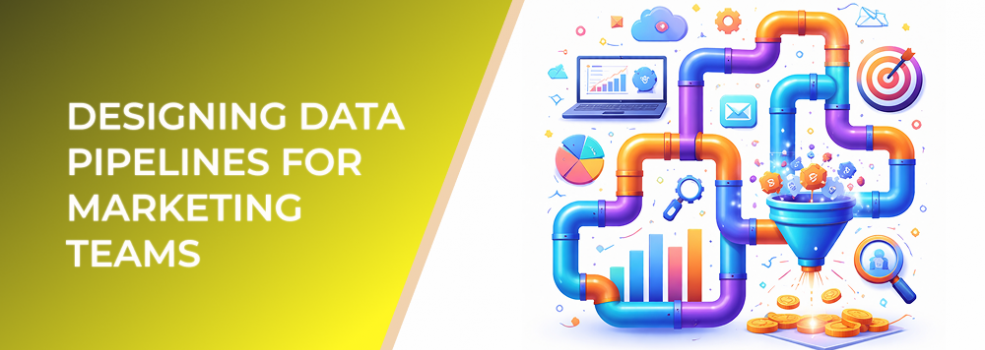
Modern marketing teams operate across dozens of platforms: ad networks, CRM systems, website analytics tools, marketing automation platforms, and sales databases. Each system generates valuable but fragmented data. Without a structured data pipeline, reporting becomes inconsistent, attribution is unreliable, and optimization slows down.
According to industry research, organizations that use integrated marketing analytics are 2.6 times more likely to outperform competitors in revenue growth. At the same time, poor data quality costs companies an average of $12.9 million annually. These statistics highlight a critical reality: marketing success increasingly depends on data engineering discipline.
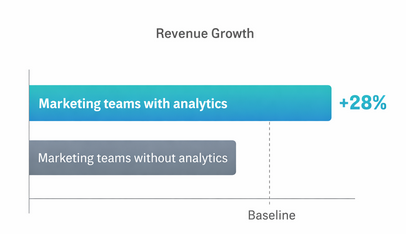
Marketing teams that leverage analytics experience up to 28% faster revenue growth compared with teams that do not use advanced data analytics
Designing an effective data pipeline is not just a technical initiative; it is a strategic marketing investment.
What Is a Marketing Data Pipeline?
A marketing data pipeline is a structured workflow that:
-
Extracts data from multiple marketing and sales platforms.
-
Transforms and standardizes that data.
-
Loads it into a central storage system (data warehouse or lake).
-
Makes it accessible for reporting, segmentation, automation, and modeling.
In practical terms, it connects ad impressions to website sessions, sessions to leads, leads to opportunities, and opportunities to revenue.
Core Components of a Marketing Data Pipeline
1. Data Sources
Typical sources include:
-
Paid advertising platforms
-
CRM systems
-
Web analytics tools
-
Email marketing platforms
-
Offline conversion data
The challenge is not volume alone. It is heterogeneity. Each system uses different schemas, naming conventions, and attribution logic.
2. Data Extraction (ETL/ELT)
Marketing pipelines usually rely on ETL (Extract, Transform, Load) or ELT architectures. Modern stacks increasingly favor ELT, where raw data is loaded first and transformed inside the warehouse.
Best practices include:
-
API-based automated extraction
-
Incremental sync instead of full refresh
-
Monitoring for schema changes
3. Data Transformation
This is where marketing logic is enforced. Transformations typically include:
-
Campaign name normalization
-
Channel grouping
-
Currency conversion
-
Attribution modeling
-
Deduplication of leads
Without strict transformation standards, dashboards become inconsistent across departments.
4. Data Storage
Centralized storage typically involves a cloud data warehouse. The warehouse must support:
-
High query performance
-
Structured and semi-structured data
-
Role-based access control
A well-designed warehouse schema reduces reporting friction and supports long-term scalability.
5. Data Activation
The final stage enables:
-
BI dashboards
-
Automated reporting
-
Audience segmentation
-
Retargeting and personalization
-
Predictive analytics
Research shows that companies using advanced customer segmentation experience up to 20% higher sales opportunities compared to those using basic segmentation.
Designing for Marketing Use Cases
Attribution and Funnel Analysis
A strong pipeline allows multi-touch attribution, cohort analysis, and full-funnel visibility. Marketing teams should define attribution logic before implementing transformations.
Real-Time vs. Batch Processing
Not all data requires real-time ingestion. Paid ad cost updates can be hourly or daily. Website events may need near real-time streaming if used for personalization.
Architect pipelines according to use case criticality rather than defaulting to real-time complexity.
Cross-Channel Standardization
Channel mapping tables and naming governance policies prevent reporting chaos. Establish controlled vocabularies for:
-
Campaign names
-
Source/medium
-
Product categories
-
Geographic classifications
Governance is as important as infrastructure.
Data Quality and Governance
Marketing teams often underestimate data governance. However, structured validation reduces reporting errors and executive mistrust.
Implement:
-
Automated anomaly detection
-
Freshness monitoring
-
Field-level validation rules
-
Documentation for all metrics
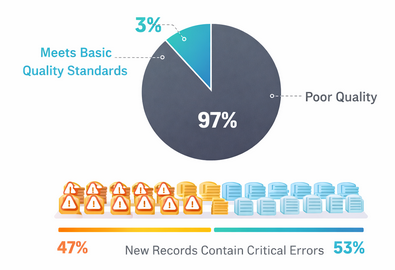
Only a small fraction of company data (3%) meets basic quality standards, and nearly half of new records contain errors — underscoring the necessity of robust data governance
High-performing data teams treat metrics definitions as version-controlled assets.
Scalability Considerations
Marketing complexity increases with growth. New ad platforms, new regions, new product lines, and new attribution requirements create exponential data expansion.
Design for scalability by:
-
Using modular transformations
-
Maintaining source-agnostic schemas
-
Separating raw and modeled layers
-
Automating documentation
Organizations that build scalable data architectures reduce time-to-insight by up to 30% compared to those relying on manual reporting processes.
Security and Compliance
Marketing data frequently includes personal identifiers. Ensure compliance with:
-
GDPR
-
CCPA
-
Internal data access policies
Apply encryption, role-based access, and data retention policies from the outset.
Common Pitfalls
-
Overengineering before validating business needs.
-
Allowing inconsistent naming conventions.
-
Building dashboards without documented metric definitions.
-
Ignoring monitoring and alerting systems.
-
Treating data engineering as a one-time project rather than an evolving capability.
Implementation Roadmap
-
Audit current data sources and reporting workflows.
-
Define business-critical KPIs and attribution logic.
-
Design unified data schema and naming standards.
-
Implement automated extraction and centralized storage.
-
Build transformation layer aligned with marketing logic.
-
Deploy BI dashboards and activation workflows.
-
Establish governance and monitoring framework.
This structured approach minimizes technical debt and maximizes long-term usability.
Conclusion
Designing data pipelines for marketing teams requires collaboration between marketing operations, analytics, and engineering. When implemented correctly, pipelines enable reliable attribution, faster optimization cycles, advanced segmentation, and predictive modeling.
In an environment where data-driven organizations are significantly more likely to achieve revenue growth leadership, investing in structured, scalable marketing data infrastructure is no longer optional.